Post-war economic problems (reparations, hyperinflation, foreign loans) (AQA A-Level History): Revision Notes
📚Revision Notes
Post-war economic problems (reparations, hyperinflation, foreign loans)
In the 1920s, Germany attempted to recover its economy. In order to alleviate increasing unemployment, transportation and modernisation projects were launched. Moreover, social spending was also manoeuvred to revive the economy. In 1913, government spending per resident was 20.5 marks. By 1925, it rose to almost 65 marks and by 1929, it reached over a hundred marks. The increase of money used in social spending and plummeting revenues resulted in deficit and finally caused the collapse of the German economy in 1930.
Note
Hyperinflation is an economic term which refers to accelerated inflation. This phenomenon suddenly devalues money or currency, while the price of goods continues to increase.
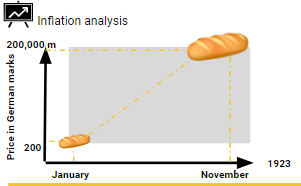
Historians suggest the following reasons for post-war economic problems.
- Government revenue from income tax began to decline since the beginning of WWI. In 1913, government revenue from income tax was over 53%, but in 1925, it decreased to 28%.
- After the war, foreign countries imposed protective tariffs on German goods.
- The economy fell into hyperinflation due to the printing of exaggerated amounts of marks.
- The Great Depression in the United States.
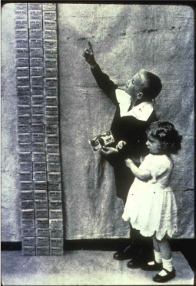
Stacks of German Marks
Note
In mid-1923, there were more than 30 factories, 1,800 banknote printing presses, and 133 companies issuing Reichsmarks. Devaluing foreign exchange rate.
One of the direct impacts of hyperinflation was the incapacity of the German government to pay for the reparations.
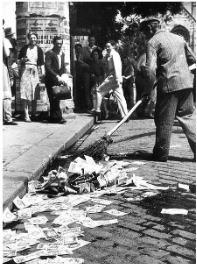
Image of a German sweeping a street filled with devalued banknotes
Foreign loans: The Dawes and Young Plans
Headed by Charles Dawes, former Director of the Bureau of the Budget and chair of the Reparation Commission, the Dawes Plan was proposed in April 1924. It supported the improvement of the German economy despite its annual reparation payments. Foreign banks provided loans to stabilise the economy, while Belgium and France were forced to evacuate the Ruhr. In recognition of his plan, Dawes became a co-recipient of the Nobel Peace Prize in 1925.
In 1929, another committee on German reparations was formed. It was headed by Owen Young, head of General Electric and member of the Dawes committee. A Bank for International Settlements was established to finally resolve payment of reparations.
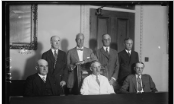
Reparations Committee confers with Secretary of State Henry L. Stimson. Committee chairman Owen D. Young sits to Stimson's left
DAWES PLAN, 1924
Reparation:

Lowered annual payment to 1 billion marks for five years and 2.5 billion for the successive years
Loans:

Germany borrowed 800 million marks from the U.S.A.
Time:

Indefinite
YOUNG PLAN, 1929
Reparation:

less than 20% of total amount
2 billion marks per year but ⅔ of which could be postponed each year, if necessary
Loans:
U.S. banks would continue to loan to Germany by coordinating with JP Morgan
Time:
Payable for 59 years
