Post-war political problems (AQA A-Level History): Revision Notes
📚Revision Notes
Post-war political problems
Post-war political problems
Disillusioned by defeat in WWI, many extremist groups emerged all over Germany. Forced by the lack of support from the German public, military and an ongoing revolution, Kaiser Wilhelm II abdicated the throne and fled to Holland. Through a National Assembly, Ebert, leader of the left-wing SPD, was elected as president. When the Treaty of Versailles was signed on 28 June 1919, Clause 231 of the treaty, commonly known as the 'War Guilt Clause', outraged the Germans.
Many Germans viewed the treaty as a dictated peace. As a consequence, signers of the treaty, Hermann Müller and Johannes Bell, representatives of the SPD and Centre Party, were branded by the right-wing and nationalist parties as 'November Criminals'.
Due to the war damages, the formation of the new government was unpopular. Many were still loyal to the Kaiser, while others continued anti-semitic and anti-communist activities.
In January 1919, the German Communist Party organised the Spartacist Uprising. By April of the same year, the southern region of Bavaria was established as a communist state.
The newly formed Weimar Republic was challenged by both the left and the right. Between 5 and 12 January 1919, the Spartacist Uprising rebelled in Berlin. By March 1920, the right-wing nationalists led by Wolfgang Kapp led a Freikorps putsch in Berlin.
In the early years of the republic, about 356 politicians were assassinated by nationalist terrorists. Among them were Walter Rathenau (foreign minister) and Matthias Erzberger (finance minister).
In 1923, attempts to seize power from the government continued. In September, the Black Reichswehr began a rebellion. By October, communism took over the governments in Saxony, Thuringia and the Rhineland. In November, the Nazis, a fascist group, organised a putsch in Munich.
Note
The 1923 Munich Putsch brought Adolf Hitler to national prominence.
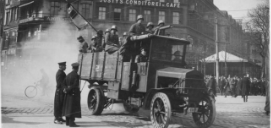
Putschists in Berlin
Note
The Kapp Putsch in 1920 was led by Gen. Walther von Lüttwitz of the Reichswehr (German Army) and supported by numerous established parties. For a time, Kapp was declared as chancellor of the Reich.
Role of the military
In December 1918, the Freikorps (Free Corps), a private paramilitary group, emerged. The members were composed of ex-soldiers, unemployed youth, and other discontents who were both nationalistic and radically conservative. Initially, they put down several left-wing revolts in Berlin, Bremen, Brunswick, Hamburg, Halle, Leipzig, Silesia and the Ruhr. Eventually, many members were involved in assassinations, including the murder of the foreign minister, Walther Rathenau, in 1922. In the succeeding years, with the support of Defence Minister Gustav Noske and General Paul von Hindenburg, the Freikorps assumed new units of the Nazis. Its commander, Ernst Rohm, became the head of the Nazi SA, also known as the Brownshirts.
Also known as the Realm Defence, the Reichswehr was the German military organisation formed from 1919 to 1935. Given the consequences of WWI, the Reichswehr army was limited to 100,000 men and 15,000 navy. On 30 September 1919, the Provisional National Army and Navy were reorganised as the Ubergangsheer or Transitional Army, which was reduced in number. As stipulated in the Treaty of Versailles, the Reichswehr was limited to the following:
- Reichsheer or the army was limited to seven infantry division and three cavalry divisions.
- The Reichsmarine was limited to certain types of ships and boats, and no submarines.