The end of the Yorkist challenge (AQA A-Level History): Revision Notes
📚Revision Notes
The end of the Yorkist challenge
📌 The Yorkshire Rebellion, 1489
Key causes of discontent
- Henry wanted to renew war with France
- France was trying to regain the land of Brittany
- Early 1489: Parliament voted £100,000 to support it (a subsidy)
- Fifteenths and tenths were not enough to generate the money needed
- There was resentment towards the taxation
- Henry commanded Northumberland to use force against the non-payers
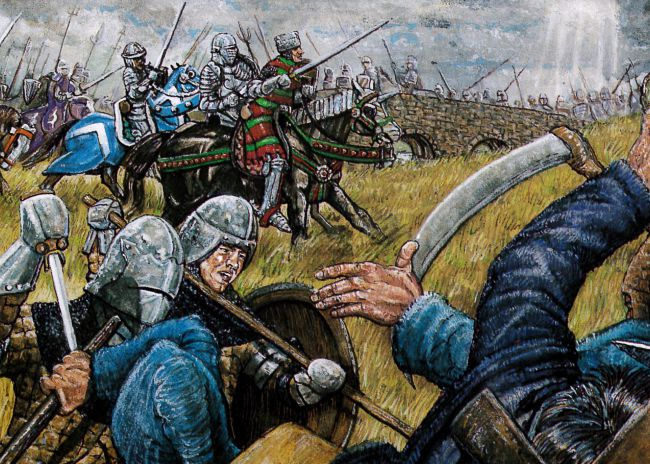
The Yorkshire Rebellion
- Serious riots broke out in Yorkshire and Durham as residents felt they were already burdened by defending the Scottish border. It was a poor area of the country and few taxes were normally collected there. This coincided with a bad harvest in the region
- The subsidy was a different form of taxation to what was normally collected as it was charged to each person individually
- Residents also felt it was irrelevant to them – they had no stake in cross-Channel trade with Brittany
- The Earl of Northumberland had to report to Henry VII that he couldn't get the northerners to pay the tax
Note
In early 1489, Henry VII sought to renew war with France, prompting Parliament to vote a substantial subsidy of £100,000. However, the taxation required to raise these funds sparked significant unrest in Yorkshire and Durham, regions already struggling with defending the Scottish border and suffering from a poor harvest. The residents, who had little connection to the conflict in Brittany, resented this new form of individual taxation. Despite the Earl of Northumberland's warnings, Henry VII ordered him to use force against those refusing to pay, exacerbating tensions in the north.
Events of the Uprising
- Unrest lead by Robert Chamber of Alton
- Began on April 20th, 1489
- Northumberland requested the support of Sir William Plumpton and Sir William Gascoigne
- They were to attend him at Thirsk on April 27th, 1489
- Following day Northumberland confronted by Chamber's men at Cock Lodge
- Northumberland was killed
Note
In April 1489, unrest led by Robert Chamber of Alton erupted, culminating in the death of Northumberland. On April 20th, Northumberland sought the aid of Sir William Plumpton and Sir William Gascoigne, requesting their presence at Thirsk by April 27th. The following day, as Northumberland confronted Chamber's men at Cock Lodge, he was killed in the conflict.
Aftermath
- Shocking affair – Northumberland's retinue failed to protect him
- Their loyalty to him was lukewarm
- Northumberland's murder encouraged the rebels to broaden their revolt
Made proclamations to meet other rebels on either:
- Allerton Moor near Pontefract
- Gatherley Moor in Richmondshire
- Attracted barely any support from the gentry
- Majority of ppts in the rebellion were yeoman, husbandmen, artisans and tradesmen
- Most significant individual arguably Sir John Egremont
- Had received favour from Henry VII
- Had also been a servant of Richard III
- Egremont and the other rebels captured York some time before May 17th
Note
The rebellion saw limited support from the gentry, with most participants being yeomen, husbandmen, artisans, and tradesmen. Notably, Sir John Egremont, who had previously received favour from Henry VII and served Richard III, played a significant role. The rebels, including Egremont, captured York sometime before May 17th.
Henry VII's response
- Responded to the death of Northumberland by leading a large army into northern England
- Royal Army set out from Hertford Castle
- Earl of Surrey released from the tower and made commander of the Vanguard
The force was people with familiar supporters of Henry:
- Earl of Shrewsbury
- Lord Hastings
- Sir William Stanley
- Sir Thomas Bourchier
- Surrey arrived at York first
- Attacked the rebels and captured Chamber
- Chamber was hanged with some other rebel leaders
- Rebels took flight when the rest of the Royal Army arrived
- Egremont fled to the Flemish court of Margaret of Burgundy, confirming his pro-Yorkist position
Note
In the aftermath of the rebellion, the Earl of Shrewsbury, Lord Hastings, Sir William Stanley, and Sir Thomas Bourchier played crucial roles in quelling the unrest. Surrey arrived in York ahead of the others, launching an assault on the rebels and capturing Chamber, who, along with other rebel leaders, was hanged. As the rest of the Royal Army arrived, the remaining rebels fled, and Egremont sought refuge at the Flemish court of Margaret of Burgundy, solidifying his pro-Yorkist stance.
Outcomes
Henry VII found a suitable candidate to rule the North in his interest, Surrey was more acceptable to the northerners than Northumberland as he was a former supporter of Richard III. This appeased many Northerners, Surrey only faced a small rebellion the following year which was suppressed quickly. He captured the rebel captains and executed them whilst securing pardons for the rest of the rebels.
This all put Henry in a favourable light with the northerners and the security of the North was a great boost to Henry's authority. This strengthened his position against remaining pro-Yorkist plotters.
At the same time his position in Europe weakened
Note
Henry VII strengthened his authority in the North by appointing Surrey, a former supporter of Richard III, as a more acceptable figure than Northumberland. Surrey's quick suppression of a small rebellion and his lenient treatment of most rebels put Henry in a favourable light, securing the North and boosting his power against pro-Yorkist plotters. However, as his control at home solidified, his position in Europe began to weaken.
There were growing tensions between himself and:
- Charles VIII of France
- James IV of Scotland (succeeded the throne in 1488) The rulers of the Low Countries