Yorkist opposition to Henry VII (AQA A-Level History): Revision Notes
📚Revision Notes
Yorkist opposition to Henry VII
📌 Lambert Simnel
Following the death of Edward IV, George's children (Lady Margaret, Countess of Salisbury and Edward Plantagenet, 17th Earl of Warwick) were both attainted on account of their father's treason.
Following Bosworth and Henry VII's ascension, Margaret was given a title and was married to Henry's cousin Sir Richard Pole, a Welsh knight.
Edward, being the last Yorkist claimant to the throne, was kept in the Tower away from the public eye but was not executed.
Note
After Edward IV's death, his children, Lady Margaret and Edward Plantagenet, 17th Earl of Warwick, were attainted due to their father's treason. Post-Bosworth, Henry VII honoured Margaret with a title and married her to Sir Richard Pole, while Edward, the final Yorkist heir, was imprisoned in the Tower but spared execution.
Lambert Simnel
- English imposter
- Probably the son of a tradesman at Oxford
- Was about 10 in 1487
- Described as a handsome youth of intelligence and good manners
- Rumours spread that the princes in the Tower were alive
- Richard Symonds, a young Oxford priest, claims Lambert is at first one of the Princes in the Tower
- He tutored Lambert in the arts and graces and etiquette of Royalty
- Lord Kildare collected an army of Irish soldiers under the command of his younger brother Thomas
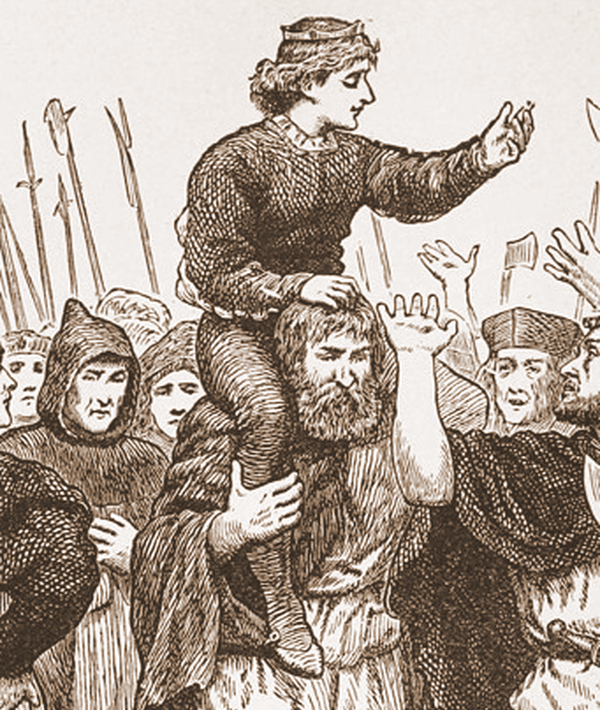
Lambert Simnel
- Then claims he is Edward Earl of Warwick upon hearing a report that he had died in the Tower
- Acted with the support of Yorkist leaders
- John de la Pole, Earl of Lincoln supported them
- Gained support from Ireland (they hated the English anyway) e.g. Earl of Kildare
- Simnel was crowned King Edward VI on May 24th, 1487, in Dublin
- Margaret Duchess of Burgundy was also a supporter and sends Swiss and German mercenaries
- Other Yorkist leaders were also involved
- Simnel was merely a figurehead for the rebellion
Attempts to destroy Simnel's claim
- Parading Edward Earl of Warwick in public
- The capture of William Symonds and his confession
- A general pardon for those who surrendered
- The purpose of these tactics was to refute Simnel's claim
- And to discredit/discourage his supporters
- It soon became apparent that the sizeable force led by John de Pole had to be defeated in battle
📌 Battle of Stoke
Estimated number of soldiers:
- Yorkists: 8000 Irish and German
- Tudors: 12,000 soldiers
Leading Generals
Yorkists: Earl of Lincoln, Sir Thomas FitzGerald, Martin Schwartz, Viscount Lovell, Lambert Simnel
Tudors: Henry VII, George Talbot Earl of Shrewsbury, George Stanley Lord Strange, Jasper Tudor Duke of Bedford, John de Vere Earl of Oxford
Events preceding the battle
- 8th June rebels arrived at Masham
- Wrote to York for admission into the city
- Then decided to move south and bypass the city
- Henry VII's ally Lord Clifford had been admitted to the city with his troops
- Earl of Northumberland also allowed into the city on June 10th
- Clifford tries to tackle the rebels on his own
- He is unsuccessful and flees back to York
- The royal army catches up to the rebels by June 16th
Events of the battle
- Henry's army divided into three battles
- Oxford led the vanguard
- Just like at Bosworth, the king left the command of the fighting to Oxford
- Lincoln's army was concentrated in one large block of Irish soldiers and Swiss/German mercenaries
- Battles started with Yorkists being bombarded with arrows from the Tudors
- Forced to leave their positions and attack
- Though outnumbered they had well-trained mercenaries in their ranks
- Vanguard was the only battle to face the attack
- Henry chose not to send in his own 'battle'
- Reinforced them with Jasper Tudor's soldiers
- Oxford kept control
- Yorkists under Lincoln were unable to break them
- The battle lasted three hours, Lincoln's army eventually broken
- German mercenaries were equipped with the latest handguns
- Henry had large numbers of longbow archers which were able to shoot much faster
- Devastating for the Irish soldiers who had very little armour
- Unable to retreat with the river on three sides
- German and Swiss mercenaries fought to the death
- Those that did run away fled towards the Trent River down a ravine, known today as the Bloody Gutter. Many were cornered and killed
Aftermath
- Lambert Simnel was judged to be a puppet of John de la Pole
- Was therefore pardoned
- Made a Spit turner and then falconer to Henry VII
- Richard Simon was imprisoned after his involvement in the conspiracy
- John de la Pole, Earl of Lincoln, Sir Thomas Fitzgerald, and Martin Schwartz all died in the battle
- Lord Francis Lovell escaped
- He was never seen again
- Some say he escaped to Scotland
Margaret Beaufort
Born: May 31st, 1443
Died: June 29th, 1509
- Mother of King Henry VII
- Daughter and heir of John Beaufort, 1st Duke of Somerset
- Descendent of Edward III
- Married Edmund Tudor, Earl of Richmond in 1455
- Henry was born Jan 1457, three months after Edmund died
- Had a second marriage to Sir Henry Stafford
- Had a third marriage to Thomas, Lord Stanley
- Margaret translated a number of devotional books
- They both helped Henry Tudor obtain the throne in 1485
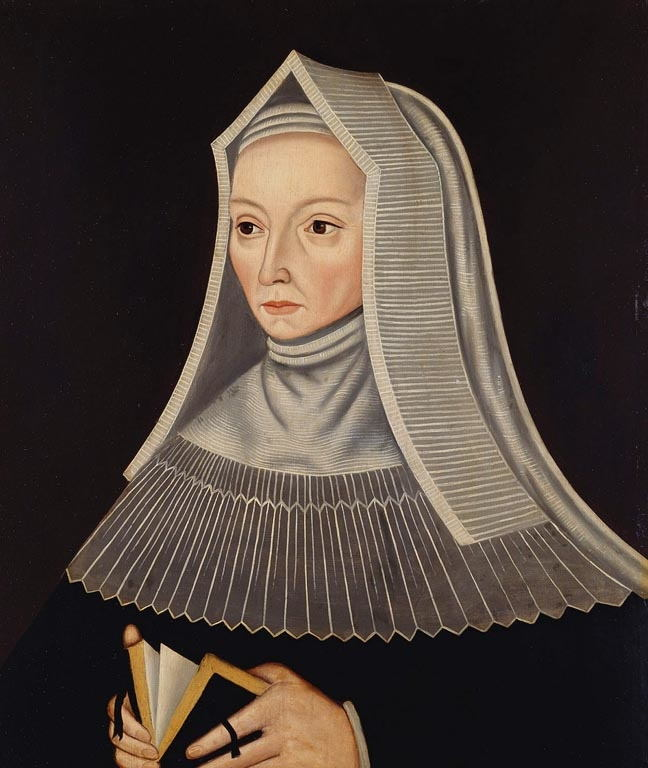
Margaret Beaufort
- Was a patron of the English printers William Caxton and Wynkyn de Worde
- Founded professorships of divinity at Oxford and Cambridge and also founded Christ's College and St John's College of Cambridge
- Married Lord Stanley to get closer to Edward IV and Elizabeth Woodville's Royal Court, was nominated as godmother to Elizabeth's daughter
- Henry was in hiding in France at this time
- When Richard took the throne Margaret and Elizabeth joined forces, they planned to put Henry Tudor on the throne. They were both involved in Buckingham's rebellion
- Margaret was stripped of all her titles and estates by Richard and was forced into house imprisonment and banned from communicating with her son in France
- Both Margaret and her husband Thomas, Lord Stanley ignored these instructions
- Battle of Bosworth victory secured Henry Tudor onto the throne
- Margaret became the Countess of Richmond and Derby
- Was given the Lady of the Order of the Garter
- Secured herself legal, political and social autonomy
- Henry VII died in April 1509 and Margaret was left in charge of his will
- Advised her son Henry VIII on who he should elect as members of his privy council
- She passed away June 1509, only two months after her son
📌 What level of threat did Perkin Warbeck present to Henry VII's reign?
The emergence of Perkin Warbeck
- Claimed he was Edward IV's youngest son Richard Duke of York
- Tudor chroniclers were adamant he was an imposter
- Identified him as a young man from Tournai in Flanders
- True identity debated
- Possibly an illegitimate son
Arrival in Ireland
- Arrived by boat at Cork in Nov 1491
- Wearing his master's fine clothes
- Bystanders proclaimed him a Yorkist Prince
- Led by Cork's former mayor John Atwater and an English exile John Taylor
- Sought out patrons to support, the Earl of Desmond rallied to them
- Warbeck had been a traveller before his arrival he was in Antwerp, Bergen op Zoom and Middelburg from 1484-87
- He learned Flemish and worked for merchants in the cloth trade
- In either April or May 1487, he travelled to the Portuguese Court with Lady Margaret Beaumont, wife of Sir Edward Brampton
- He entered the service of the royal councillor and explorer Pero Vaz de Cunha
- Whilst in the service of Meno he sailed to Cork, he was in Meno's clothes he was wearing when the Yorkists declared he was a Prince
Warbeck's escape to France
- Henry's response to Warbeck's arrival was swift, especially following the Simnel uprising. He sent a force to Ireland in December 1491 led by James Ormond and Thomas Garth
- The pressure on Yorkists too strong so Warbeck fled to France in a fleet provided by Charles VIII of France and arrived at Harfleur in March 1942
- Charles VIII received him as a Prince so royal support placed Warbeck in the spotlight which escalated the problems Henry VII faced
- As one of Warbeck's mentors, John Taylor wrote to both James IV of Scotland and Margaret of Burgundy
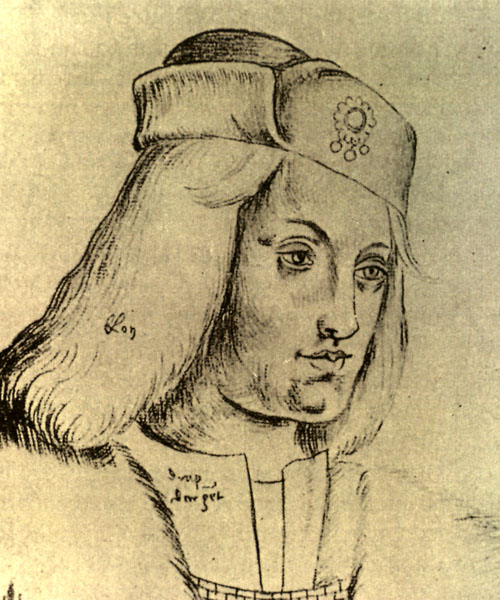
Perkin Warbeck
- Announced the discovery of Prince Richard in hopes of gaining their support
Henry's invasion
- Warbeck's stay in France was not long
- Henry invaded France in October 1492
- Warbeck's presence at the French Court added to Henry's motivation and urgency
- Needed to prevent an invasion akin to his own years prior
- Laying plans for an attack on France for a few years he wanted to expand military muscles in Europe
- The main ally in Europe was Archduke Maximilian, heir to the Holy Roman Empire and co-ruler of Burgundy who was also keen on war with France, there had been in diplomatic talks with the English king since 1490
- Henry's army arrived at Calais on October 2nd, 1492 whilst Maximilian's troops were slow to arrive
- Henry VII had already agreed a truce with Charles VIII once they had arrived, the Treaty of Etaples agreed on November 3rd, 1492
- It was not without controversy
- Maximilian's representatives felt their alliance treaty had been violated, this severely damaged relations between England and the Archduke
Note
In October 1492, Henry VII's invasion of France was driven by the presence of Perkin Warbeck at the French Court, intensifying his resolve to prevent a repeat of past invasions. Having planned for years to bolster England's military stance in Europe, Henry's forces landed in Calais on October 2nd. Despite the delayed arrival of Archduke Maximilian's troops, Henry secured a truce with Charles VIII through the Treaty of Etaples on November 3rd. This agreement, however, sparked controversy and strained relations with Maximilian, who felt the treaty breached their alliance.
Warbeck's escape to the Low Countries
- Warbeck was banished from France as part of the peace negotiations, Charles VIII agreed to stop harbouring Henry's rebellious enemies
- Warbeck was given a warm reception and encouragement in the Low Countries from Margaret of Burgundy and her son-in-law Archduke Maximilian and his son Philip, they arrived at Margaret's household on December 12th, 1492
- Margaret welcomed him as her long-lost nephew and Maximilian welcomed him due to his new hostility towards Henry VII
- Strong possibility that if Warbeck was placed on the throne the Treaty of Etaples would be invalidated meaning England would renew alliance with Maximilian and his Duchy of Burgundy
- Perceived failure in France did not help Henry's position in England, Warbeck supporters keen to exploit the situation. Spies were sent out to uncover the true identity of Warbeck. Henry placed the blame for Warbeck and Simnel of Margaret of Burgundy
- Ambassadors were sent to Margaret accusing her of plotting, one personally insulted her which hardened her resolve against Henry
- He blockaded the Low Countries so Maximilian banned the import of English wool which caused economic hardship for merchants on both sides of the Channel for the next three years, Maximilian by this time had become Holy Roman Emperor
- Warbeck now had the most powerful ruler supporting him, he accompanied Maximilian to his father's funeral in Vienna in December 1493
Note
In the turbulent political landscape of late 15th-century Europe, the pretender Perkin Warbeck found refuge and support in the Low Countries, under the patronage of Margaret of Burgundy and her ambitious son-in-law, Archduke Maximilian. Their backing, driven by hostility towards Henry VII of England, posed a significant threat to Henry's rule. As tensions escalated, diplomatic relations deteriorated, leading to economic hardships and strained alliances across the English Channel. Warbeck's journey, marked by intrigue and shifting allegiances, underscored the precarious balance of power in Renaissance Europe.
Support for Warbeck in England
- Henry's network of spies in the Low Countries brought many supporters of Warbeck to attention, throughout 1494 evidence was gathered against plotters
- In January and February 1495 a number of men were put on trial for treason for their contact with Warbeck
- Many of the convicted men were linked to surviving senior members of the House of York which confirmed where the support for Warbeck lay
- Supporters included:
- Lord Fitzwalter, a Norfolk landowner
- Sir Simon Mountfort of Coleshill
- William Worsley, Dean of St Paul's
- Thomas Powys, Prior of Langley
- Most outstanding of those convicted was Sir William Stanley
- Confessed to contacting Warbeck in 1493
- Treachery highlighted as most significant at this stage
- Appeared to be a strong supporter of Henry VII
- Tried and convicted as a traitor on Feb 7th
- Had saved Henry at Bosworth but reported to have considered his rewards too few for his transfer to Tudor service
- The involvement of Stanley retainers with Warbeck suggests a genuine willingness to aid Prince Richard
- Rather than the vague assertion that if Warbeck truly was the Yorkist Prince then he would not be opposed by Sir William
- Stanley's castle at Holt in the Welsh Marches was found to contain the astounding sum of £10,000 in cash
- Sufficient to keep an invading army in the field for many weeks
- Feb 16th: Stanley was spared being hung, drawn and quartered
- Was beheaded on Tower Hill
- Only key figure executed for his part in the plot
- Henry attempted to show mercy and avoid a strong response from opponents
Note
In early 1495, Henry VII's network uncovered extensive support for the pretender Perkin Warbeck, leading to treason trials. Among those convicted was Sir William Stanley, a former ally who had previously saved Henry at Bosworth. Despite his initial loyalty, Stanley's substantial financial backing and treasonous contact with Warbeck led to his execution, marking him as the most prominent figure punished in the plot. Henry's decision to execute Stanley, rather than subject him to a more brutal fate, reflected his attempt to balance justice with mercy.
Warbeck's invasion plans
- Warbeck was undeterred by this turn of events
- Continued his invasion plans with the support of Margaret of Burgundy and other powerful European supporters
- His invasion force probably numbered about 1300
- The force reached Kent coast on 3rd July
- A small force landed to see if the Kentish men were with Warbeck
- The locals delayed their answer
- Gave them time to raise a hasty force to oppose the landing party
- The Kentish attack on the invaders resulted in the deaths of about 150 men and the capture of many others
Warbeck arrives in Scotland
- November or December 1495: Warbeck received as a Prince by James IV in Scotland
- Allowed Warbeck to marry Lady Katherine Gordon, daughter of the Earl of Huntly, in January 1496
- Gave him Falkland Palace as a base
- Together they planned an invasion of England in September 1496
- Henry had a spy in Scotland, Lord Bothwell, who informed him of the planned invasion
- It was an unpopular plan in Scotland
- Warbeck's agreement with the Scottish king was that for his support, Warbeck would hand over the town of Berwick and pay 50,000 marks towards James IV's military expenses
- Bothwell reported to Henry that James IV's forces were to meet with those of Warbeck on 15th Sept at Ellem Kirk, and then to cross into England on 17th September. In response, Lord Neville was sent with a large force to combat the Scots, the Scots bid a hasty retreat
- The failed invasion made it clear that the Yorkist cause was no longer as strong as had been in the North
Flight to Ireland
- Warbeck landed at Cork in Ireland on 26th July
- Found he had no support there
Involvement in Southwest England
- Landed at Whitesand Bay in Cornwall on 7th Sept and was well received
- News of Warbeck's invasion plans reached Henry VII on 12th Sept
- Swiftly sent Lord Daubeney overland to confront the pretender
- Lord Willoughby was sent by sea in order to cut off any possibility of Warbeck's retreat
- Warbeck was able to secure St Michael's Mount from where he advanced through Penryn
- Attacked Exeter on 17th September, 1497
- The original invasion force of about 1300 men had increased to 8000
Retreat and capture in Taunton
- The next city defended itself, led by the Earl of Devon
- The rebels withdrew to Cullompton on 18th September, many had deserted Warbeck
- As the royal forces began to approach the Southwest, Warbeck withdrew to Taunton, they wanted to avoid a confrontation
- Henry VII saw that he could encircle Warbeck with the forces of the South West's aristocracy
- With the support of Exeter's garrison behind the rebels
- Warbeck escaped from Taunton at night on 21st September with a small company of men and rose south-east
- One of his supporters escaped to France whilst others took sanctuary in London
- Warbeck failed to reach the coast, he took refuge in a sanctuary with three companions at Beaulieu Abbey
- They were recognised and handed over on a promise of pardon to the Abbey
- Warbeck was taken to Taunton castle
- On 5th October he confessed this pretence in front of Henry VII, he was then used as a propaganda tool by being paraded through London on numerous occasions as well as accompanying the king on his progresses
- Warbeck escaped from the king's custody on 9th June 1498
- Some suggest the king wanted to test Warbeck's loyalty and create circumstances to see whether he would escape others suggest that Henry VII wanted to get rid of Warbeck and so letting him escape made his capture and imprisonment appear legitimate
- Warbeck was found in the Charterhouse at Sheen, his punishment included being displayed in the stocks on top of a scaffold of empty wine barrels
- On 18th June 1498 he was shackled and locked up in the tower of London for life
- Warbeck confessed that the deceit was the creation of Margaret of Burgundy
- Henry used this to put pressure on the Duchess, he called on her formally to renounce her support for Yorkist rebels
- In September 1498 she relented and asked for the king's forgiveness
- In the summer of 1499 sympathisers in London hatched a plot to free Warbeck and his fellow prisoner, Edward, Earl of Warwick, and place either of them on the throne
- The Earl of Warwick's servant planned to secure the release of the Earl while Henry VII was on the Isle of Wight
- Warbeck was tried on 16th Nov at Westminster
- Hanged at Tyburn on 13th November 1499
- Following one final confession that he was not a Plantagenet
- The Earl of Warwick appeared before the peers of England on 19th Nov and confessed his treasonm, he was beheaded a week later
Note
In the fall of 1497, Perkin Warbeck, a pretender to the English throne, fled across the South West, eventually taking refuge at Beaulieu Abbey. After being betrayed and captured, he confessed his imposture to Henry VII on October 5. Despite being paraded and used as a propaganda tool, Warbeck escaped in June 1498 but was recaptured, leading to his execution on November 13, 1499. His final confession implicated Margaret of Burgundy, who later sought Henry's forgiveness. The Earl of Warwick, another key figure, was also executed shortly after confessing his treason.
📌 The Yorkshire Rebellion, 1489
Key causes of discontent
- Henry wanted to renew the war with France
- France was trying to regain the land of Brittany
- Early 1489: Parliament voted £100,000 to support it (a subsidy)
- Fifteenths and tenths were not enough to generate the money needed
- There was resentment towards the taxation, serious riots broke out in Yorkshire and Durham
- Residents felt they were already burdened by defending the Scottish border, it was a poor area of the country and few taxes were normally collected there, it coincided with a bad harvest in the region
- The subsidy was a different form of taxation from what was normally collected, it charged to each person individually
- Residents also felt it was irrelevant to them – they had no stake in cross-Channel trade with Brittany
- Earl of Northumberland had to report to Henry VII that he couldn't get the northerners to pay the tax
- Henry commanded Northumberland to use force against the non-payers
Events of the Uprising
- Unrest led by Robert Chamber of Alton
- Began on April 20th, 1489
- Northumberland requested the support of Sir William Plumpton and Sir William Gascoigne
- They were to attend him at Thirsk on April 27th, 1489
- Following day Northumberland confronted by Chamber's men at Cock Lodge
- Northumberland was killed
Aftermath
- Shocking affair: Northumberland's retinue failed to protect him
- Their loyalty to him was lukewarm
- Northumberland's murder encouraged the rebels to broaden their revolt
- Made proclamations to meet other rebels on either:
- Allerton Moor near Pontefract
- Gatherley Moor in Richmondshire
- Attracted barely any support from the gentry
- Majority of ppts in the rebellion were yeoman, husbandmen, artisans and tradesmen
- Most significant individual arguably Sir John Egremont, he had received favour from Henry VII, had also been a servant of Richard III
- Egremont and the other rebels captured York some time before May 17th
Henry VII's response
- Responded to the death of Northumberland by leading a large army into northern England
- Royal Army set out from Hertford Castle
- Earl of Surrey released from the tower and made commander of the Vanguard
- Force was peopled with familiar supporters of Henry:
- Earl of Shrewsbury
- Lord Hastings
- Sir William Stanley
- Sir Thomas Bourchier
- Surrey arrived at York first and attacked the rebels and captured Chamber. Chamber was hanged with some other rebel leaders, the rebels took flight when the rest of the Royal Army arrived
- Egremont fled to the Flemish court of Margaret of Burgundy, confirming his pro-Yorkist position
Outcomes
- Henry VII found a suitable candidate to rule the North in his interest
- Surrey was more acceptable to the northerners than Northumberland, this was because he was a former supporter of Richard III
- Surrey faced a small rebellion the following year however he suppressed it quickly, he captured the rebel captains and executed them and decured pardons for the rest of the rebels. This put him in a favourable light with the northerners
- The security of the North was a great boost to Henry's authority and strengthened his position against remaining pro-Yorkist plotters. At the same time, his position in Europe weakened, there were growing tensions between himself and:
- Charles VIII of France
- James IV of Scotland (succeeded the throne in 1488)
- The rulers of the Low Countries
Henry's paranoia
- Fines paid by nobles in case of future misbehaviour and instalments paid yearly, to ensure good behaviour. This made men financially incapable of launching rebellions
- The running of the country into the king's chamber to be overseen by him as he felt paranoid following William Stanley's betrayal in 1495
- Attendees did not reserve them
- spy network: kept an eye on noble families that were not trusted
- Henrys paranoia made him introduce new things which strengthened his position
Note
Recognises bred resentment as impoverished nobles
'The Yorkists were never a serious threat to Henry VII' assess the validity of this view
Note
Criteria: strength of Alernate claim to the throne, domestic support, financial support
Henry strength
- Lovell revolt - and we had a strong army of 3000 men causing Lovell to flee
- Henry successfully put down every rebellion
- the pretenders like Lambert Simnel and Warbeck were defeated and executed
Note
Opposition forces made up of foreign mercenaries had the support of Margaret of Burgundy, and opposition forces made up of Henrys' inner circle had support from Warbeck which was long and dragged out ultimately Henry remained on the throne with weak claims to the throne
- Lovell revolt 1495: loyalty to the Yorkist cause
- CA: the army of 3000 was raised and his forces fled and then removed from the sanctuary by force
- Lovell revolted loyalty to the Yorkist cause yet no figurehead was really around
- Lambert Simnel had claimed the throne as he was an impostor claiming to be Earl of Warwick
- go back week claim as he was an impostor claiming to be Richard Duke of York
- CA: despite being imposters mainly believed although this is questionable intentions were likely selfish
Support (foreign and Yorkist)
The pretenders
- CA: Lambert Simnel claimed to be Edward Earl of Warwick who was Clarence's son and received a great reception in Ireland, especially from Kildare he was annoyed that Henry hadn't confirmed him as deputy Lieutenant of Ireland - Margaret of Burgundy sent 2000 mercenaries commanded by Martin Schwarz
- After three hours they were defeated by Henry's 8000-strong army of stoke, Simnel who was only 10 was saved.
- CA: Perkin Warbeck claimed to be Richard Duke of York, he had little support in Ireland but signed the Treaty of Etaples with Charles of France and gained 1200 men from Margaret of Burgundy. James IV of Scotland gave war back an annual pension of 1200 pounds
- Warbeck was forced to retreat as lacked support and imprisoned and executed noble-supported Yorkist pretenders
- Margaret of Burgundy was wealthy and determined to overthrow Henry, Margaret provided foreign mercenaries
- Lovell reality support in the north Yorkshire Worcestershire and way marches
- CA: go back last support along the way despite initially having lots of support
Conclusion
Note
The Yorkists were not a serious threat and ultimately, they did not remove him from the throne despite the help of Yorkists and foreign support Henry's strength reduced the threat