Crushing of the Lancastrian Cause (AQA A-Level History): Revision Notes
📚Revision Notes
Crushing of the Lancastrian Cause
📌 How successfully did Edward IV deal with Lancastrian resistance?
- March 1461: Battle of Towton: Earl of Northumberland, Earl of Clifford, Earl of Devon executed
- July 1461: Warwick appointed Warden of the East and West marches to control Northern counties
- Oct 1461: Lancastrians defeated near Caernarvon in north Wales
- Oct 1461: Pembroke Castle taken from Jasper Tudor
- Dec 1462: Somerset pardoned
- Dec 1462: the Earl of Warwick captured Dunstanburgh and Bamburgh castles
- Dec 1462: Dunstanburgh castle returned to Sir Ralph Percy
- Jan 1463: Warwick withdraws from the siege of Alnwick
- April 1463: Sir Ralph Percy hands over Dunstanburgh Castle to Henry and Margaret upon return to England
- July 1463: Earl of Warwick and Lord Montagu confront the Scots at Norham on the Tweed: the Scot force fled
- Oct 1463: Edward agrees a truce with Louis XI, the King of France
- Oct 1463: Bamburgh Castle taken over by Henry Beaufort, Duke of Somerset
- April 1464: The Battle of Hedgeley Moor
Note
Edward IV successfully quelled Lancastrian resistance through decisive military victories, strategic alliances, and shrewd political manoeuvres. His triumphs at the battles of Towton and Tewkesbury, combined with his efforts to secure loyalty from key nobles, solidified his reign and weakened the Lancastrian cause.
- Sir Raph Percy was killed: he fought to the death
- 6000 Yorkists
- 5000 Lancastrians
- Lord Roos' soldiers break and flee early on leading to disarray amongst the Lancastrians
- Scottish allies then concluded a peace negotiation with the Yorkists, ending Lancastrian support
- May 1464: The Battle of Hexham – Somerset, Hungerford and Roos beheaded
- Yorkist leaders: John Neville, Marquess of Montagu
- Lancastrian leaders: Henry Beaufort Duke of Somerset, Lord Roos
- After camping next to the Devil's Water River, the Lancs are attacked by Montagu from higher ground
- the Lancastrians quickly surrendered and flee into the river
- John Neville offered no mercy and executed 30 leading Lancs including Somerset and Roos
- May 1464: Alnwick and Dunstanburgh recaptured by the Yorkists
How effectively did Edward IV deal with opposition?
📌 How did Edward consolidate his power?
- The crushing of rebels in Kent
- John de Vere's rising
- Pardons for former Lancastrians
- Upon Edward's first ascension to the throne in 1461 he had accepted many ex-Lancastrians through Royal pardons
- Some Lancastrian commanders were habitual traitors and had been pardoned before only to take up arms again
- The Lancastrian commanders were slaughtered after the Battle of Tewkesbury
- Edward's main policy was to re-establish law and order
- He also offered pardons to those who submitted to him, who would be rewarded for their loyalty
- Sir John Fortescue held his office during the remainder of Henry VI's reign to whom he was loyal
- He was attainted of treason in the first parliament of Edward IV
- On the defeat of the Lancastrian party, he made his submission to Edward, who reversed his attainder in October 1471
- He was given back his lands in return for loyalty until his death
- John Morton was archbishop of Canterbury and favoured the Lancastrian cause
- Upon the ascension of Edward, he was declared a traitor and forced to sue for a pardon
- While in exile he helped arrange the coalition of Warwick and Clarence with the Lancastrians and Louis XI
- Patronage
- Restrictions on livery and maintenance
Note
In 1461, Edward IV ascended to the throne, seeking to re-establish law and order. He granted pardons to many ex-Lancastrians, but habitual traitors faced severe consequences, as seen after the Battle of Tewkesbury. While Sir John Fortescue, initially attainted of treason, had his status reversed in 1471, John Morton, archbishop of Canterbury and Lancastrian sympathiser, was forced into exile and sought a pardon. Edward also implemented restrictions on livery and maintenance to curb private armies and reinforce his control.
📌 Why was the Battle of Barnet significant?
- Clarence wanted to marry Warwick's daughter
- Lincolnshire Rebellion, Redesdale Rebellion, Holderness Rebellion
- Burgundy
- Richard, John, Thomas, William, George
- Warwick was known as the king-maker because everyone he supported eventually became King
- Elizabeth's parents were Jacquetta of Luxemburg and Richard Woodville
- The Duke of Suffolk – executed on a ship called "Nicholas of the Tower"
- The Duke of Somerset – executed in front of an inn called "The Castle Inn"
- Son of Charles VII Hoped for a marriage match with his sister-in-law Bona of Savoy to Edward. Arranged by Warwick this was part of his scheming to create an alliance with France and was his one example of his dominance of Edward's government. Edward scuppered these plans by marrying Elizabeth Woodville
- Louis only found out when Warwick did not turn up to their planned negotiations. Warwick and Clarence with support from Louis forced Edward IV to abdicate and have Henry VI put back on the throne
- As a result of his support, Louis demanded Henry (and Warwick) to declare war on his enemy Burgundy, but this did not materialise until February 1471
- Queen Margaret and her son Edward have not yet arrived in England due to terrible weather, so are stuck across the channel
Note
Warwick, known as the Kingmaker, initially supported Clarence's marriage to Warwick's daughter and was instrumental in Edward IV's brief abdication, restoring Henry VI. Warwick's efforts to ally with France were thwarted by Edward's marriage to Elizabeth Woodville. Despite Louis XI's pressure to declare war on Burgundy, the conflict only began in February 1471, while Queen Margaret and her son were delayed across the channel.
Edward Returns
- He returned to England in 1471 with the assistance of his brother-in-law, the Duke of Burgundy
- However, he faced hostility and so maintained that he only came to claim the Duchy of York
- Landing in Yorkshire, Edward assembled troops and equipment and headed south
- He gathered more troops as he went
- Edward reached London unopposed on the 12th of April
- On the way he manages to persuade Clarence at Daventry back to his side and is then welcomed into London
- He seizes Henry VI and meets his son for the first time
- Aware of Edward's movements, Warwick wavered at first then marched towards London from Coventry to confront him at Barnet
Generals Involved, Size of Army
15,000 Lancastrian troops
-
Led by the Earl of Oxford, Duke of Exeter, Warwick and John Neville (Montagu) 10,000 – 12,000 Yorkist troops
-
Led by Edward, the Duke of Hastings, and the Duke of Gloucester, Edward's youngest brother Events of the battle
-
Warwick took up a position about a mile north of Barnet on the 13th of April
-
Edward took up position to the south of the Lancastrians and despite the dark he deployed his troops on arrival rather than wait for the morning
-
The men were to light no fires and keep silent
-
The Duke of Gloucester led the right flank and Hastings led the left flank
-
Clarence stayed with his brother in the centre and reserves were kept at the rear
-
They were deployed very close to Warwick's lines
-
Edward misjudged the distance in the dark, but the closeness meant Warwick's men overshot their opponents
-
In the Lancastrian army, the Earl of Oxford commanded the left wing, Warwick & John Neville commanded the centre, and the right was commanded by the Duke of Exeter
-
A thick fog enveloped the battlefield, so visibility was poor
-
The two armies could not properly see each other
-
Oxford's flank overwhelmed Hasting's group and caused them to flee towards Barnet
-
Gloucester won a similar victory over Exeter
-
Oxford returned to battle, but the banners were mistaken for Edward's and the Lancastrians attacked them
-
Oxford and his men retreated from the battle
-
The Lancastrian line broke down and fled
-
As the fog lifted, Edward saw that the Lancastrian army was in disarray, so sent in his reserves Deaths:
-
John Neville, Marquess of Montagu
-
Warwick was also killed trying to escape
Note
On April 13th, during the Battle of Barnet, Yorkist forces led by Edward IV and his brothers faced the Lancastrians commanded by the Earl of Oxford, Warwick, and John Neville. Despite poor visibility due to thick fog, Edward's troops managed to gain the upper hand. Mistaken banners and confusion led the Lancastrian forces to collapse, with key figures like Warwick and John Neville killed in the ensuing chaos.
The Battle of Tewkesbury
Meanwhile in Weymouth
- On the same day as the Battle of Barnet on the 14th of April 1471, Margaret, Prince Edward and supporters arrived back in England from exile in France
- They landed at Weymouth
- Margaret was joined by Lancastrian supporters led by Somerset
- Instead, they headed north to make the crossing of the River Severn at Tewkesbury
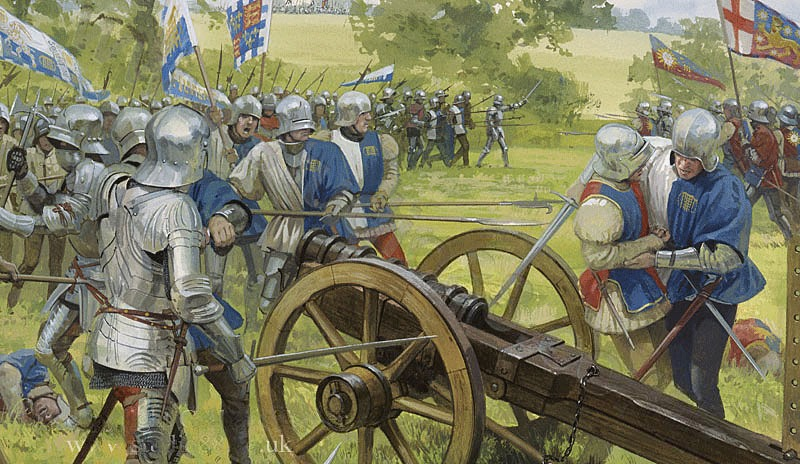
The Battle of Tewkesbury
- King Edward meanwhile was at Windsor and learning of Lancastrian manoeuvres, he headed for the West Country in an attempt to intercept Margaret and Somerset before they could reach Wales
- After Barnet, Somerset would not attempt an assault upon Yorkist forces without superior numbers, so to reinforce his army he headed for Wales, where he could rely on the support of Jasper Tudor
- The Lancastrian advance to Wales was delayed, first when they made a detour to Bristol for much needed supplies, and second when the city of Gloucester refused them entry
- Edward, at the head of his army, having narrowly missed an opportunity to confront the enemy at Sodbury, followed in pursuit
Generals involved, size of army
6,000 Lancastrians
- Led by the Duke of Somerset, Baron Wenlock and Prince Edward, the Earl of Devon
5,000 Yorkists
- Led by Edward IV, Clarence, Gloucester, Hastings
Positions
Lancastrians
- A defensive position a mile south of Tewkesbury
- The River Avon and the River Severn were to their rear
- Tewkesbury Abbey was just behind the Lancastrian centre
- The right flank was commanded by Somerset
- The centre was commanded by Wenlock (and Prince Edward)
- The left flank was commanded by Devon
Yorkists
- 200 mounted spearmen were positioned in the woods to the left of the army
- Edward and Clarence commanded the centre
- Gloucester led the Vanguard
- Hastings led the rear
Events
- On the 4th of May the Yorkists advanced on the Lancastrian position
- They showered the Lancastrians with arrows
- Somerset led an attack on Edward's flank
- The Yorkists beat back the attack with the 200 spearmen in the woods
- Somerset's forces attempted an escape across the Severn, but most were slaughtered
- The meadow astride the Colnbrook leading down to the river is known as "Bloody Meadow"
- Somerset returned to the Lancastrian lines before killing Wenlock for failing to provide support. He then sought sanctuary at Tewkesbury Abbey
- With morale collapsing, the Lancastrian army erupted into panic and tried fleeing
- Many were killed by pursuing Yorkists or drowned in the River Avon
- Prince Edward was killed either during battle or in the aftermath
- Around 2000 Lancastrians died
Aftermath
- Many Lancastrians took sanctuary in Tewkesbury Abbey
- King Edward gave permission for Prince Edward to be buried there
- Somerset and other leaders were dragged out of the Abbey and were ordered by Gloucester and the Duke of Norfolk to be put to death
- Somerset and his younger brother were both buried at Tewkesbury Abbey
- Queen Margaret, defeated by the death of her son, was taken captive and imprisoned at the end of the battle
- Edward takes back the throne
- Henry VI died in the Tower of London in May 1471 – the demise of his son had sealed his fate
- The death of Henry and the Beaufort male line left Margaret Beaufort and her son, Henry Tudor, as the senior representatives of the House of Lancaster
Edward Earl of March
📌 Was the Battle of Towton a turning point for the Yorkist cause?
- 1442-83
- Born on April 28th whilst his father serving as Lieutenant-General of Normandy during the French wars
- He was aristocratic and of royal blood
- He was intelligent and affable
- He was good-looking (debatable)
- He was 6ft 4
- A brilliant soldier
- Became the 4th Duke of York in Dec 1460
- He was 18 when he fought his way to the throne
The Battle of Ferrybridge 1461
- The river Aire was in winter flood and lay between Edward's army at Pontefract and Towton
- Edward sent a force under the Duke of Suffolk to demand a crossing bridge
- The Lancastrians had destroyed the bridge
- The Yorkists rebuilt the bridge and guarded it overnight
- Lancastrians took them by surprise the next morning led by Clifford and Neville and took control of the bridge, damaging it to destroy the Yorkists
- A fight ensued on the bridge but there were high casualties
- Warwick was injured so Edward ordered his troops to cross the Aire 3 miles upstream
- Clifford and Neville retreated and were hunted down by Warwick's uncle Lord Fauconberg, and were killed
Battle of Towton – 29th March 1461
Estimated number of soldiers:
between 50,000 and 75,000
Leading Generals:
- Norfolk
- Edward IV
- Warwick
- Fauconberg
- Suffolk
Events of the Battle
- Yorkist longbowmen fire their arrows with the wind blowing behind them, into the Lancastrian forces
- The Lancastrians retaliate but because of the wind and snow their arrows fall short
- Rising casualties force the Lancastrian army to attack the Yorkists through the arrow storm
- The Yorkists advance to meet the Lancastrians, but the Lancastrians slowly gain the advantage thanks to strength in number
- The Duke of Norfolk and his reinforcements enter the fray on the Yorkists' side in early afternoon
- They start to turn the tide
- The Lancastrians lose ground, fall back and are routed
- Thousands of Lancastrian soldiers are chased and drown as they try to escape
- Their bodies create a dam across the River Cock
Lancastrian dead
- Earl of Northumberland
- Earl of Devon
- Earl of Wiltshire Henry VI, Margaret and Prince Edward escaped to Scotland. Henry hadn't taken part in the battle as it was Palm Sunday. He had foreign support from Scotland and France. The Earl of Warwick stayed in the North of England and aimed to consolidate Edward IV's reign in the region. Warwick supressed the disorder that followed in Yorkshire and Durham into the early summer of 1461.
He also oversaw the submission of Dunstanburgh and Alnwick Castle.
By October 1461 the north had been secured and Warwick returned to Westminster to join Edward IV in November.
The Earl was rewarded with the renewal of his captaincy of Calais, and he was also made Admiral of England.
The Death of Edward
📌 Why was there a succession crisis following Edward's death?
- 1481: England and France renew their alliance
- 1482: Ed faced trying to keep Scotland from attacking the North of England
- Also was attempting to keep alliances with both France and Burgundy
- Jan 1482: Ed advised Burgundy to seek a truce with France
- 27th March 1482: Mary of Burgundy was killed in a riding accident, succeeded by her 4yr-old son Philip
- Dec 1482: Treaty of Arras signed by Mary's Widower, Archduke Maximilian, and Louis XI – the Dauphin was betrothed to Maximilian's daughter Mary
- England was excluded from these negotiations
Hannes Kleineke's interpretation
- The agreement left Ed's foreign policy in ruins
- He lost his French pension and proposed a marriage alliance with the next king of France
- Had also lost alliance with Burgundy
- England was now surrounded by hostile powers
- Could have recovered from this situation but his sudden death prevented this
Edward died on the 9th of April in 1483
- There are many sources on the cause of Edward's death
- Mancini says Edward caught a cold whilst out fishing when he "allowed the damp cold to strike his vitals when one day he was taken in a small boat with those whom he had bidden go fishing and watched their sport too eagerly"
- Others considered pneumonia or typhoid
- Some attributed it to his unhealthy lifestyle as he led a very sedentary life in the later years of his reign
- Poison had been considered
Edward's Will
- Gave the throne to his eldest son, the Prince of Wales
- His second son was given the Duchy of York
- Richard Duke of Gloucester was made Protector of the Realm whilst the sons came of age
- The Woodvilles objected to this as they were not included at all
- They also were largely unliked by the other nobles in government and the rest of the country
Pro-Woodville
- Anthony Woodville, Earl Rivers – Edward V's tutor
- Elizabeth Woodville – Edward's wife
- Thomas, Marquis of Dorset (Elizabeth's eldest son)
- The Woodville family
- Edward V (Ed IV's son) was very close with the Woodville family, especially Earl Rivers
- Gloucester is loyal to his brother and for now isn't on bad terms with any noble, friends with Hastings who was in exile with him and Edward in 1471
Anti-Woodville
- John, Lord Howard – served Edward for many years but did not inherit his share of estates when the Duke of Norfolk died – they were given to Edward's second son, Richard of York
- Henry, Duke of Buckingham (friends with Gloucester, has limited power)
- Lord Hastings – has a disliking, particularly for Thomas, Marquis of Dorset (Elizabeth Woodville's son), also dislikes Anthony Woodville (who wanted Hasting's position as Lieutenant of Calais and deserted the Burgundian army in 1476)