Factional Rivalries (AQA A-Level History): Revision Notes
📚Revision Notes
Factional Rivalry
📌 How did Edward consolidate his power?
Pardons for former Lancastrians
- Upon Edward's first ascension to the throne in 1461 he had accepted many ex-Lancastrians through Royal pardons. Some Lancastrian commanders were habitual traitors and had been pardoned before only to take up arms again
- The Lancastrian commanders were slaughtered after the Battle of Tewkesbury
- Edward's main policy was to re-establish law and order. He also offered pardons to those who submitted to him, who would be rewarded for their loyalty
- Sir John Fortescue held his office during the remainder of Henry VI's reign to whom he was loyal
- He was attainted of treason in the first parliament of Edward IV
- On the defeat of the Lancastrian party, he made his submission to Edward, who reversed his attainder in October 1471
- He was given back his lands in return for loyalty until his death
- John Morton was archbishop of Canterbury and favoured the Lancastrian cause
- Upon the ascension of Edward, he was declared a traitor and forced to sue for a pardon
- While in exile he helped arrange the coalition of Warwick and Clarence with the Lancastrians and Louis XI's Patronage
- Restrictions on livery and maintenance
Note
During Edward IV's reign in the mid-15th century, he faced challenges from Lancastrian loyalists despite offering pardons for previous rebellions. His policy aimed to restore order through pardons for loyalists and severe measures against repeat offenders. Figures like Sir John Fortescue faced political shifts, attainted for treason initially but later pardoned for loyalty. The period also saw religious figures like John Morton forced into exile for supporting Lancastrians, highlighting the turbulent political and religious landscape of the time.
📌 The Readeption of Henry VI
The decline of Warwick's influence
- Edward's secret marriage to Elizabeth Woodville instead of Bona of Savoy (as Warwick planned)
- Growing influence of the Woodvilles in court
- Late 1467: withdrew from the court to the north and his Yorkshire estates
- His brother George was dismissed as chancellor
- Clarence was unhappy about his blocked marriage to Isabel Neville
- Edward didn't want to unite his two most powerful magnates
- Rumours circulated that Warwick was plotting against Edward
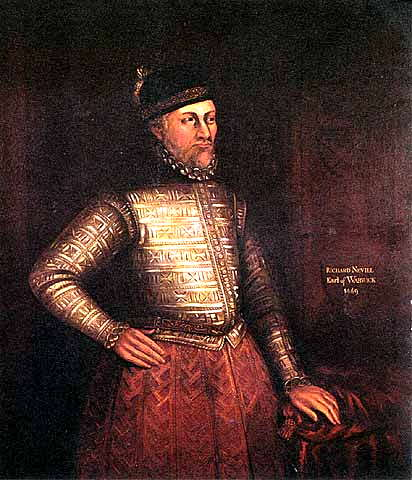
Warwick the Kingmaker
- As a result, Edward called Warwick to council meetings in 1468
- Warwick declined to attend
- Clarence and Warick had sibling rivalry: jealous and ambitious
- Clarence was influenced by Warwick, grew up in his household at Middleham (like Edward himself)
- Restless due to his lack of power compared to Edward IV
- Resented the Woodvilles because of their gaining influence in court over Edward
- Edward denied his request to marry Isabel Neville (Warwick's daughter) and Clarence blamed Woodville's influence for this
- Clarence was involved in Warwick's plans to get a dispensation from the Pope so Clarence could marry Isabel
- Warwick himself does not have a claim to the throne but Clarence does
- Therefore Warwick uses Clarence to gain power Key Events in Warwick and Clarence's Invasion
- Warwick and Clarence were involved in two uprisings: Robin of Resesdale and Robin of Holderness
- Angered by local disputes
- Both uprisings were put down by John Neville Lord Montagu
- Warwick sees the opportunity to restart the rebellion
- Edward is massively outnumbered
- 11th July: King appeals for Warwick and Clarence to support him, they refuse and set sail for Calais
- Clarence marries Isabel
- These uprisings lead on to the Battle of Edgecote Moor
- Clarence and Warwick return to Kent
- The rebel army defeats the Earls of Devon and Pembroke and Edward is captured afterwards whilst Earl Rivers and John Woodville are executed
- Warwick attempts to rule as Protector in place of Edward
- Widespread rioting in the north forced Warwick to release the King mid 1469
- The uneasy peace between Warwick, Clarence and Edward Lincolnshire Rebellion
- Despite Edward's leniency the Lincolnshire Rebellion under Robert Welles began, spurred on by Warwick and Clarence
- Warwick deliberately got Lord Welles to attack the household of Sir Thomas Burgh this was done to provoke the uprising
- Clarence and Warwick had also lied to Edward about raising armies to put it down
Note
Edward IV's secret marriage to Elizabeth Woodville instead of Bona of Savoy triggered significant court shifts, increasing Woodville's influence. By late 1467, Edward had distanced himself from Warwick and his brother Clarence, who were unhappy with their reduced power and the Woodvilles' rise. Warwick and Clarence, motivated by sibling rivalry and resentment, participated in uprisings like Robin of Redesdale and Robin of Holderness. After failing to reconcile with Edward, they sailed for Calais, where Clarence married Isabel Neville. Their rebellion culminated in the Battle of Edgecote Moor, where they captured Edward IV and executed key Woodville allies. Warwick briefly ruled as Protector but faced riots, leading to Edward's release. The Lincolnshire Rebellion, spurred by Warwick and Clarence, further unsettled the realm.
The Battle of Losecoat Field:
- March 1470: to remove Neville powerbase in the north, Earl of Northumberland's title was taken from John Neville and given back to Henry Percy Battle of Losecoat Field
- Rebel army charged
Cried out "A Clarence, a Warwick" implicating them both in the rebellion
- Rebels are quickly defeated
- Threw off their coats in retreat
- Robert Welles confessed that Warwick and Clarence were behind the rebellion before his execution The Readeption of Henry VI
Warwick and Clarence escape again to Calais, they team up with Louis XI and Margaret to put Henry VI back on the throne. To be done using a French invasion
- Anne Neville, Warwick's other daughter, is promised to Henry's son Prince Edward
- Warwick, Clarence and Henry VI are to cross to England before Margaret and Prince Ed
- Edward IV escaped to Burgundy due to lack of support esp. since John Neville had sided with Warwick (after his title of Northumberland was removed in March 1470)
- Clarence and Warwick put Henry back on the throne Edward IV's Return
- Edward IV had used his time in Burgundy to gather support from his brother-in-law Charles the Bold. Edward lands in Yorkshire in March 1471 and lies to the locals that he's only there to claim the Duchy of York as a servant of Henry VI and soon gains support and confronts Warwick at Coventry.
- Warwick has no support and bars the gates so Edward marches on to London and retakes the throne
- Despite pathetic attempt by George Neville to parade Henry VI through the streets to rally support
- Edward IV is warmly welcomed back by Henry VI and then turns back North to deal with Warwick outside of Barnet
Note
In March 1470, the Earl of Northumberland's title was stripped from John Neville and given to Henry Percy, leading to the Battle of Losecoat Field. Rebels cried out "A Clarence, a Warwick" as they were defeated, and Robert Welles later confessed Warwick and Clarence were behind the rebellion before his execution. Warwick and Clarence fled to Calais, aligning with Louis XI and Margaret to restore Henry VI. Edward IV, having gathered support from Burgundy, returned in March 1471, defeated Warwick at Barnet, and reclaimed the throne.
📌 The Battle of Tewkesbury
Meanwhile in Weymouth
- On the same day as the Battle of Barnet on the 14th of April 1471, Margaret, Prince Edward and supporters arrived back in England from exile in France
- Led by the Duke of Somerset, Baron Wenlock and Prince Edward, the Earl of Devon 5,000 Yorkists
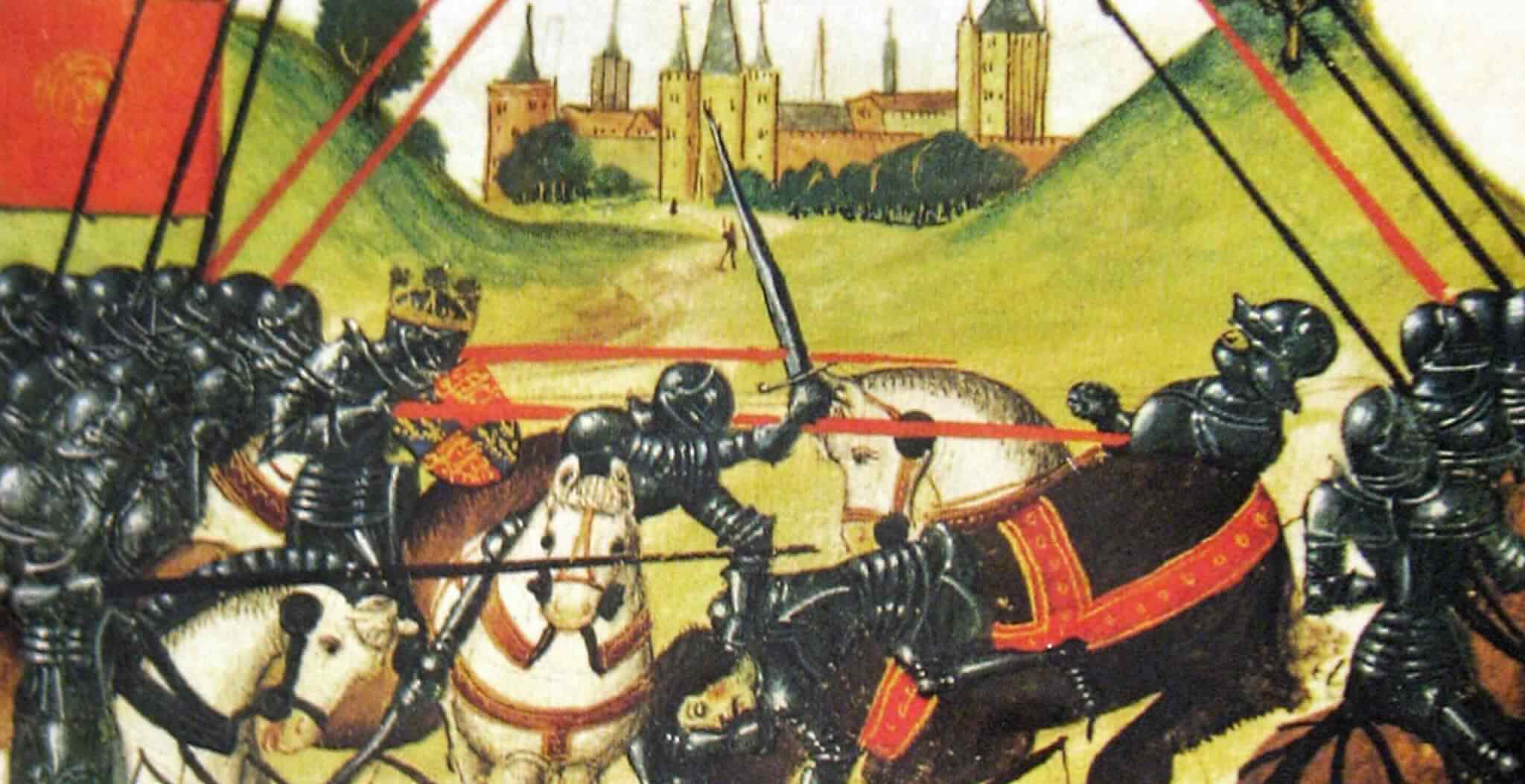
Battle of Tewkesbury
- King Edward meanwhile was at Windsor and learning of Lancastrian manoeuvres, he headed for the West Country in an attempt to intercept Margaret and Somerset before they could reach Wales
- They landed at Weymouth
- Margaret was joined by Lancastrian supporters led by Somerset
- After Barnet, Somerset would not attempt an assault upon Yorkist forces without superior numbers, so in order to reinforce his army he headed for Wales, where he could rely on the support of Jasper Tudor
- The Lancastrian advance to Wales was delayed, first when they made a detour to Bristol for much needed supplies, and second when the city of Gloucester refused them entry
- Instead they headed north to make the crossing of the River Severn at Tewkesbury
- Edward, at the head of his army, having narrowly missed an opportunity to confront the enemy at Sodbury, followed in pursuit of 6,000 Lancastrians
- Led by Edward IV, Clarence, Gloucester, Hastings
Positions
Lancastrians
- A defensive position a mile south of Tewkesbury
- The River Avon and the River Severn were to their rear
- Tewkesbury Abbey was just behind the Lancastrian centre
- The right flank was commanded by Somerset
- The centre was commanded by Wenlock (and Prince Edward)
- The left flank was commanded by DevonYorkists
- 200 mounted spearmen were positioned in the woods to the left of the army
- Edward and Clarence commanded the centre
- Gloucester led the Vanguard
- Hastings led the rear
Events
- On the 4th of May, the Yorkists advanced on the Lancastrian position
- They showered the Lancastrians with arrows
- Somerset led an attack on Edward's flank
- The Yorkists beat back the attack with the 200 spearmen in the woods
- Somerset's forces attempted an escape across the Severn, but most were slaughtered
- The meadow astride the Colnbrook leading down to the river is known as "Bloody Meadow"
- Somerset returned to the Lancastrian lines before killing Wenlock for failing to provide support
- He then sought sanctuary at Tewkesbury Abbey
- With morale collapsing, the Lancastrian army erupted into panic and tried fleeing
- Many were killed by pursuing Yorkists or drowned in the River Avon
- Prince Edward was killed either during battle or in the aftermath
- Around 2000 Lancastrians died Generals involved, size of army Aftermath
- Many Lancastrians took sanctuary in Tewkesbury Abbey
- King Edward gave permission for Prince Edward to be buried there
- Somerset and other leaders were dragged out of the Abbey and were ordered by Gloucester and the Duke of Norfolk to be put to death
- Somerset and his younger brother were both buried at Tewkesbury Abbey
- Queen Margaret, defeated by the death of her son, was taken captive and imprisoned at the end of the battle
- Edward takes back the throne
- Henry VI dies in the Tower of London in May 1471: the demise of his son had sealed his fate
- The death of Henry and the Beaufort male line left Margaret Beaufort and her son, Henry Tudor, as the senior representatives of the House
Note
On May 4th, 1471, the Yorkists decisively defeated the Lancastrians at Tewkesbury. The Lancastrians, including Somerset, suffered heavy losses with around 2,000 dead. Somerset's forces faced brutal resistance and attempted escape, but many were killed or drowned. Somerset and other leaders were later executed, while Queen Margaret was captured. The battle solidified Edward IV's return to the throne, and Henry VI died in the Tower of London, leaving Margaret Beaufort and her son, Henry Tudor, as the prominent remaining Lancastrian figures.
The crushing of rebels in Kent - John de Vere's rising
John de Vere, the 13th Earl of Oxford, was involved in a significant rebellion against King Edward IV during the Wars of the Roses. This event, sometimes referred to as John de Vere's rising, took place in Kent, a key battleground in England.
Background
John de Vere was a staunch Lancastrian supporter. After the defeat of Henry VI and the Lancastrians at the Battle of Towton in 1461, Edward IV, from the Yorkist faction, ascended to the throne. Many Lancastrians, including de Vere, continued to resist Edward IV's rule.
The Rebellion
In 1471, de Vere joined forces with Thomas Neville, known as the Bastard of Fauconberg, to lead a rebellion in Kent. The uprising was part of a broader Lancastrian effort to dethrone Edward IV and restore Henry VI. The rebels managed to gather significant support and launched an attack on London. They also attempted to gain control over strategic locations in Kent.
Crushing the Rebellion
Edward IV acted swiftly to suppress the rising. The King's forces, led by key Yorkist commanders, confronted the rebels in several engagements. The decisive battle occurred near the town of Sandwich in Kent. The royal army outmanoeuvred the rebels, leading to their defeat.
Aftermath
John de Vere was captured, but he later escaped and continued his resistance until 1474 when he was finally arrested and imprisoned. His estates were confiscated, and he was sentenced to death, although his execution was delayed. He ultimately spent many years in captivity before being released and restored to favour by Henry VII after the Battle of Bosworth in 1485, where the Lancastrians finally triumphed.
Significance
The crushing of John de Vere's rebellion in Kent demonstrated Edward IV's determination to maintain his rule and eliminate Lancastrian opposition. It also highlighted the ongoing turbulence and factional conflict that characterised the Wars of the Roses, a series of civil wars that profoundly affected England during the late 15th century.