Political Vacuum (AQA A-Level History): Revision Notes
📚Revision Notes
Political Vacuum
📌 Why was Edward accepted as the New Monarch in 1461?
- Victory at Towton and Mortimer's Cross
- Many Lancastrians simply gave up and changed their allegiance to Edward IV, e.g. Lord Rivers
- He had the support of the aristocracy
- He had great abilities as a military leader
- Got involved with the fighting and was great at raising the morale of his men
- Wise beyond his years – intelligent
Note
Following his decisive victories, many Lancastrians, including Lord Rivers, switched their allegiance to Edward IV. His military prowess and ability to inspire his troops, along with the strong support of the aristocracy, solidified his claim to the throne. Wise beyond his years and highly intelligent, Edward IV quickly established himself as a formidable and respected leader.
📌 What impact did the Yorkists have on securing Edward's reign?
- They had more effective military commanders than the Lancastrians
- They had the support of London and Kent
- They had finances coming from the merchants of London, who raised corporate loans, advances and private loans, totalling at least £11,000
- Henry was incapable of managing finance and strategic sources of support were allowed to pass into the hands of his opponents
- Yorkists relied on the command of military resources, including the lieutenancy of Ireland and the 1000-strong Calais garrison
- The Nevilles commanded the West March in the north to defend the border against Scotland
- Men could be paid with royal wages
- Calais provided the largest arsenal of weapons available to the English Crown
- From their position in Calais before June 1460, Warwick and Edward managed to recruit Burgundian Knights, men-at-arms and gunners
Note
The Yorkists' success can be attributed to superior military leadership, strategic alliances, and financial backing, particularly from London merchants. With control of key military resources like the Calais garrison and support from influential families like the Nevilles, they effectively outmanoeuvred the Lancastrians. Additionally, Henry VI's poor financial management allowed the Yorkists to capitalise on these advantages, ultimately tipping the balance in their favour before June 1460.
📌 What issues did he still face?
- When he came to the throne, Edward inherited Henry's financial problems and could not afford to garrison the northern castles under reliable captains
- Margaret and her son Edward were still at large despite the many Lancastrians who had given up
- The Queen had the support of foreign powers, including France and Scotland so she had the potential to rebuild her forces
- The Percy family still showed great resistance and had the stronghold in the far north of England (although the family was much diminished)
- Any campaign against them would be long and expensive as the region was protected by the castles of Alnwick, Bamburgh and Dunstanburgh
- The Lancastrians still had strongholds in Wales although resistance soon fell apart after a campaign led by Lord Herbert
- Edward tried to win over the support of Sir Ralph Percy, by giving him commands over some of the northern strongholds, but Ralph was quick to pass over Dunstanburgh castle to Queen Margaret in 1462
- There was still a strong enough Lancastrian party that was not going to accept Edward IV on the throne, making his position less certain
Note
Upon ascending the throne, Edward IV faced significant financial issues inherited from Henry VI, making it difficult to secure northern England. Despite victories, the Lancastrians, supported by foreign powers and the Percy family, remained a formidable threat. Efforts to secure loyalty, such as entrusting Sir Ralph Percy with northern castles, backfired, further destabilising Edward's rule.
Lord Rivers
- Father was involved as a captain on Henry V's campaigns in France in 1415 and 1417
- Rivers followed in his father's footsteps and served in France from 1427 in a number of roles
- Was knighted by Henry VI in 1426
- He was one of the escorts that took Margaret to England in 1444
- In 1450 he was appointed as seneschal (steward) of Gascony
- Served as Lieutenant of Calais from 1451 to 1455
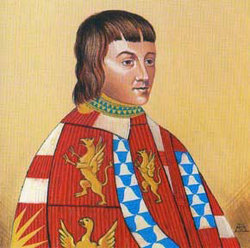
Earl Rivers
- Had a secret marriage to the late John, Duke of Bedford's wife, Jacquetta of Luxemburg in 1437
- It was a scandalous alliance between a duchess and a mere knight
- He was fined £1000 by Henry VI for marrying without his permission and for taking possession of Jacquetta's dower
- The marriage was Rivers' fortune
- He was created a baron on the 9th of May 1448 and chose to style himself as Lord Rivers
- Was involved in the suppression of the Cade rebellion in 1450
- Spent most of the next decade abroad, avoiding most of the growing crisis
- Started to spend more time in England in 1456
- Became constable of Rochester in 1457
- Tried to defend Kent against invasion by the Yorkists but was captured in 1460 at Sandwich
- Continued support of the Lancastrian cause and fought on their side at Towton
- He was swift to concede defeat however
- He changed sides to the Yorkists and became a favourite to Edward IV, who married his eldest daughter Elizabeth
Note
Sir Richard Woodville, later known as Lord Rivers, followed in his father's military footsteps, serving in France and earning a knighthood from Henry VI in 1426. His secret marriage to Jacquetta of Luxemburg in 1437 brought scandal and a £1000 fine, but also significant fortune. Created Baron Rivers in 1448, he remained active in English politics, notably suppressing the Cade Rebellion in 1450. Initially a Lancastrian supporter, Rivers later shifted his allegiance to the Yorkists, becoming a favoured figure at Edward IV's court after his daughter Elizabeth married the king.