Force Diagrams (AQA A-Level Mathematics): Revision Notes
📚Revision Notes
3.1.1 Force Diagrams
Force diagrams, also known as free-body diagrams (FBDs), are essential tools in mechanics. They help visualise the forces acting on an object, making it easier to analyse the object's motion or equilibrium. Here's a guide to understanding and creating force diagrams:
1. What is a Force Diagram?
Note
- A force diagram is a simplified representation of an object (or system) with all the forces acting on it illustrated as vectors.
- The object is usually represented by a simple shape, like a dot or a box, and the forces are shown as arrows pointing in the direction in which the forces act.
2. Steps to Draw a Force Diagram
Note
- Identify the object: Determine which object you are analysing and isolate it from the surroundings.
- Draw the object: Represent the object by a simple shape, often a point (for simplicity) or a box if more context is needed.
- Identify all the forces acting on the object: Consider forces such as gravity, normal force, tension, friction, applied forces, and air resistance.
- Draw the forces as arrows:
- The length of each arrow represents the magnitude of the force.
- The direction of the arrow shows the direction in which the force acts.
- Label each force clearly (e.g., , , , etc.).
- Check for equilibrium or net force:
- If the object is in equilibrium (stationary or moving at constant velocity), the forces should balance, meaning the arrows should add up to zero.
- If the object is accelerating, there will be a net force in the direction of acceleration.
3. Common Forces to Include
- Weight : Acts downward, equal to the mass of the object times the acceleration due to gravity .
- Normal Force : Acts perpendicular to the surface on which the object rests, opposing the weight if on a horizontal surface.
- Tension : If the object is connected to a rope or string, tension acts along the string.
- Friction : Opposes the motion or attempted motion between two surfaces in contact.
- Applied Force : Any external force applied to the object.
- Air Resistance : Acts opposite to the direction of motion, more significant at higher speeds.
4. Worked Example
Note
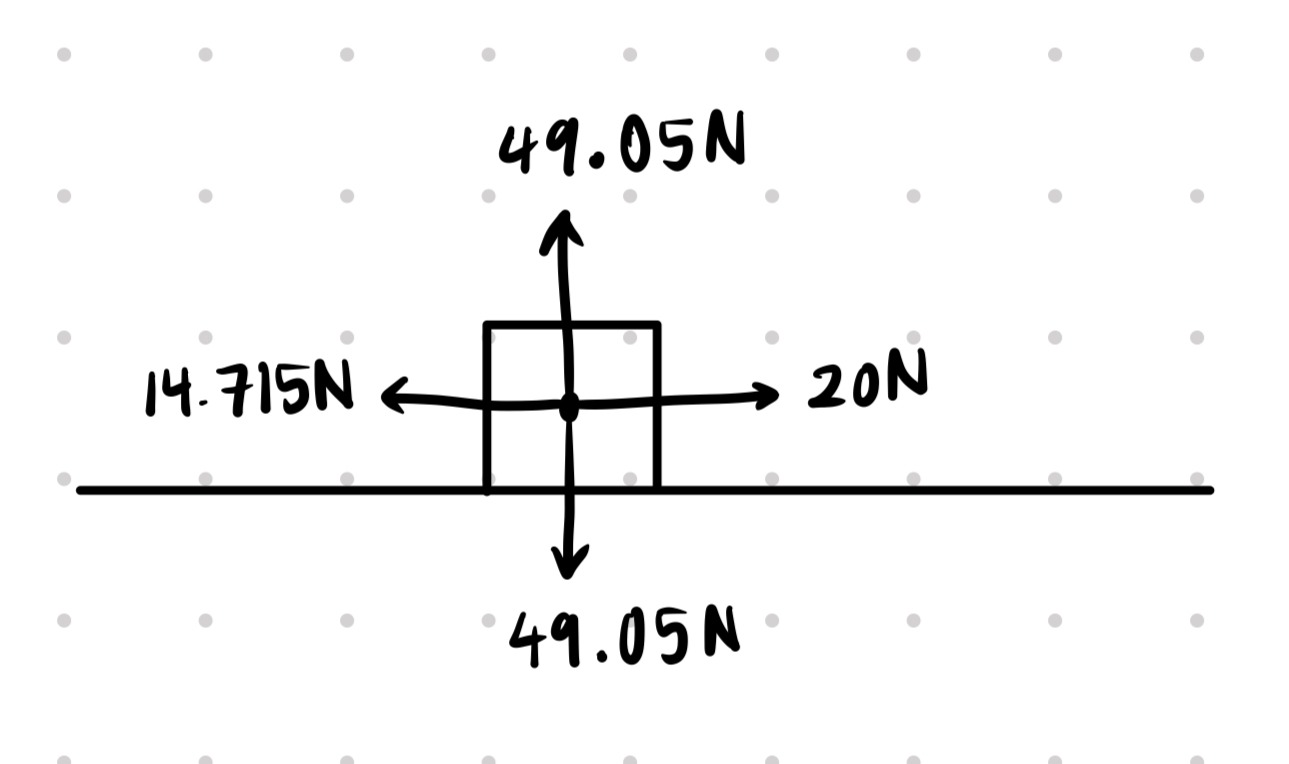
Problem: A box of mass is on a flat surface. A force of is applied horizontally to the right. The coefficient of friction between the box and the surface is . Draw the force diagram.
Step 1: Identify forces acting on the box.
- Weight : Downward, .
- Normal Force : Upward, balancing the weight, so .
- Applied Force : to the right.
- Frictional Force : Opposes motion, calculated using to the left.
Step 2: Draw the diagram.
- Draw a box or point to represent the object.
- Draw arrows representing each force:
- Weight pointing downwards.
- Normal force pointing upwards.
- Applied force pointing to the right.
- Frictional force pointing to the left.
Final Diagram: The box will have:
- A downward arrow labelled for gravity.
- An upward arrow labelled for the normal force.
- A rightward arrow labelled for the applied force.
- A leftward arrow labelled for friction.
5. Interpreting the Diagram
- Net Force: You can see that the applied force and friction are not equal, so the box will accelerate to the right. The net force in the horizontal direction is .
- Equilibrium: If all forces balanced out (e.g., if friction equalled the applied force), the object would be in equilibrium, and there would be no acceleration.
Resolving Non-Perpendicular Forces
Problem Statement:
Note
Question : Find the magnitude and direction of the resultant of the given forces.
Solution:
Step 1: Resolve the Forces Horizontally and Vertically
- Horizontal Component:
(Any forces with a component acting horizontally should be considered.)
- Vertical Component:
(Any forces with a component acting vertically should be considered.)
Step 2: Calculate the Magnitude and Direction
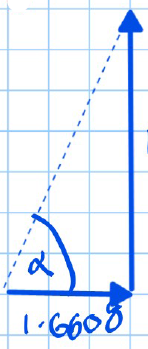
- Magnitude of the Resultant Force :
- Direction relative to the positive horizontal:
Final Answer:
- Magnitude:
- Direction: above the positive horizontal (Note: Always provide a reference line for the direction.)