Coefficient of Friction (AQA A-Level Mathematics): Revision Notes
📚Revision Notes
3.3.2 Coefficient of Friction
Concept:
- In A-Level Maths, friction is modelled as being proportional to the normal contact force between objects.
Mathematical Representation:
Note
- is the frictional force.
- is the normal contact force.
Equation:
Note
- is the coefficient of friction and measures how rough the contact between two objects is.
Diagram:
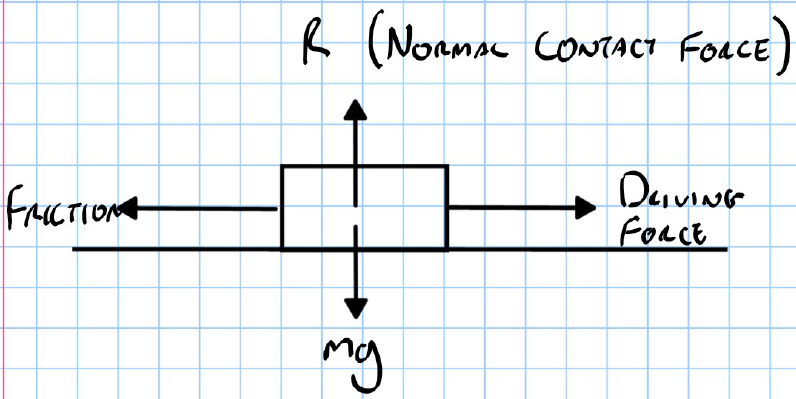
- The frictional force opposes the driving force, and mg is the gravitational force acting on the object.
Nature of Friction:
- Friction "fights" and resists any driving force up to a limit .
- When an object is on the point of slipping, it is said to be in "limiting equilibrium." At this point, the frictional force is at its maximum value .
Example 1: Finding the Maximum Force without Causing Motion (Limiting Equilibrium)
Problem Statement:
Note
- A mass of 8 kg rests on a rough horizontal plane.
- The coefficient of friction between the mass and the plane is 0.5.
- Find the magnitude of the maximum force P that can act on this mass without causing it to move if:
- The force P is horizontal.
- The force P acts at an angle of above the horizontal.
Part (a): Force P is Horizontal
- Given:
- Coefficient of friction
- Weight
- Equilibrium in the vertical direction:
- The normal reaction force
- Frictional force at the point of slipping:
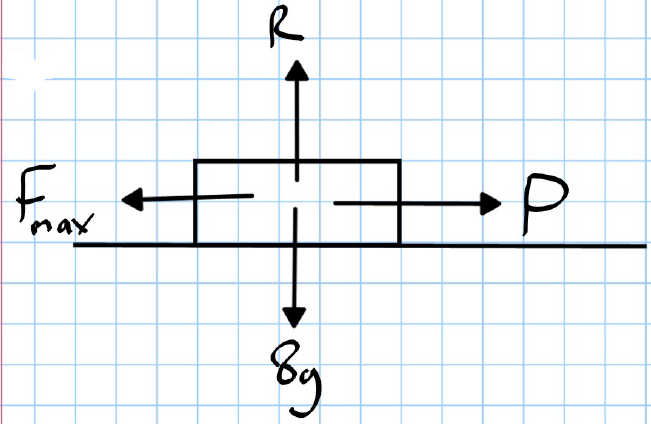
- Maximum force :
Answer (a):
Part (b): Force P Acts at an Angle of above the Horizontal
- Resolve the force :
- Horizontal component:
- Vertical component:
- Vertical equilibrium:
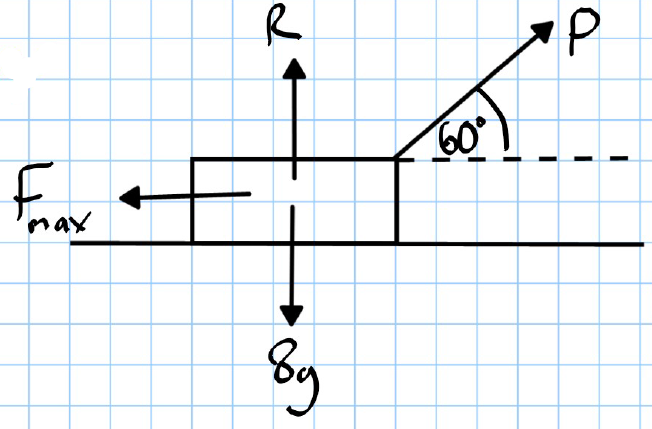
- Frictional force at the point of slipping:
- Horizontal equilibrium:
Simplifying:
- Solve for :
Answer (b):
Tips:
Note
- Understand the formula: The frictional force is given by , where is the coefficient of friction and is the normal reaction force. Ensure you calculate accurately, especially on inclined planes.
- Distinguish between static and kinetic friction: Static friction prevents motion, and (maximum value before slipping). Kinetic friction applies once the object is moving, and .
- Consider all forces: Don't forget to account for other forces acting on the object, such as applied forces or weight components on an inclined plane. Use to find acceleration or tension when needed.