Moments Diagrams (AQA A-Level Mathematics): Revision Notes
📚Revision Notes
4.1.1 Moments Diagrams
Moments
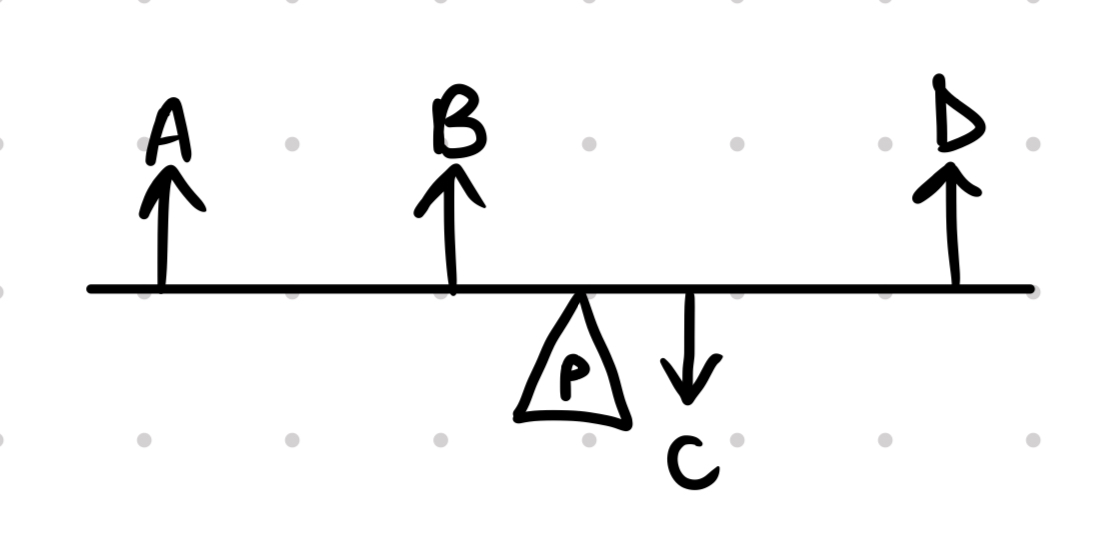
A moment is the turning effect that a force has. For example, consider a force applied to the following see-saw:
Note
We can see that the see-saw is pivoted about . Each of the forces , and will have a turning effect (except one). When taking moments about , considering to be the pivot and considering clockwise as the positive direction:
- Force A has a clockwise moment.
- Force B has no turning effect as it is acting into the pivot.
- Force C has a clockwise turning effect.
- Force D has an anticlockwise turning effect. The magnitude of the moment (or turning effect) of a force is given by:
Note
💡Note: The distance refers to the perpendicular distance from the pivot to the line of action of the force.
Problem 1: Jack and Jill on a Seesaw
Note
📝Given:
- Jack and Jill are playing on a seesaw made from a uniform plank of length 5 m, pivoted at , the midpoint of
- Jack has a mass of 35 kg and Jill has a mass of 28 kg.
- Jill sits at A and Jack sits at a distance x m from .
- The plank is in equilibrium. Find: The value of .
Solution:
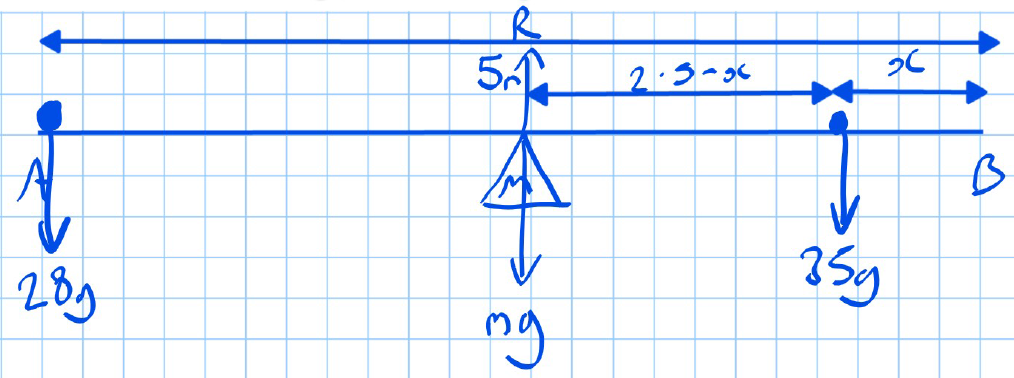
- Identify the forces and moments:
- Weight of Jill = acting at .
- Weight of Jack = g acting at a distance m from .
- Weight of the plank = mg acting at the centre (This weight does not cause any turning effect as it acts at the pivot).
- Taking moments about the pivot M:
- Solve for :
Result: The value of x = 0.5 m.
Problem 2: Q5, (Jan 2010, Q4) Tension in the Rope
Note
Given:
-
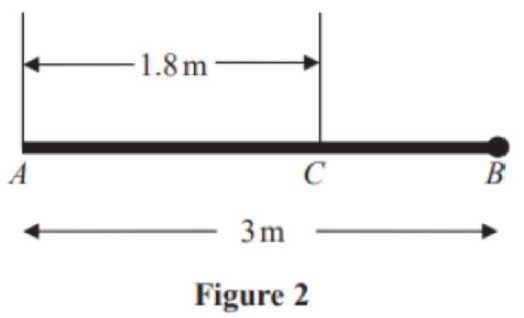
A pole has length 3 m and weight Newtons.
-
The pole is held in a horizontal position in equilibrium by two vertical ropes attached at points and .
-
AC = 1.8 m, and a load of weight 20 N is attached to the rod at B.
-
The pole is modelled as a uniform rod. Find:
-
(a) The tension in the rope attached to the pole at C in terms of W.
-
(b) The tension in the rope attached to the pole at in terms of .
-
(c) The value of given that the tension in the rope at is eight times the tension in the rope at .
Solution (a):
- Identify the forces and moments:
- Let be the tension at and be the tension at .
- Weight of the pole W acts at the centre of the rod.
- The N force acts at .
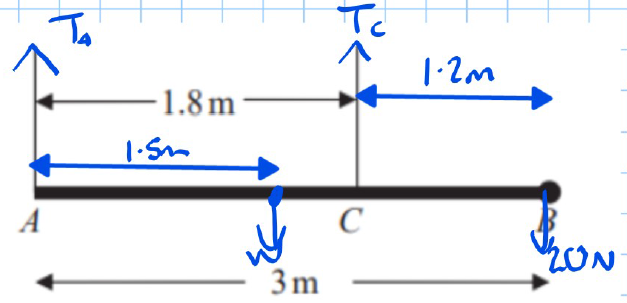
- Taking moments about to eliminate :
- Solve for T_C:
- Find the value of W:
- Given and using the equilibrium condition :
- Substitute into the equation and solve for .
Note
Given:
- is the tension at .
- is the tension at
- W is the weight of the pole.
- The pole is in equilibrium.
Solution (b):
Find in terms of
Using the equilibrium condition for vertical forces:
Substitute into the equation:
Solving for :
Part (c):
Note
Given , find W
Substitute into the equation for :
Expanding and solving for :
Multiply the entire equation by to clear the fractions:
Simplifying:
Result: The weight W of the pole is 280 N.
Tips:
Note
- Identify the pivot point: Determine the point about which moments are taken (the pivot). Moments are calculated as , with clockwise moments usually taken as positive and anticlockwise as negative (or vice versa, as per convention).
- Resolve all forces: Ensure all forces, including weights, reaction forces, and applied loads, are accounted for. If forces are acting at angles, resolve them into perpendicular components before calculating moments.
- Apply the principle of moments: For equilibrium, the sum of clockwise moments equals the sum of anticlockwise moments about the pivot point. Use this to set up equations and solve for unknown forces or distances.