Using Moments - Equilibrium (AQA A-Level Mathematics): Revision Notes
📚Revision Notes
4.1.2 Using Moments - Equilibrium
Problem: Ladder in Equilibrium
Note
Given:
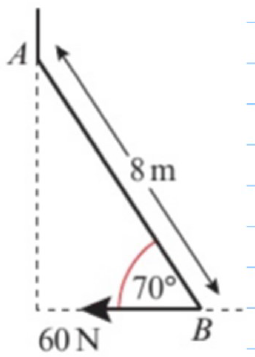
- A uniform ladder is leaning against a smooth vertical wall on rough horizontal ground at an angle of 70° to the horizontal.
- The ladder has a length of 8 m.
- It is held in equilibrium by a frictional force of magnitude 60 N acting horizontally at .
- The ladder's weight acts at its centre of mass. Find:
- The magnitude of the normal reaction of the wall on the ladder at A.
- The mass of the ladder.
Solution:
(a): Magnitude of the Normal Reaction at A
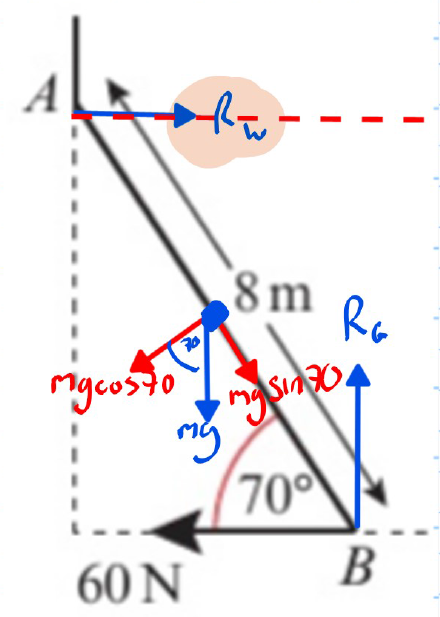
- Identify the forces:
- : Normal reaction force at the wall (horizontal) at .
- : Normal reaction force at the ground (vertical) at .
- Frictional force of 60 N at .
- Horizontal forces:
- . Result: The normal reaction of the wall on the ladder at is 60 N.
(b): Mass of the Ladder
- Taking moments about point :
- Solve for the mass :
Simplifying:
Result: The mass of the ladder is approximately 33.64 kg.
Problem: Tension in the String of a Uniform Rod
Note
Given:
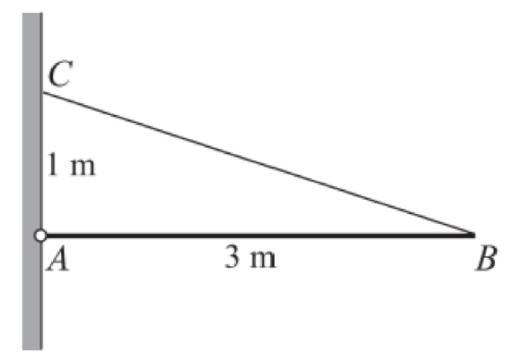
- A uniform rod has weight 20 N and length 3 m.
- The end is freely hinged to a point on a vertical wall.
- The rod is held horizontally and in equilibrium by a light inextensible string.
- One end of the string is attached to the rod at .
- The other end of the string is attached to a point , which is 1 m directly above . Find: Calculate the tension in the string.
Solution:
- Calculate the angle :
- Given that , use the arctan function:
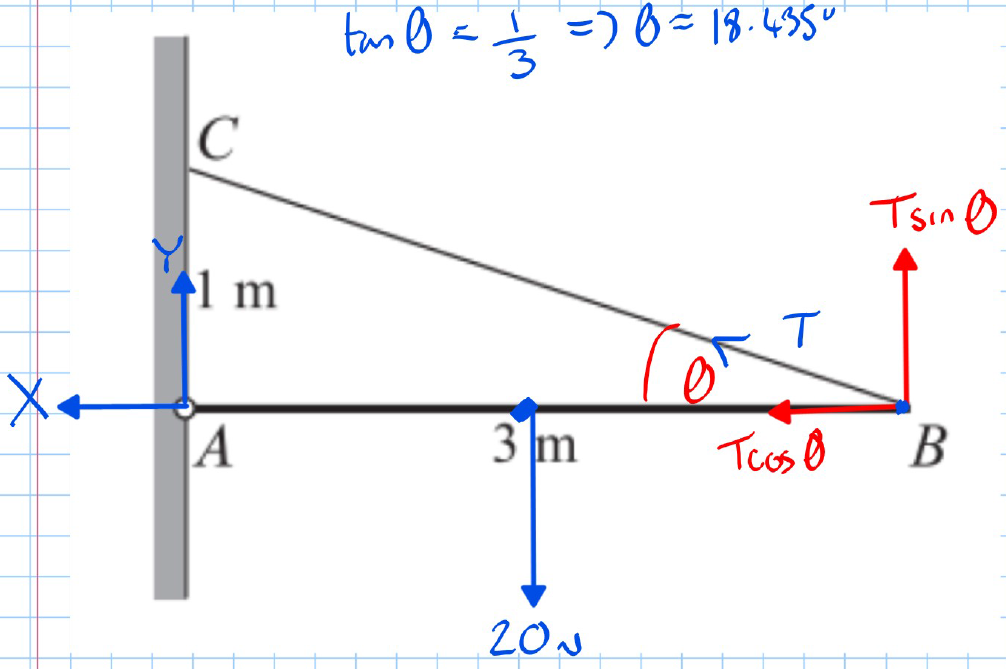
- Take moments about point :
- The rod's weight acts at its midpoint, so the distance from is 1.5 m.
- The tension in the string is at an angle to the horizontal, giving components and .
- Solve for :
Result: The tension in the string is approximately 31.62 N.
Tips:
Note
- Identify the pivot point: Choose a point where one or more unknown forces act, as forces through the pivot have no moment. This simplifies the equation by eliminating unknowns.
- Apply the principle of moments: In equilibrium, the sum of clockwise moments equals the sum of anticlockwise moments about any point. Set up an equation for these moments to solve for unknown forces or distances.
- Use equilibrium conditions: In addition to moments, apply the conditions for translational equilibrium:
- (horizontal forces balance).
- (vertical forces balance).