Centres of Mass (AQA A-Level Mathematics): Revision Notes
📚Revision Notes
4.1.3 Centres of Mass
Problem: Moments in 2 Dimensions
Note
Given:
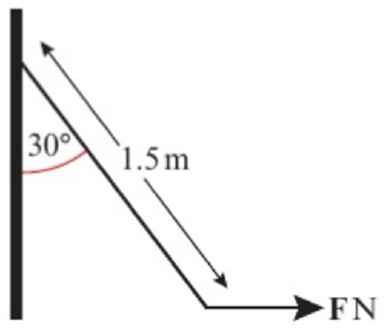
- A metal lever of mass 5 kg and length 1.5 m is attached by a smooth hinge to a vertical wall.
- The lever is held at an angle of 30° to the vertical by a horizontal force of magnitude F N applied at the other end of the lever.
- The lever is modelled as a uniform rod. Find: The value of F.
Solution:
Method 1: Changing Direction of Force
- Resolve forces into components parallel and perpendicular to the given distances.
- Weight of the lever 5g acts downward.
- Resolve the weight into two components:
- Perpendicular component: 5g sin(30°)
- Parallel component: 5g cos(30°)
- Force F is horizontal, and it is already perpendicular to the lever.
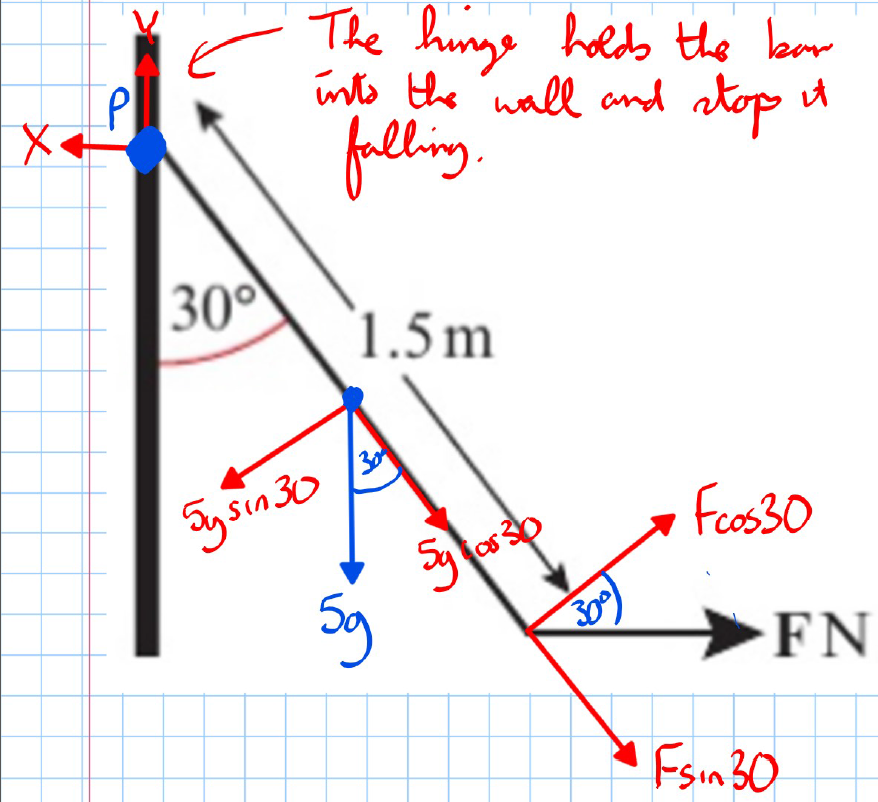
- Take moments about the pivot P:
- Taking clockwise moments as positive.
- Solve the resulting equation:
Simplifying:
Method 2: Resolve Perpendicular Distances
- Resolve distances perpendicular to the line of action of the forces.
- The perpendicular distance of the weight from the pivot P is 0.75 sin(30°).
- The perpendicular distance of F from the pivot P is 1.5 cos(30°).
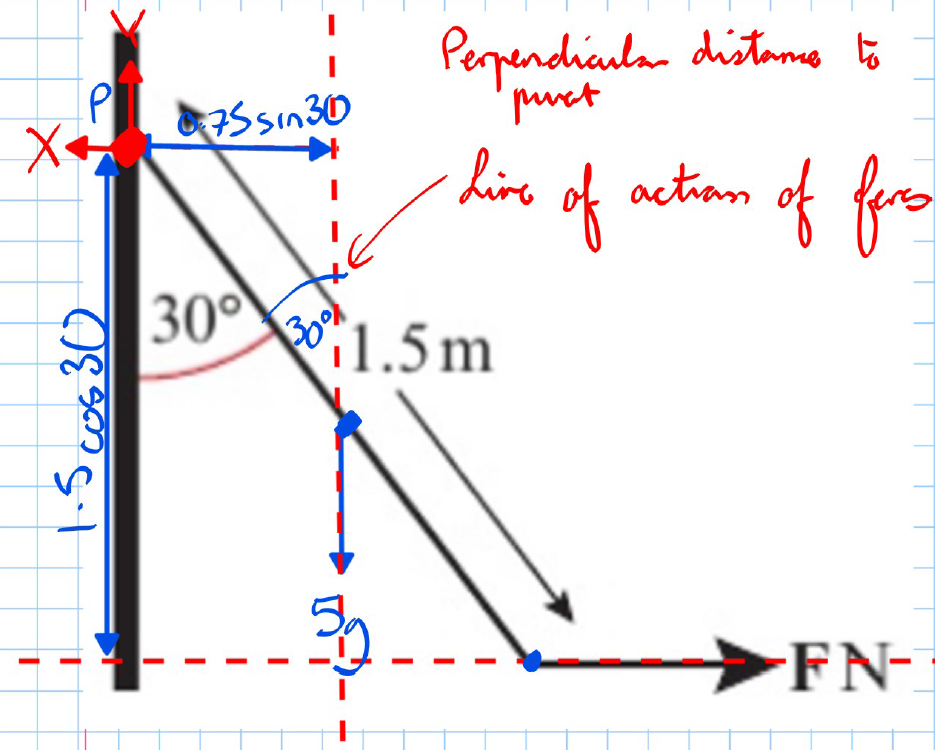
- Take moments about the pivot P:
- Solve the resulting equation: The calculation is the same as in Method 1, leading to:
Result: The value of F is approximately 14.15 N.
Tips:
Note
- Draw a clear free body diagram: Identify all forces acting on the ladder, including:
- The weight of the ladder acting at its centre of mass.
- The normal reaction forces at the ground and the wall.
- Friction at the base (if applicable), which opposes slipping.
- Resolve forces and take moments: Resolve forces horizontally and vertically, applying equilibrium conditions ( ∑ Fx = 0 , ∑ Fy = 0). To solve for unknowns, take moments about a point, often the base of the ladder, where one or more forces pass through, eliminating them from the equation.
- Use friction carefully: For the ladder to remain in equilibrium, friction at the base must be sufficient to prevent slipping. Use F_friction = μN, where N is the normal force, and check if the friction is enough by comparing it with the horizontal forces.