x = g(x) Iteration (AQA A-Level Mathematics): Revision Notes
📚Revision Notes
10.1.3 x = g(x) Iteration
Fixed Point Iterative Methods
Solving simultaneous equations where one of the equations is is possible using numerical methods.
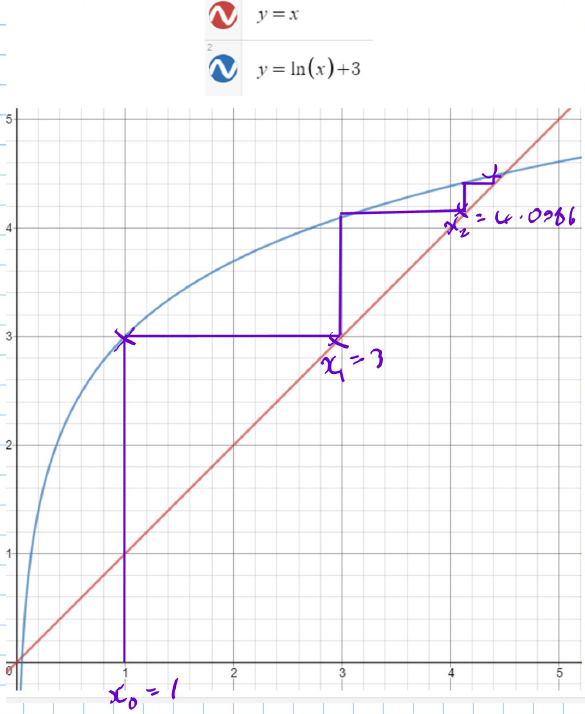
Method:
Note
- Choose a suitable start value for , then find the corresponding -value on the curve.
- Move over to the curve. Reuse this -value.
- Repeat this process until suitably close to a root (assuming the process converges).
Note
📑Example:
Cobweb Diagram Worked Example
Note
📑Example The curve intersects the -axis at the point where . (a) Show that lies between 0.5 and 1.0.
(b) Show that the equation can be rearranged into the form .
(c)
(i) Use the iteration with to find , giving your answer to two decimal places.
(ii) The sketch on Figure 1 shows parts of the graphs of and , and the position of .
On Figure 1, draw a cobweb or staircase diagram to show how convergence takes place, indicating the positions of and on the -axis.
Solution:
(a)
Change of sign. Since the curve is continuous in the interval , then a root lies in this interval.
(b)
Here we have rearranged the equation we wanted to solve into separate equations, one of which is .
- We are solving simultaneously:
- LHS:
- RHS: (c) (i)
(c) (ii)
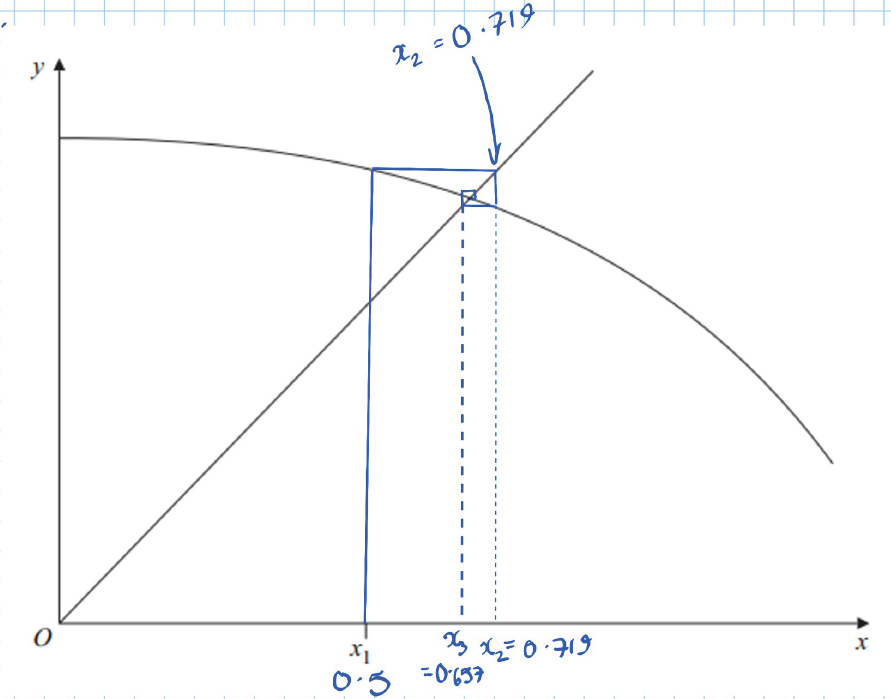
Staircase Diagram Worked Example
Note
📑Example : (b) The curve intersects the line at the point where .
(i) Show that lies between 0.5 and 1.5.
(This would involve substituting and into the equation and showing the signs of the function change.)
(ii) Show that the equation can be rearranged into the form:
(iii) Use the iteration with to find , giving your answer to two significant figures.
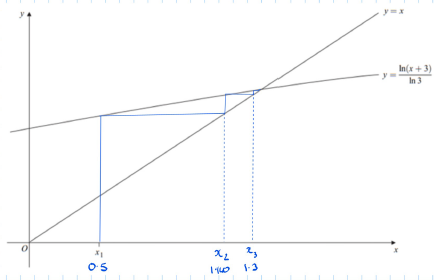
(iv) The sketch on Figure 1 shows part of the graphs of and , and the position of .
On Figure 1, draw a cobweb or staircase diagram to show how convergence takes place, indicating the positions of and on the -axis.
Solution
(b) (i)
Note: Change of signs only works when one side of the equation is 0.
Rearrange the equation to:
Substituting and into the equation:
Change of signs: Since the function is continuous in the interval (), there is a root in this interval.
(ii)
Taking logarithms:
solved with
(iii) The iterative formula used is:
Starting with an initial guess:
- (to significant figures) (iv)
:::