Trapezium Rule (Numerical Integration) (AQA A-Level Mathematics): Revision Notes
📚Revision Notes
10.1.5 Trapezium Rule (Numerical Integration)
Numerical Integration
Upper and Lower Bounds using rectangle
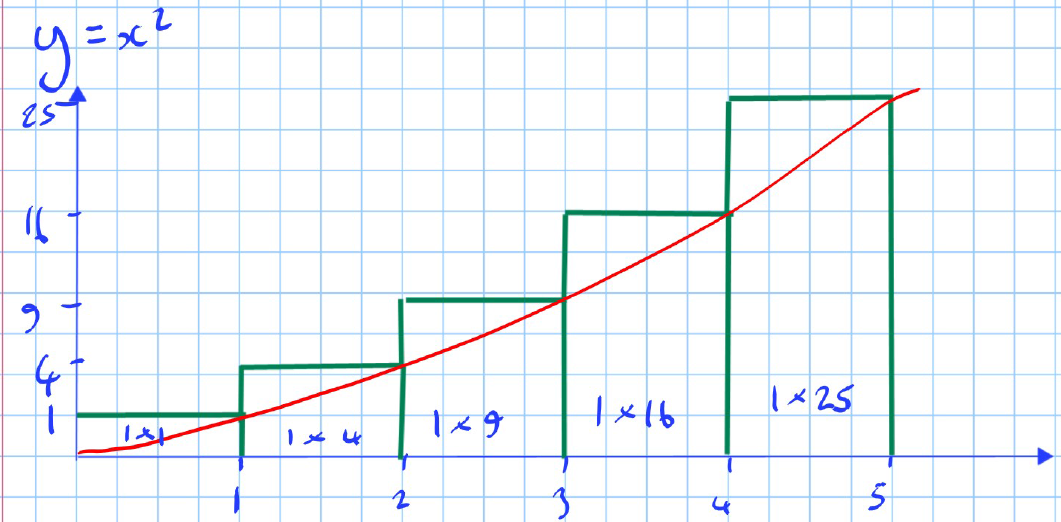
Upper Bound
Note
- Concept:
- The area under a curve from to is approximated using rectangles.
- The tops of these rectangles lie above the curve, leading to an overestimate.
- Calculation:
- The sum of the areas of these rectangles is calculated:
- This gives an approximate area of 55.
- Conclusion:
- The integral is less than or equal to .
- This is an upper bound.
Lower Bound
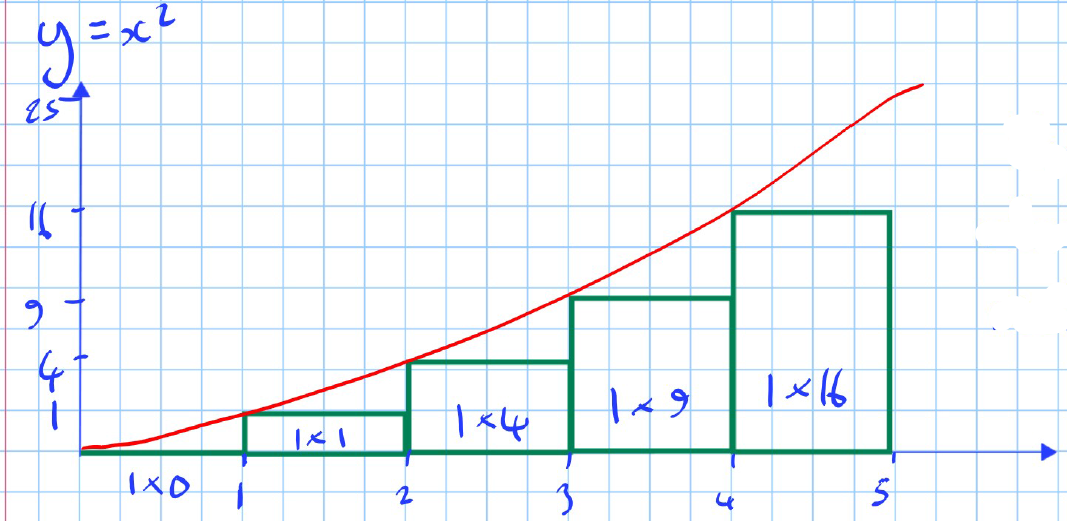
Note
- Concept:
- Here, the left-hand side (LHS) of the rectangles touches the curve, leading to an underestimate.
- The tops of these rectangles lie beneath the curve.
- Calculation:
- The sum of the areas of these rectangles is:
- Conclusion:
- This result provides a lower bound for the integral . If we use an infinite number of infinitely thin retanlges
Note:
Note
This is theory that underpins integrations,
- Find an Upper and Lower Bound using Rectangles
- Make the Rectangles Thinner
- is the limit as where h is the rectangle width.
Note
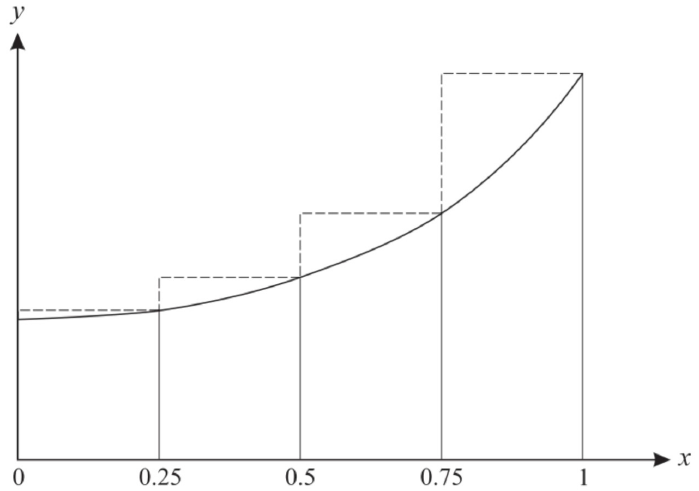
The diagram shows the curve with the equation , for . The region under the curve between these limits is divided into four strips of equal width. The area of this region under the curve is A.
- (i) Upper Bound Calculation:
- By considering the set of rectangles indicated in the diagram, show that an upper bound for A is 1.71. Solution:
- (ii) Lower Bound Calculation:
- By considering an appropriate set of four rectangles, find a lower bound for A. Solution:
Numerical Integration: The Trapezium Rule
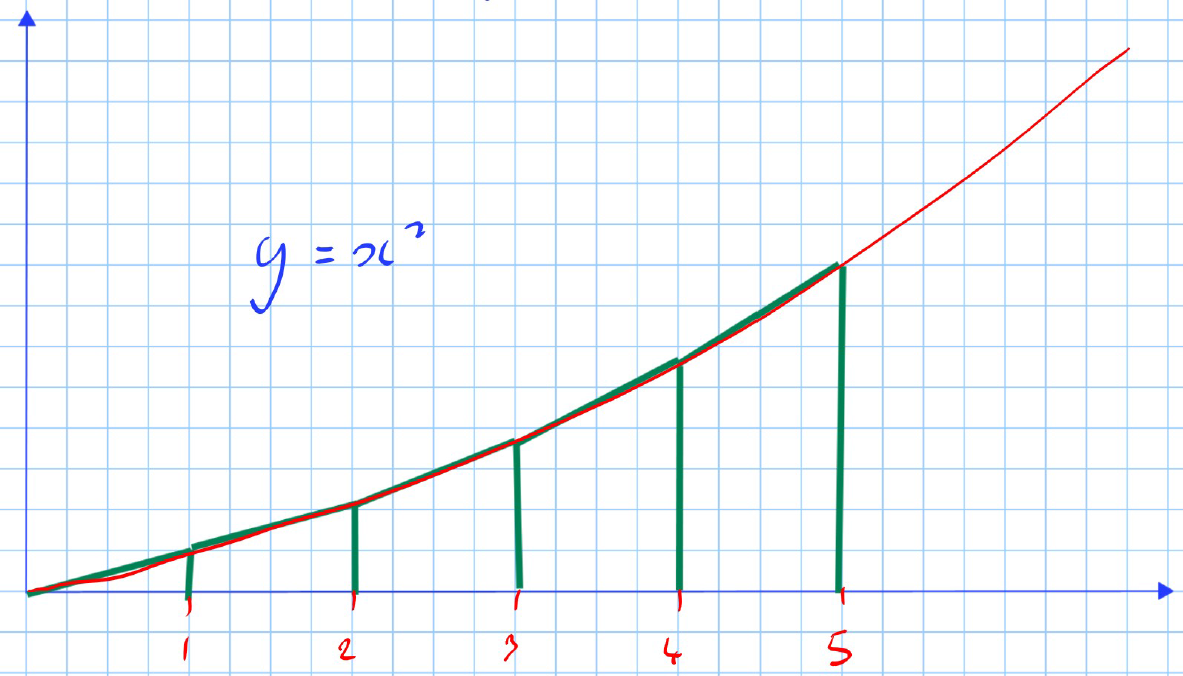
These trapeziums will give an overestimate for the area because the tops of the trapeziums lie above the curve. This is true for any positive convex curve.
| 0 | 1 | 2 | 3 | 4 | 5 | |
|---|---|---|---|---|---|---|
In this calculation, we are using 5 strips/trapezia. 5 strips require 6 ordinates (-values).
Exam Answer
Given:
- | | 0 | 1 | 2 | 3 | 4 | 5 | |---|---|---|---|---|---|---| | | | | | | | |
Using the Trapezium Rule:
Note
Note: To improve the estimate given by the trapezium rule, use more/thinner strips.