Proof by Deduction (AQA A-Level Mathematics): Revision Notes
📚Revision Notes
1.1.2 Proof by Deduction
Proof
Proof is a mathematical tool used to test whether statements are true or not. There are many different types/styles of proof that can be used in different situations.
Proof by Deduction
This is a type of proof used to deduce other true statements from statements we already know to be true.
Notation (⇒)
This sign means "implies that". It means that the statement on the right of the sign is a direct consequence of the statement on the left.
Note
e.g.
""
Note
e.g.
" does not imply "
This is true because
Note
e.g.
Also true are
which allows us to write the double-sided implication sign.
Note
Q1 (Jun 2006, Q4)
In each of the following cases choose one of the statements:
- to describe the complete relationship between and .
(i)
-
-
-
Solution:
- (ii)
-
-
-
Solution:
Note
Q4 (Jan 2012, Q9)
Complete each of the following by putting the best connecting symbol (, , or ) in the box. Explain your choice, giving full reasons.
(i)
being even means (EVEN×EVEN×EVEN) is also even. Add 1 then it becomes odd.
because letting , we get and which is not even.
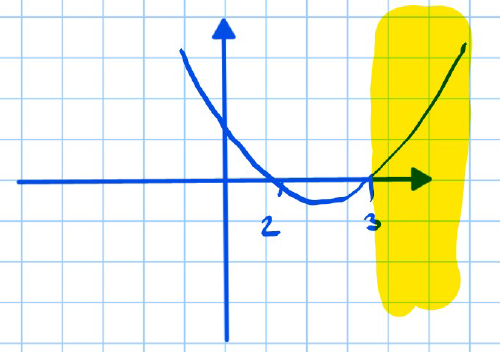
(ii)
because from the graph we can see that or satisfy the inequality. Not just .
Proof Involving Odd and Even Numbers
An even number is any integer multiple of 2 (including 0). An odd number is one that is not even (but must be an integer).
Mathematical Definitions
Note
A number is even if it can be written in the form where is an integer.
Note
A number is odd if it can be written in the form or where or is an integer.
Note
e.g. Prove the sum of two even numbers is also even. Let my even numbers be and .
Important to use two different letters as numbers may differ
Emphasise it being a multiple of 2 by factorising.
Which is of the form even.
Conclusion is important.
Prove that the sum of the squares of any two consecutive numbers is odd.
Let my two numbers be
Used the same letter as it is important in the question that numbers are consecutive
Take out a factor of 2 from wherever we can.
Which is of the form odd.
Prove that the product of two odd numbers is also odd.
- Define your starting numbers:
- Let and (2n+1) be the two odd numbers in question.
- Perform whatever operation was requested:
- Factorize in a way that proves evenness or oddness:
- Emphasise by leaving outside the bracket.
- Conclude by spelling out what you have just shown:
- Since this is of the form , we can deduce the product of two odd numbers is odd.
Notation
⇒means "implies that" or "leads to the direct consequence"
Note
Example:
Means "does not imply". This is because in this case could be .
This statement is true because is a direct consequence of .
A "double-way implication" is also referred to as "if and only if" or "iff".
Note
Question (Q1. Jun 2006, Q4)
In each of the following cases, choose one of the statements to describe the complete relationship between P and Q.
- (i)
- :
- Solution:
- (ii)
- :
- Solution: