Linear Trigonometric Equations (AQA A-Level Mathematics): Revision Notes
📚Revision Notes
5.3.2 Linear Trigonometric Equations
Linear trigonometric equations are equations that involve trigonometric functions like sine, cosine, or tangent, and the variable (usually) appears in a linear form, meaning it's not squared, cubed, etc. Solving these equations involves finding all possible angles that satisfy the equation within a given range, often within one full cycle of the trigonometric function (e.g.,) to
1. Basic Steps to Solve Linear Trigonometric Equations:
- Isolate the Trigonometric Function:
- Get the trigonometric function like on one side of the equation.
- Solve for the Angle:
- Use the inverse trigonometric function to find the principal solution. Remember that trigonometric functions are periodic, so there may be multiple solutions within the given interval.
- Consider the General Solution:
- For sine and cosine functions, account for their periodic nature by adding the general solution using (where is an integer) to find all solutions within the specified interval.
- For tangent, since its period is to find all solutions.
- Check the Interval:
- Make sure that the solutions you find are within the given interval (e.g., ).
2. Examples of Solving Linear Trigonometric Equations:
Note
Example 1: Solving = 0.5
- Step 1: Isolate the function:
- Step 2: Find the principal solution: The principal solution is
- Step 3: Consider all solutions: (Because is positive in the first and second quadrants.)
- Step 4: List all solutions within the interval
Note
Example 2: Solving
- Step 1: Isolate the function:
- Step 2: Find the principal solution: The principal solution is
- Step 3: Consider all solutions: (Because is negative in the second and third quadrants.)
- Step 4: List all solutions within the interval
Note
Example 3: Solving
- Step 1: Isolate the function:
- Step 2: Find the principal solution: The principal solution is range, we convert this to
- Step 3: Consider all solutions: (Because is negative in the third and fourth quadrants.)
- Step 4: List all solutions within the interval
Note
Example 4: Solving
- Step 1: Isolate the function:
- Step 2: Find the principal solution: The principal solution is
- Step 3: Consider all solutions: (Because the period of
- Step 4: List all solutions within the interval
3. General Solutions for Trigonometric Equations:
For any trigonometric equation, the general solutions are often given as:
- Sine Equation
- Cosine Equation
- Tangent Equation
Summary:
Linear trigonometric equations involve solving for angles that satisfy trigonometric equations like By isolating the trigonometric function, finding the principal solution, and considering the periodic nature of trigonometric functions, you can find all solutions within a specified interval.
Solving Trig Equations
Note
Example: Solve for
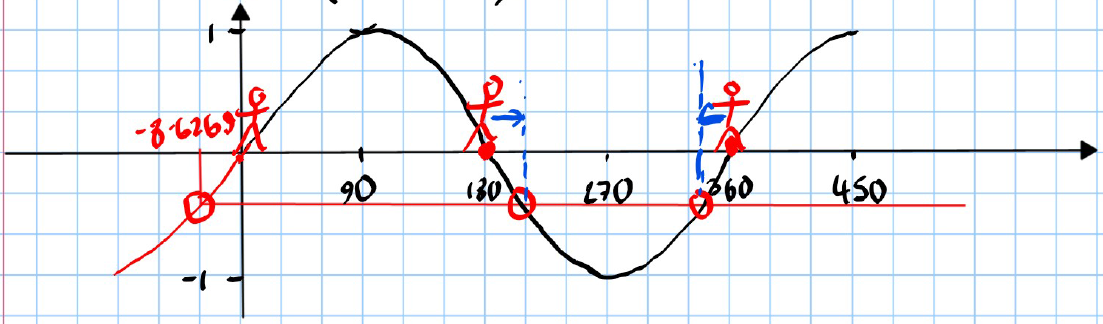
Visual representation of on the graph with solutions indicated.
Note
Solving for
The only think which can penetrate is cos bracket is
Method:
- Cosine both sides:
- Do not YET!!! There are multiple solutions at the moment we use an inverse trig function. Find these.
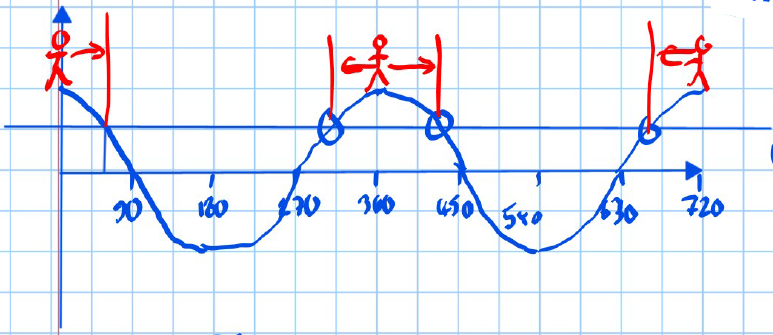
- Once we have multiple solutions, use them to find x:
Note
Example
Solve for
- Rearrange the equation to solve for :
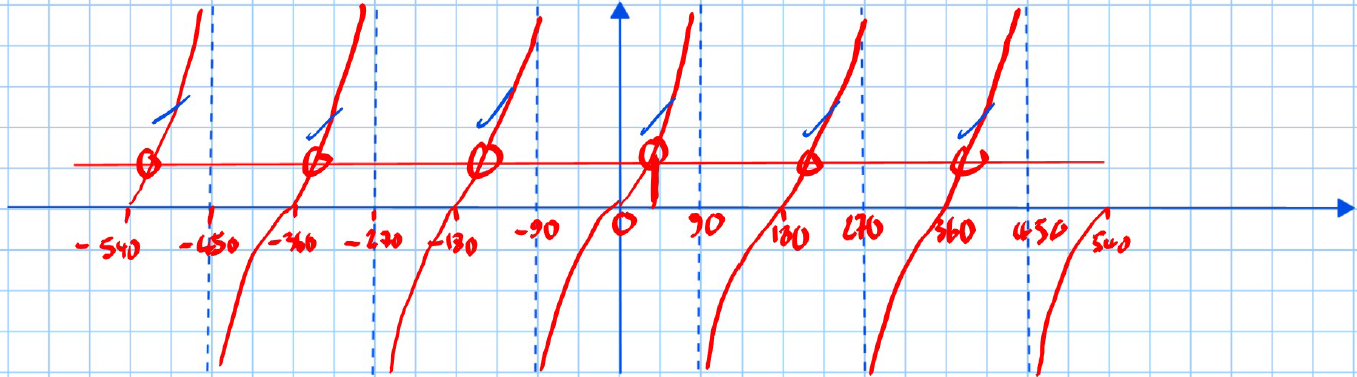
Extend the interval to accommodate the factor of :
- List out the angles:
- Divide by to find :
Note
Solve for
- Set up the inequality:
Find the related angle by taking the inverse sine:
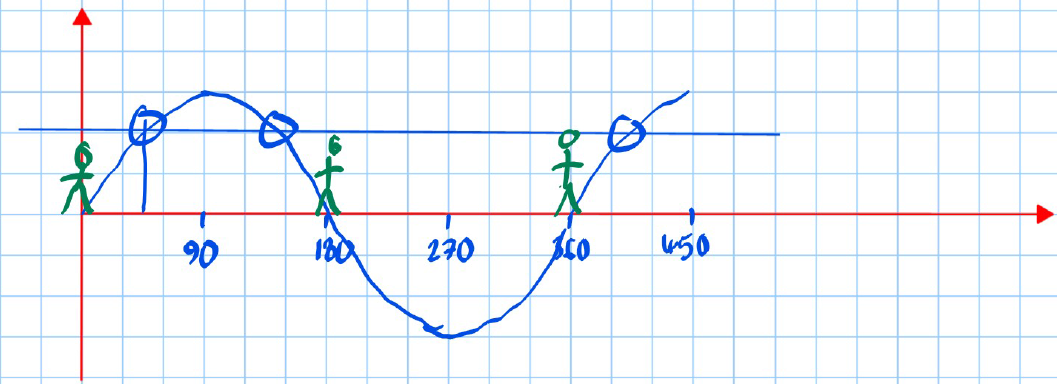
- Use the graph to identify additional solutions: Graph shows angles at 135° and 405°.
- Solve for :
Trigonometric Equations
Graphs:
-
- Red graph
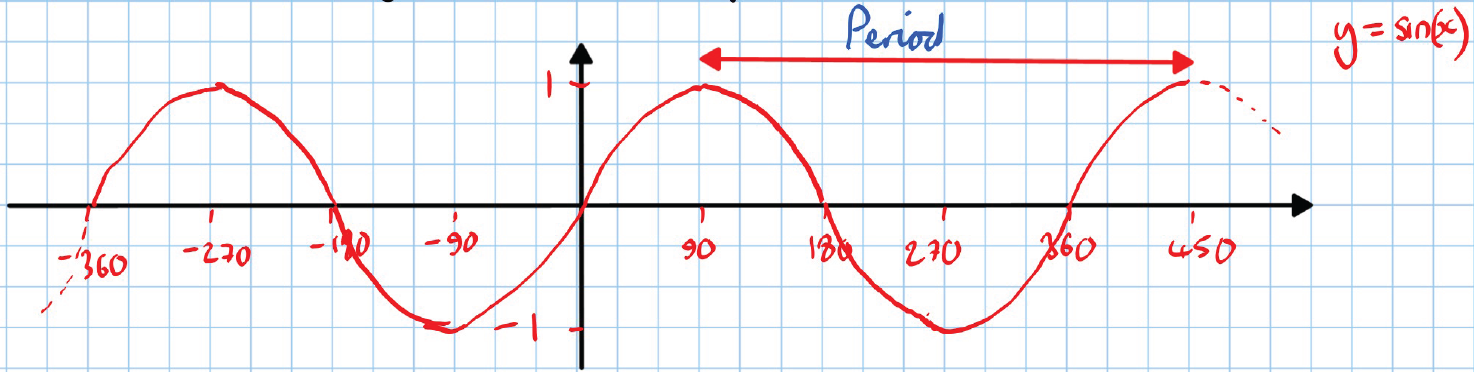
-
- Blue graph
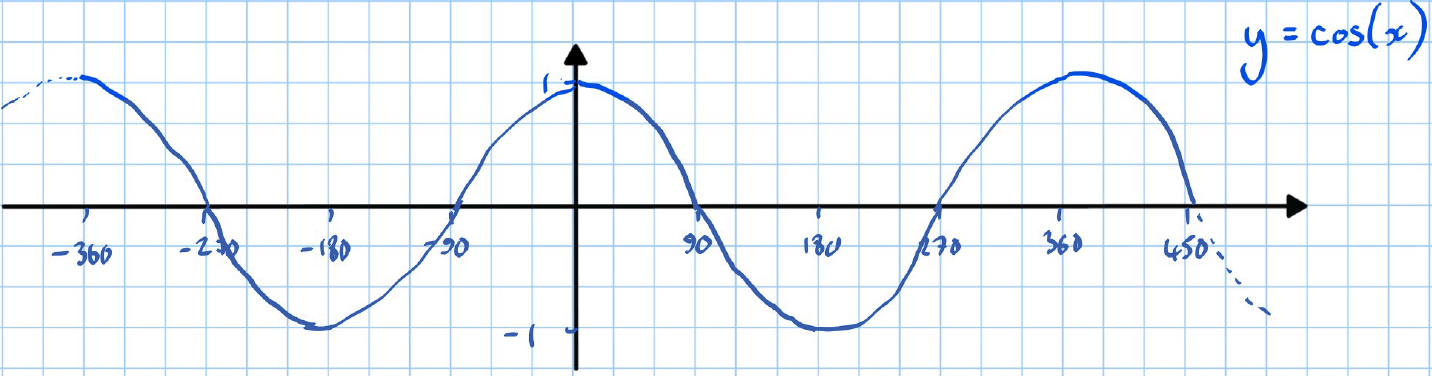
-
- Green graph
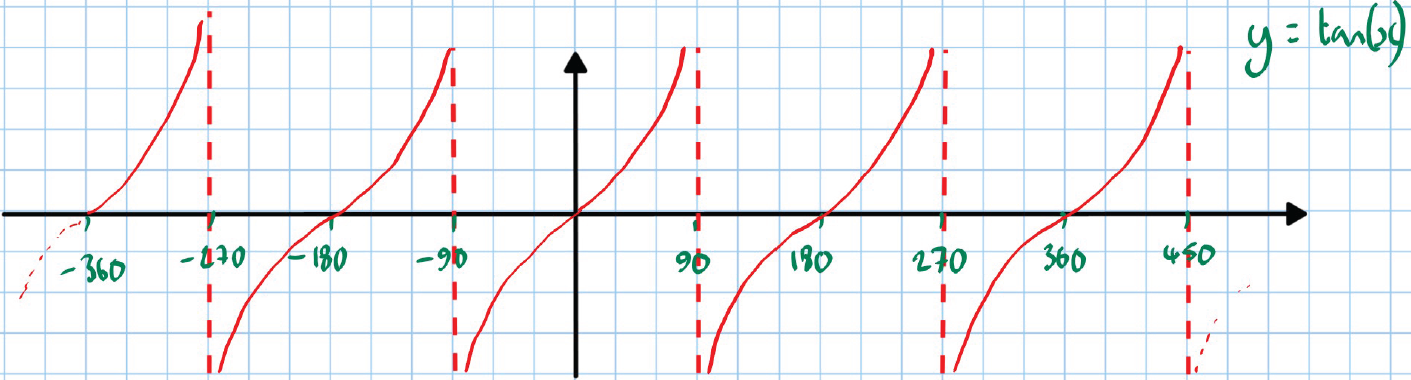
Note: Each graph is labelled with angles in degrees on the x-axis and the function values on the y-axis, showing typical periodic behaviour.
Description:
Trigonometric equations, due to the infinite nature of the standard trig functions, typically have an infinite number of solutions. For this reason, in any given equation, we are told the domain in which the solutions are required.
Note
Example:
- Find the first solution on your calculator:
Note: This is not required as a line of working, but it's part of the thought process.
Implied truncation rather than rounding.
- The calculation is done using a calculator, displaying .
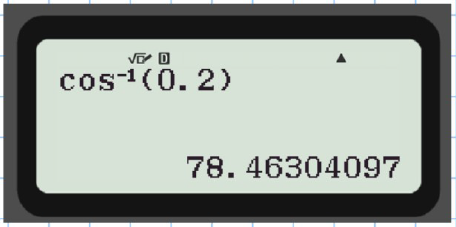
Steps to Solve Trigonometric Equations:
-
Sketch the relevant graph within the domain given to identify other solutions.
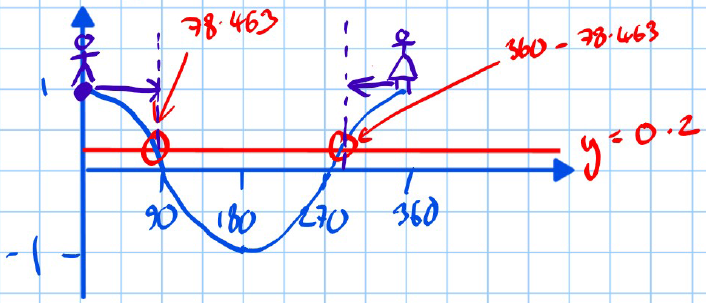
-
Conclude with all valid solutions:
Note
Example:
Solve , for :
-
Initial solution:
-
Note: The initial solution is invalid, but if the graph is extended, it can be used to find valid solutions.
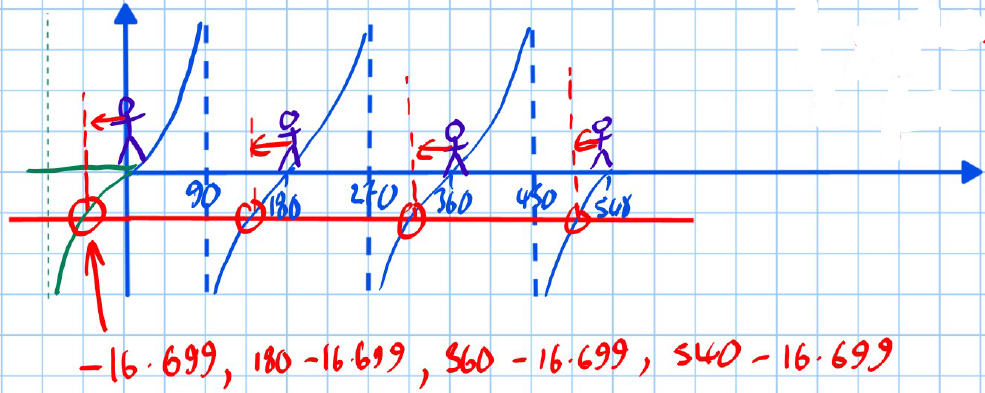
-
Mark the graph and use extensions to find solutions:
-
Solving Trig Equations Involving Compound Angles:
By "compound angle," we mean "an angle more complicated than just ."
- Example: Solve
- Notice we are solving for , but the angle is within the function.
- Method: 3. Modify the domain to find limits for the compound angle in the bracket. 4. Here,
- Solve within the modified domain.