Reciprocal Trig Functions - Definitions (AQA A-Level Mathematics): Revision Notes
📚Revision Notes
5.5.1 Reciprocal Trig Functions - Definitions
Reciprocal trigonometric functions are the reciprocals (or multiplicative inverses) of the basic trigonometric functions (sine, cosine, and tangent). These reciprocal functions are commonly used in trigonometry to simplify expressions and solve equations.
1. Definitions of the Reciprocal Trigonometric Functions:
- Cosecant
- Cosecant is the reciprocal of the sine function.
- It is undefined when (or multiples of radians).
- Secant
- Secant is the reciprocal of the cosine function.
- It is undefined when , which occurs at
- Cotangent (
- Cotangent is the reciprocal of the tangent function.
- It is undefined when , which occurs at (or multiples of radians).
2. Domains and Ranges:
- Cosecant ():
- Domain: All real numbers except , where is any integer.
- Range: is undefined between and , so the range is
- Secant ):
- Domain: All real numbers except , where is any integer.
- Range: is undefined between and , so the range is
- Cotangent ():
- Domain: All real numbers except , where is any integer.
- Range: All real numbers .
3. Graphs of Reciprocal Trigonometric Functions:
- Cosecant ():
- The graph of has vertical asymptotes at points where , because is undefined there.
- The graph consists of branches that approach these asymptotes and have minimum and maximum points corresponding to the peaks and troughs of the sine graph.
- Secant ():
- The graph of has vertical asymptotes at points where \cos \theta$$ = 0 , because is undefined there.
- The graph has branches that approach these asymptotes, with similar peaks and troughs corresponding to the cosine graph.
- Cotangent ():
- The graph of has vertical asymptotes where , corresponding to points where
- The graph decreases as increases, creating a series of repeating curves over each interval
4. Key Identities Involving Reciprocal Trigonometric Functions:
- Pythagorean Identity for Cosecant and Cotangent:
- Derived from dividing the basic Pythagorean identity by
- Pythagorean Identity for Secant and Tangent:
- Derived from dividing the basic Pythagorean identity by .
5. Example Problems Involving Reciprocal Trig Functions:
Note
Example 1: Simplify
- Solution: So, .
Note
Example 2: Solve .
- Solution: So, the solutions are
Summary:
Note
- Reciprocal trigonometric functions are the inverses of the basic sine, cosine, and tangent functions, and are used to simplify and solve trigonometric equations.
- Understanding the domains, ranges, and graphs of these functions is essential for working with them effectively.
- Key identities involving these functions can be used to manipulate and solve trigonometric expressions in a variety of contexts.
Further Reciprocal Trig Functions
Note
a. Given that , find the exact value of . b. Given that , find the exact value of .
c. Given that , find the possible values of , giving your answers in the form .
SOLUTION
a)
b)
c)
Note:
Derive relevant trig identities
Note
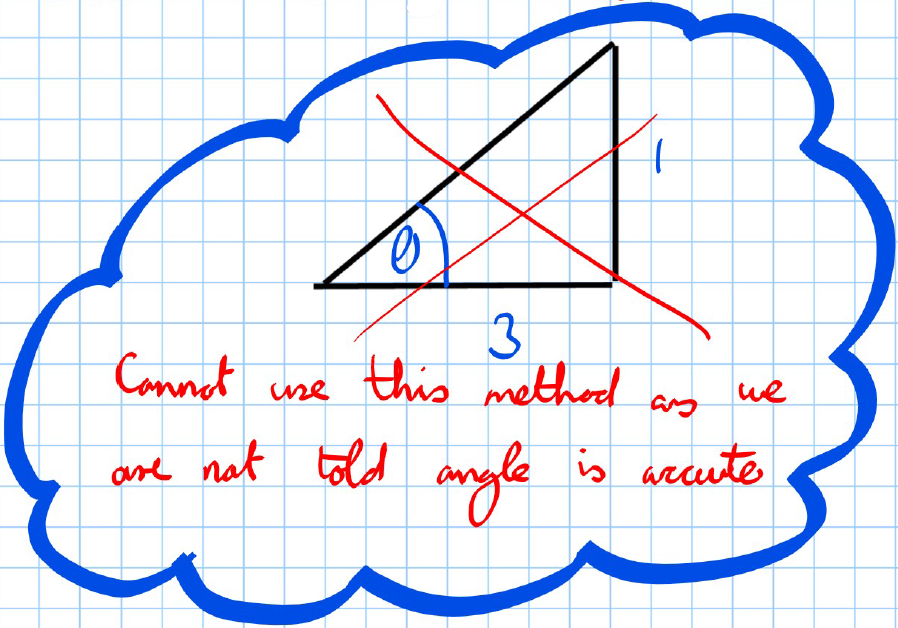
A diagram of a right-angled triangle is drawn, with:
- Hypotenuse labelled as ,
- Opposite side labelled as ,
- Adjacent side labelled as . However, a note states:
Cannot use this method as we are not told angle is acute.