The Binomial Distribution (AQA A-Level Mathematics): Revision Notes
📚Revision Notes
4.2.1 The Binomial Distribution
The binomial distribution describes a game with two outcomes, "win" or "lose." This game is to be played a fixed number of times irrespective of outcomes.
Notation
The above notation describes such a game played n times where the probability of success on each go is . refers to the number of wins obtained.
- : This is the probability of a win each time.
- : Number of trials.
- : Number of wins. (Has a binomial distribution)
Assumptions
- Trials are independent.
- Fixed probability of winning each time.
Note
Example: Consider a game in which a dice is rolled . Let be the number of "sixes" rolled in total.
- Consider to be the number of "sixes".
- We have .
Thus,
In the previous scenario, find the probability we roll exactly seven 6s in the twenty throws.
Explanation:
- Seven
- Seven wins
- Thirteen losses
- Number of different orders events can happen in
The Binomial Distribution
Note
Example: The random variable .
Questions:
Find:
a)
b)
c)
- Find Step 1: Use the Binomial Probability Formula
For a binomial distribution, the probability of getting r successes in n trials is given by:
Where:
- (the number of trials)
- (the probability of success on each trial)
- (the number of successes we want)
Step 2: Substitute the Values and Calculate the Result
Instructions for Calculator:
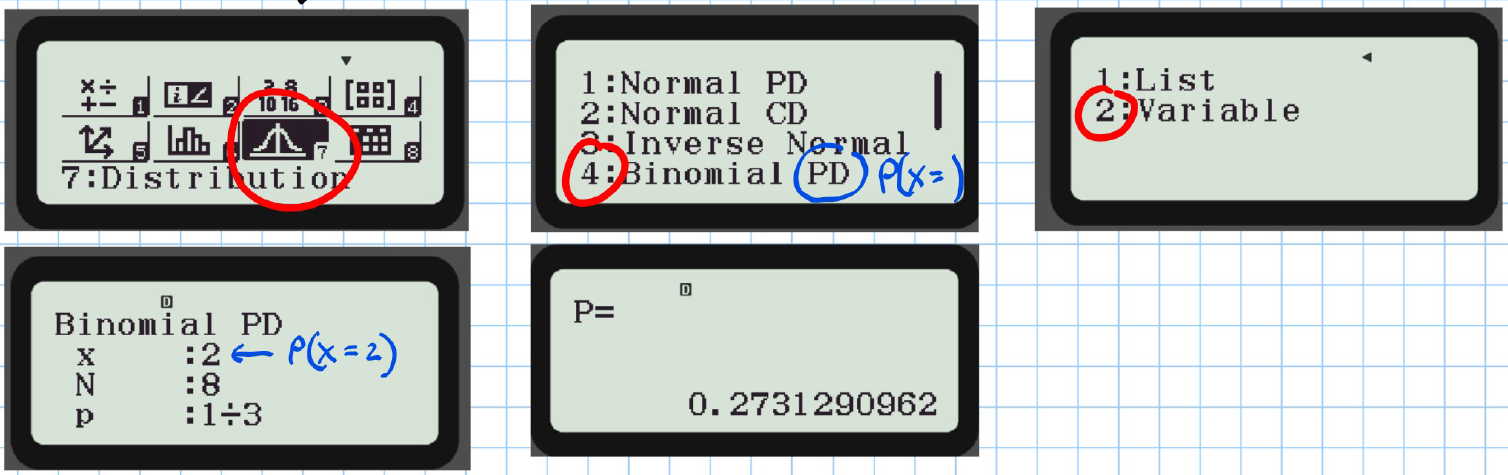
- Go to "" by pressing [] then [].
- Select [ ].
- Enter .
- Calculate .
b. Find
c. Find
Step 1: Understand the Question
We are asked to find the probability that X is less than or equal to 1.
This can be shown in this notation:
Step 2: Use the Binomial Formula for and
For
For
Step 3: Calculate the Result
Note
Example: The probability of a switch being faulty is . A random sample of switches is taken from the production line.
Questions:
a) Define a suitable distribution to model the number of faulty switches in this sample, and justify your choice.
b) Find the probability that the sample contains faulty switches.
a) Define a suitable distribution to model the number of faulty switches in this sample, and justify your choice.
Step 1: Identify the Distribution
We are asked to model the number of faulty switches in a random sample of switches, with the probability of any switch being faulty given as .
This is a binomial distribution because:
- There is a fixed number of trials ( switches)
- Each switch is either faulty or not faulty (a binary outcome)
- The probability of a switch being faulty is constant at
- The switches are independent of each other. Thus, the number of faulty switches X follows the binomial distribution:
Where:
- is the number of trials (switches)
- is the probability of success (faulty switch)
Step 2: Justify the Choice
- The trials (checking each switch) are independent because whether one switch is faulty does not affect the others.
- The probability of finding a faulty switch remains constant at for each switch.
b) Find the probability that the sample contains 4 faulty switches.
Step 1: Use the Binomial Formula
We need to calculate where
Where:
- (the number of switches)
- (the probability of a switch being faulty)
- (the number of faulty switches)
Step 2: Substitute the Values and Calculate the Result
Thus, the probability that the sample contains faulty switches is approximately or