Analogy between linear and rotational motion (AQA A-Level Physics): Revision Notes
📚Revision Notes
Analogy between linear and rotational motion
Introduction
There is a systematic relationship between linear motion and rotational motion in physics. Each quantity in linear motion has a corresponding quantity in rotational motion, and the mathematical relationships between these quantities follow similar patterns. Understanding these correspondences allows you to apply familiar concepts from linear motion to solve problems involving rotational motion.
Note
The beauty of this analogy is that once you master linear motion, you already understand the fundamental principles of rotational motion—you just need to identify the corresponding quantities and apply the same mathematical patterns.
Corresponding quantities
Mass and moment of inertia
In linear motion, mass () represents the property of an object that resists changes in its linear velocity. In rotational motion, the corresponding property is moment of inertia (), measured in kg m⁻². Moment of inertia represents an object's resistance to changes in its rotational motion and depends not only on the mass but also on how that mass is distributed relative to the axis of rotation.
Important
Unlike mass, which is a fixed property of an object, moment of inertia varies depending on the axis of rotation. The same object can have different moments of inertia about different axes.
Velocity and angular velocity
Linear velocity is defined as the rate of change of displacement with respect to time:
The rotational equivalent is angular velocity (), defined as the rate of change of angular displacement with respect to time:
Angular velocity is measured in rad s⁻¹ and describes how quickly an object rotates about an axis.
Acceleration and angular acceleration
Linear acceleration is the rate of change of velocity with respect to time:
Similarly, angular acceleration () is the rate of change of angular velocity with respect to time:
Angular acceleration is measured in rad s⁻² and describes how quickly the rotational speed changes.
Displacement and angular displacement
Linear displacement () measures the distance moved in a straight line. The rotational analogue is angular displacement (), measured in radians, which describes the angle through which an object has rotated about an axis.
Kinetic energy
The translational kinetic energy of an object moving in a straight line is given by:
For rotational motion, the rotational kinetic energy is:
Important
Notice the identical mathematical structure! This equation has the same form as the linear version, with replacing and replacing . This pattern repeats throughout all corresponding equations.
Momentum and angular momentum
Linear momentum is the product of mass and velocity:
Angular momentum () is the rotational equivalent, measured in N m s:
Angular momentum represents the quantity of rotational motion possessed by an object.
Force and torque
In linear motion, force causes acceleration according to Newton's second law:
Force can also be expressed as the rate of change of momentum:
In rotational motion, the equivalent of force is torque (or turning moment), denoted by and measured in N m. Torque is defined as:
where is the perpendicular distance from the axis of rotation to the line of action of the force.
Note
Torque can also be expressed in forms analogous to the force equations:
These equations show that torque causes angular acceleration and represents the rate of change of angular momentum, just as force causes linear acceleration and represents the rate of change of linear momentum.
Work done
The work done by a force moving an object through a linear displacement is:
For rotational motion, work done by a torque rotating an object through an angular displacement is:
Both expressions have units of joules (J).
Power
Power in linear motion is the rate of doing work, which can be expressed as:
In rotational motion, power is given by:
Both are measured in watts (W).
Impulse and angular impulse
Impulse in linear motion is the product of force and time:
Impulse equals the change in linear momentum:
In rotational motion, angular impulse is the product of torque and time:
Angular impulse equals the change in angular momentum:
Angular impulse is measured in N m s.
Understanding the pattern
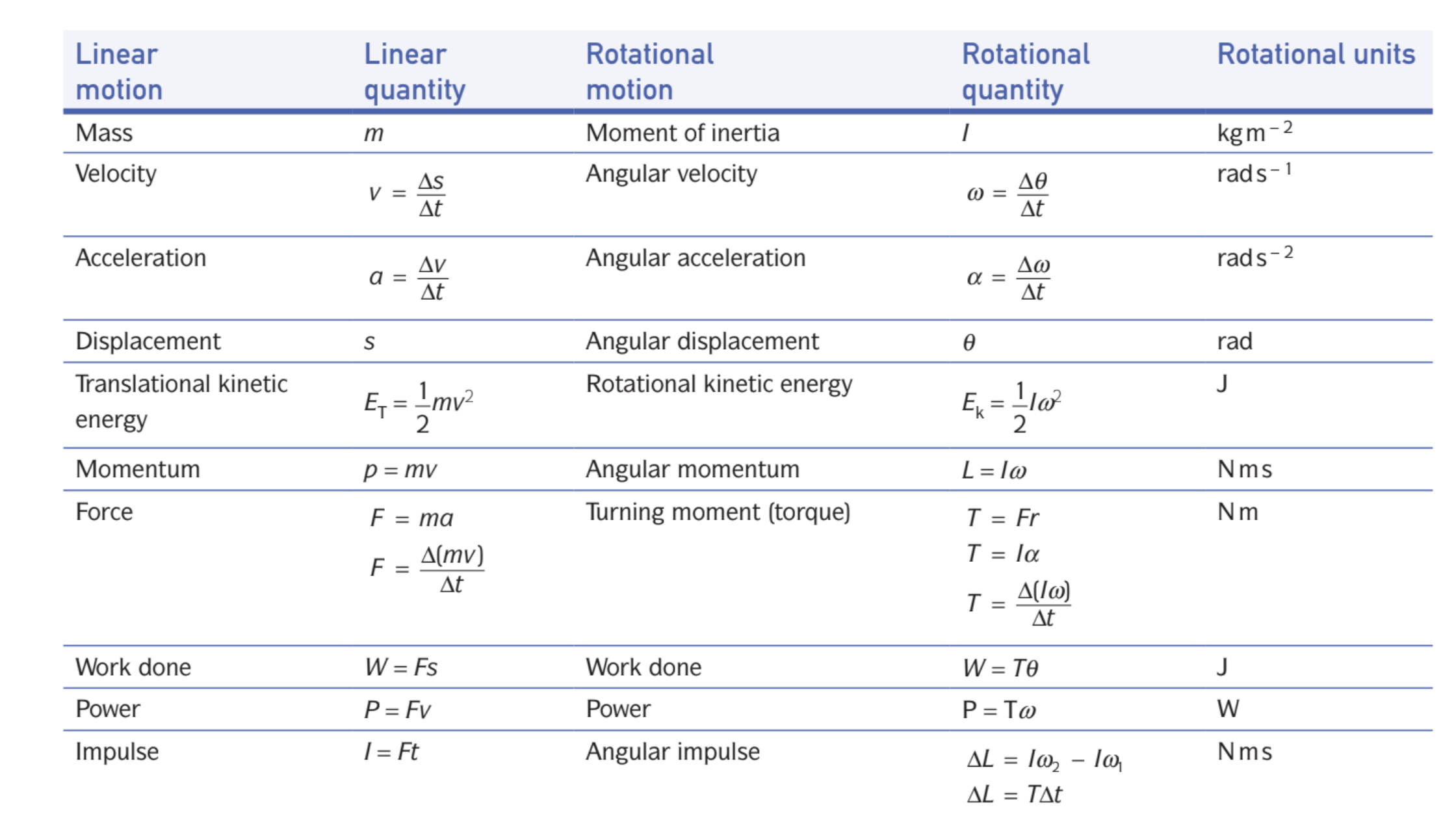
The correspondences between linear and rotational quantities follow a consistent pattern.
Note
Substitution Rules for Converting Linear to Rotational Equations:
When converting from linear to rotational equations, apply these systematic replacements:
- Replace mass () with moment of inertia ()
- Replace linear velocity () with angular velocity ()
- Replace linear acceleration () with angular acceleration ()
- Replace linear displacement () with angular displacement ()
- Replace force () with torque ()
The mathematical structure of the equations remains the same, making it easier to work with rotational motion once you understand linear motion.
Summary
Summary
Key Points to Remember:
- Every quantity in linear motion has a corresponding quantity in rotational motion
- Moment of inertia () plays the same role in rotational motion as mass () does in linear motion
- Angular velocity (), angular acceleration (), and angular displacement () are the rotational equivalents of , , and
- Torque () is the rotational equivalent of force and causes angular acceleration
- All equations for energy, momentum, work, and power have rotational forms following the same mathematical patterns
- The units for rotational quantities follow logically from the linear units: rad s⁻¹ for angular velocity, rad s⁻² for angular acceleration, and N m for torque