Mathematics of circular motion (AQA A-Level Physics): Revision Notes
📚Revision Notes
Mathematics of circular motion
Introduction to circular motion
When studying rotational dynamics, we begin by examining how a single particle moves in a circular path. This forms the foundation for understanding more complex rotating systems. A particle moving in a circle has both angular and linear characteristics that we need to describe mathematically.
Note
Understanding circular motion of individual particles is essential before progressing to the rotation of extended objects and rigid bodies. The concepts developed here—angular velocity, tangential velocity, and angular acceleration—apply to all rotational systems.
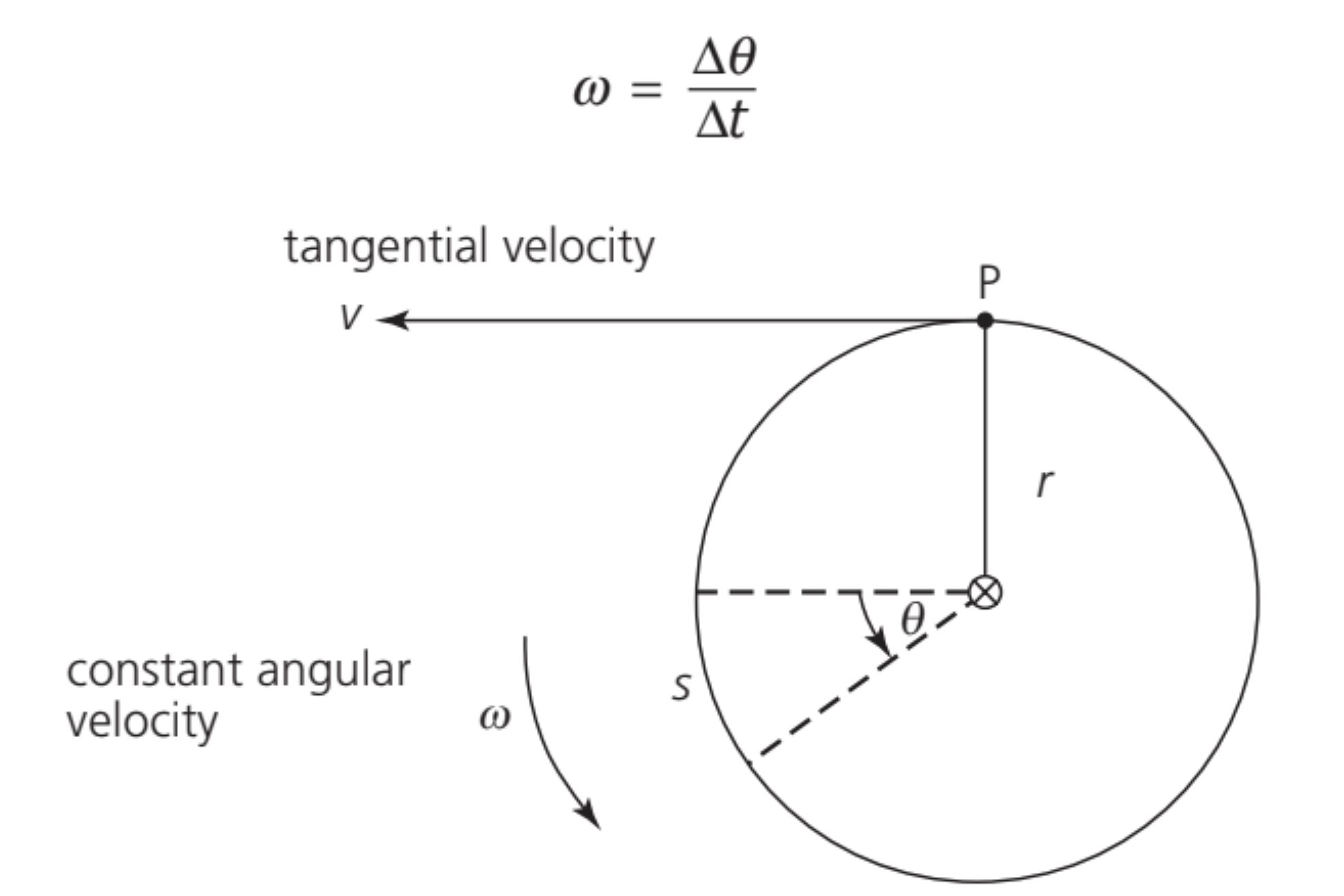
Angular velocity and angular displacement
Defining angular velocity
When a particle moves along a circular path, its position can be described by an angular displacement (), which represents the angle through which the radius has rotated from a reference position. This angle must be measured in radians for the equations of rotational motion to work correctly.
Angular velocity () describes how quickly an object rotates. It is defined as the rate of change of angular displacement with respect to time:
where:
- is the angular velocity
- is the change in angular displacement (in radians)
- is the time interval
Angular velocity is measured in rad s⁻¹ (radians per second).
Understanding radians
Important
A radian is the angle at the centre of a circle when the arc length is equal to the radius. This is a fundamental definition that makes radians the natural unit for angular measurements in physics and mathematics.
Mathematically, this gives us the relationship:
where is the arc length, is the radius, and is the angle in radians.
Since the circumference of a complete circle is , there are radians in a full circle. This means:
This conversion is essential when working between degrees and radians.
Revolutions and conversions
In rotational dynamics, particularly when dealing with engines and rotating machinery, angular velocity is often expressed in revolutions per minute (rpm) rather than radians per second. One revolution (rev) is equivalent to one complete rotation of radians.
To convert from rpm to rad s⁻¹, we need to:
- Convert revolutions to radians by multiplying by
- Convert minutes to seconds by dividing by 60
Therefore:
Period of rotation
The period of rotation () is the time taken for one complete revolution. It is related to angular velocity by:
Note
This relationship shows that a higher angular velocity corresponds to a shorter period, which makes physical sense—if something spins faster, it completes each rotation in less time. The period and angular velocity are inversely proportional to each other.
Worked example: converting angular velocity
Example
Worked Example: Converting Angular Velocity
Let's convert an angular velocity of 100 rpm to radians per second and find the period of rotation.
Step 1: Convert rpm to rad s⁻¹
Step 2: Calculate the period
Therefore, 100 rpm equals 10.5 rad s⁻¹, and the period of rotation is 0.60 seconds.
Tangential velocity
Understanding tangential velocity
A particle moving in a circular path has a linear velocity at any instant, which is directed along the tangent to the circle at that point. This is called the tangential velocity (). Although the particle follows a curved path, at any given moment, its instantaneous velocity is in a straight line tangent to the circle.
The tangential velocity is directly related to the angular velocity by:
where:
- is the tangential velocity
- is the radius of the circular path
- is the angular velocity
Physical interpretation
Note
This relationship reveals an important principle: for a given angular velocity, the tangential velocity increases with distance from the centre of rotation. Points further from the axis move faster in terms of linear speed, even though all points on a rigid rotating object have the same angular velocity.
You can observe this by spinning a disc on a pencil and marking dots along a radius. The dots further from the centre travel faster and cover more distance in the same time period, even though they all complete one rotation together.
Units in the relationship
The units in the equation must be consistent. If the radius is measured in metres (m), then:
- Angular velocity must be in rad s⁻¹
- Tangential velocity will be in m s⁻¹
If the radius is measured in centimetres (cm), then the tangential velocity will be in cm s⁻¹, provided remains in rad s⁻¹.
Angular acceleration
Defining angular acceleration
Angular acceleration () occurs when a rotating object changes its rate of rotation—either speeding up or slowing down. It is defined as the rate of change of angular velocity:
where:
- is the angular acceleration
- is the change in angular velocity
- is the time interval
Angular acceleration is measured in rad s⁻² (radians per second squared).
Distinguishing angular acceleration from centripetal acceleration
Important
Critical Distinction: Angular vs. Centripetal Acceleration
It is important not to confuse angular acceleration with centripetal acceleration, as they describe entirely different aspects of circular motion:
Centripetal acceleration is present in all circular motion, even when angular velocity is constant. It arises because the direction of the velocity vector continuously changes as the particle moves around the circle. This acceleration is:
- Always directed towards the centre of the circle
- Measured in m s⁻² (it is a linear acceleration)
- Present even in uniform circular motion
- Example: gravitational acceleration keeping a satellite in orbit
Angular acceleration, on the other hand, only occurs when the angular velocity itself is changing—when the object is speeding up or slowing down its rotation. It is:
- Measured in rad s⁻²
- Describes rotational behaviour rather than linear motion
- Zero in uniform circular motion
Tangential acceleration
When angular acceleration occurs, there must be a corresponding change in tangential velocity, since and is changing. This gives rise to a tangential acceleration (), which acts along the direction of motion (tangent to the circle).
The relationship between tangential acceleration and angular acceleration is:
where:
- is the tangential acceleration
- is the radius
- is the angular acceleration
As with the earlier relationships, the units must be consistent. If is in metres, then:
- Angular acceleration must be in rad s⁻²
- Tangential acceleration will be in m s⁻²
This tangential acceleration represents the rate of change of the tangential velocity—the particle is speeding up or slowing down along its circular path.
Summary
Key Points to Remember:
-
Angular velocity () describes how fast something rotates, measured in rad s⁻¹. Remember that radians = 360° = 1 revolution.
-
Tangential velocity () is the linear speed of a particle on a circular path. It increases with distance from the centre—points further out move faster for the same angular velocity.
-
Period of rotation () is inversely related to angular velocity—faster rotation means shorter period.
-
Angular acceleration () describes changing rotation rate, measured in rad s⁻². Don't confuse this with centripetal acceleration, which is present even in uniform circular motion.
-
Tangential acceleration () accompanies angular acceleration and represents the changing speed along the circular path.