Second law and engines (AQA A-Level Physics): Revision Notes
📚Revision Notes
11.2.5 Second Law and Engines
Second Law of Thermodynamics
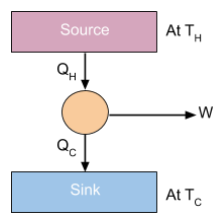
The second law of thermodynamics states that a heat engine must operate between a source and a sink to function. This implies that:
- The engine receives heat from a high-temperature source.
- The engine does work (W) as part of its operation.
- A portion of the heat energy is inevitably lost to a sink at a lower temperature. In other words, some energy must be transferred to the sink and cannot be used to perform work, which makes it impossible for the engine to achieve 100% efficiency. For example, if the engine and source reached the same temperature, heat transfer would stop, and the engine would cease to do work.
Efficiency of Heat Engines
The efficiency of a heat engine can be calculated as:
where:
- : Heat energy absorbed from the source.
- : Heat energy lost to the sink.
- : Work output. The maximum theoretical efficiency (for an ideal engine using an ideal gas) is determined by the temperatures of the source and sink (:
where:
-
and must be in Kelvin. To maximise engine efficiency:
-
Source temperature ( should be as high as possible.
-
Sink temperature should be as low as possible, ideally reaching absolute zero (0 K) for perfect efficiency, although this is unachievable in practical systems.
Real Engine Efficiency Limitations
Real engines cannot achieve the theoretical maximum efficiency for several reasons:
- Frictional forces within the engine consume some energy.
- Incomplete combustion of fuel leads to less effective heating.
- Internal components (e.g., pumps, motors) require energy to operate.
Enhancing Efficiency in Practical Systems
Despite the limitations, there are practical approaches to optimise energy use:
- Combined Heat and Power (CHP) Schemes:
- These systems capture and use waste heat (e.g., from power plants) to heat nearby buildings. This approach is efficient when facilities are close to populated areas, although distance limits practical application in the UK.
- Regenerative Braking:
- In vehicles, braking energy (usually lost as heat) is stored, for example, in a flywheel. This stored energy can later be used to accelerate the vehicle, thereby conserving energy that would otherwise dissipate.