Particle interactions (AQA A-Level Physics): Revision Notes
📚Revision Notes
2.1.4 Particle interactions
The Four Fundamental Forces
In particle physics, there are four fundamental forces that govern interactions between particles. Each of these forces is associated with a unique type of exchange particle that transmits the force between interacting particles:
- Gravity:
- Acts on all particles with mass.
- Has an infinite range.
- The exchange particle is hypothesised to be the graviton (not yet experimentally confirmed).
- Electromagnetic Force:
- Acts on charged particles.
- Also has an infinite range.
- Mediated by the virtual photon ().
- Weak Nuclear Force:
- Acts on all particles.
- Has a very short range of about 10^{-18} m.
- The exchange particles are the W bosons .
- Strong Nuclear Force:
- Acts only on hadrons (particles made of quarks, such as protons and neutrons).
- Has a range of approximately 3 × 10^{-15} m.
- The exchange particle is the gluon.
Note
These exchange particles transfer energy and momentum between the interacting particles. A helpful analogy is to imagine two people on skateboards throwing a ball back and forth. Each throw represents an exchange of momentum that pushes each person backwards, mimicking the repulsive effect. If we imagine using a boomerang instead, this would simulate an attractive force, as it returns to the thrower.
Weak Nuclear Force and Particle Decays
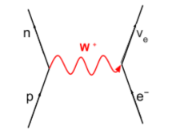
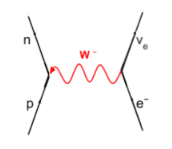
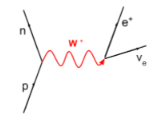
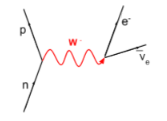
The weak nuclear force is responsible for certain types of particle decay processes, such as beta decay, as well as interactions like electron capture and electron-proton collisions. These interactions can be visualised using Feynman diagrams, which help illustrate the role of the exchange particles.
- Electron Capture:
- Electron capture occurs when a proton in the nucleus captures an electron from an orbital, converting into a neutron.
- This interaction is mediated by a boson. Equation:
Feynman Diagram Explanation: In the Feynman diagram, the proton captures an electron, emitting a boson, which subsequently decays into an electron neutrino .
- Electron-Proton Collision:
- In this process, an electron collides with a proton to produce a neutron and an electron neutrino.
- The boson acts as the exchange particle. Equation:
Feynman Diagram Explanation: Here, the proton and electron interact, and a boson is exchanged. This boson decays into a neutron and an electron neutrino .
- Beta Decay:
- Beta-plus decay: A proton converts into a neutron, emitting a positron and an electron neutrino . Equation:
Feynman Diagram: The proton emits a boson, which decays into a positron and an electron neutrino.
- Beta-minus decay: A neutron converts into a proton, emitting an electron and an antineutrino . Equation:
Feynman Diagram: The neutron emits a boson, which then decays into an electron and an electron antineutrino.
Note
Key Points
- Exchange Particles: Mediate fundamental forces and transfer energy and momentum.
- Feynman Diagrams: Useful visual representations of particle interactions, showing exchange particles and resultant products.
- Weak Nuclear Force: Responsible for beta decay, electron capture, and electron-proton collisions, with interactions mediated by bosons.