Classification of particles (AQA A-Level Physics): Revision Notes
📚Revision Notes
2.1.5 Classification of particles
Overview of Particle Types
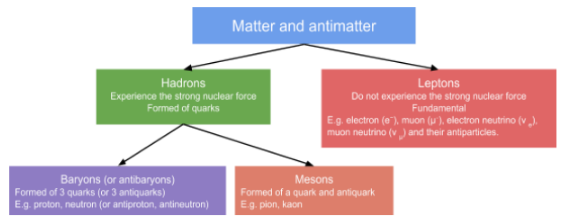
In particle physics, all particles are classified as either hadrons or leptons:
- Leptons:
- Fundamental Particles: Leptons cannot be broken down into smaller components, meaning they are truly fundamental.
- Do Not Experience the Strong Nuclear Force: Unlike hadrons, leptons are unaffected by the strong nuclear force.
- Examples: Electrons , muons , electron neutrinos , and muon neutrinos , along with their corresponding antiparticles.
- Hadrons:
- Made of Quarks: Hadrons are composite particles, formed from quarks.
- Experience the Strong Nuclear Force: Hadrons interact via the strong nuclear force, which holds them together.
- Subcategories of Hadrons:
- Baryons: Composed of three quarks (e.g., protons and neutrons).
- Antibaryons: Composed of three antiquarks (e.g., antiprotons).
- Mesons: Composed of a quark and an antiquark (e.g., pions and kaons).
Properties and Conservation Laws
- Baryon Number:
- Definition: A quantum number used to distinguish baryons, antibaryons, and non-baryonic particles.
- Baryons have a baryon number of .
- Antibaryons have a baryon number of .
- Non-baryonic particles have a baryon number of .
- Conservation: In particle interactions, the total baryon number is always conserved.
- Proton Stability: The proton is the only stable baryon; all other baryons eventually decay into protons either directly or through intermediate particles.
- Lepton Number:
- Definition: Similar to the baryon number, this quantum number distinguishes leptons and antileptons.
- Leptons have a lepton number of .
- Antileptons have a lepton number of .
- Non-leptonic particles have a lepton number of .
- Types of Lepton Numbers: There are two types of lepton numbers that must be conserved separately:
- Electron Lepton Number (e.g., electrons and electron neutrinos).
- Muon Lepton Number (e.g., muons and muon neutrinos).
- Conservation: Lepton numbers are conserved in all particle interactions. For instance, if an electron neutrino is involved in an interaction, the electron lepton number before and after the interaction must be the same.
Example
Example: The muon is a heavier cousin of the electron and is sometimes called a "heavy electron". Muons decay into electrons, conserving lepton number in the process.
Strange Particles and Strangeness
- Strange Particles:
- These particles are produced through the strong interaction but decay via the weak interaction.
- Examples include kaons, which decay into pions through weak interaction processes.
- Strangeness:
- Definition: Strangeness is a property that determines whether particles are strange particles.
- Conservation: Strangeness is conserved in strong interactions, meaning that strange particles must be created in pairs. However, in weak interactions, strangeness can change by , , or .
Scientific Research in Particle Physics
The study of particle interactions often requires particle accelerators, which are large and expensive facilities capable of colliding particles at extremely high speeds. These experiments generate massive amounts of data and require international collaboration due to their complexity and scale. This cooperation allows scientists worldwide to advance their understanding of particle physics and share in the discovery process.
Note
Key Points
- Leptons: Fundamental particles not affected by the strong nuclear force.
- Hadrons: Made of quarks and divided into baryons, antibaryons, and mesons.
- Conservation Laws: Both baryon number and lepton number are conserved in particle interactions.
- Strangeness: A property of strange particles that is conserved in strong interactions but can change in weak interactions.
- Particle Accelerators: Essential tools in particle physics that rely on international collaboration for construction, operation, and data analysis.