Applications of conservation laws (AQA A-Level Physics): Revision Notes
📚Revision Notes
2.1.7 Applications of Conservation Laws
Key Conservation Laws in Particle Physics
In all particle interactions, certain conservation laws must be upheld to ensure that the reaction is physically possible. The quantities that must always be conserved include:
- Energy and Momentum
- Charge
- Baryon Number
- Electron Lepton Number
- Muon Lepton Number Strangeness must also be conserved, but only in strong interactions. It does not need to be conserved in weak interactions (like beta decay).
Applying Conservation Laws in Interactions
To verify whether a given particle interaction obeys the conservation laws, we can evaluate each property before and after the interaction and ensure they match.
Example
Example: Beta-minus Decay
In this example, a neutron () decays into a proton (), electron , and an electron antineutrino . Since beta decay is a weak interaction, we do not need to conserve strangeness. The table below summarises the properties before and after the interaction:
| Property | Before Interaction | After Interaction | Change |
|---|---|---|---|
| Charge | |||
| Baryon Number | |||
| Electron Lepton Number | |||
| Muon Lepton Number | |||
| Strangeness |
Since all values are conserved, this interaction is allowed.
Beta Decay and Quark Changes
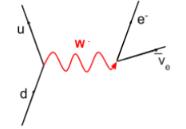
Beta-minus and beta-plus decay are both caused by the weak interaction, which allows for a change in quark type. This process can be visualised with Feynman diagrams:
- Beta-minus Decay:
- Process: A down quark () in a neutron changes into an up quark (), converting the neutron into a proton.
- Diagram: A boson is emitted, which then decays into an electron and an electron antineutrino .
- Beta-plus Decay:
- Process: An up quark () in a proton changes into a down quark (), converting the proton into a neutron.
- Diagram: A boson is emitted, which then decays into a positron and an electron neutrino .
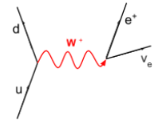
These diagrams help illustrate how a change in quark type leads to the transformation of particles in weak interactions.
Note
Key Points
- Conservation Laws: All particle interactions must conserve energy, momentum, charge, baryon number, and lepton numbers.
- Weak Interactions: Strangeness is not conserved in weak interactions, but it must be conserved in strong interactions.
- Beta Decay: Involves a change in quark type and can be represented with Feynman diagrams showing the exchange of bosons.