Force, energy and momentum (AQA A-Level Physics): Revision Notes
📚Revision Notes
4.1.8 Conservation of Energy
Principle of Conservation of Energy
The conservation of energy principle states that energy cannot be created or destroyed, only transferred from one form to another. In a closed system (where no energy enters or leaves), the total energy remains constant.
Mathematically:
This principle is useful for solving problems involving gravitational potential energy and kinetic energy .
Formulas for Energy:
- Gravitational Potential Energy (GPE):
Where:
- m = mass of the object ()
- g = gravitational field strength (9.81 m/s²)
- = change in height ()
- Kinetic Energy ():
Where:
- = mass of the object ()
- = velocity of the object ()
Note
Example Walkthrough:
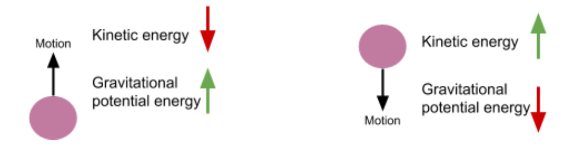
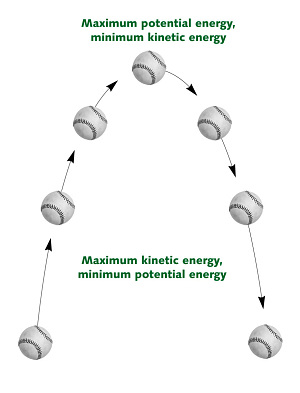
Imagine a ball being thrown into the air. Initially, the kinetic energy given by the thrower propels the ball upward. As it rises, kinetic energy is gradually transferred to gravitational potential energy as the ball gains height. Eventually, at the ball's highest point, all kinetic energy is converted into potential energy, momentarily making its velocity zero.
Then, as the ball starts to fall back down, gravitational potential energy is converted back into kinetic energy. When it reaches the ground, most of this energy will have been converted back to kinetic energy (ignoring air resistance).
Important
Important note: Resistive forces, such as air resistance, will cause some energy to transfer to the surroundings as heat. Thus, not all initial kinetic energy will convert into gravitational potential energy.
Note
Example Problem: Pendulum Motion
Consider a simple pendulum of mass 500 g (0.5 kg), which rises to a height of 10 cm (0.1 m) above its equilibrium point. We're asked to find the maximum speed it achieves as it swings back down.
- Calculate Maximum Gravitational Potential Energy (GPE):
- Equate GPE to Kinetic Energy (KE): Since energy is conserved, the potential energy at the top will equal the kinetic energy at the bottom (ignoring air resistance). Set :
Rearrange to solve for :
Maximum Speed = 1.4 m/s