Scalars and vectors (AQA A-Level Physics): Revision Notes
📚Revision Notes
4.1.1 Scalars and vectors
In physics, quantities can be classified as scalars or vectors:
- Scalars have only magnitude (size) and no direction. Examples include distance, speed, mass, and temperature.
- Vectors have both magnitude and direction. Examples include displacement, velocity, force (or weight), and acceleration.
Adding Vectors
There are two main methods to add vectors, depending on their orientation:
- Calculation Method (for Perpendicular Vectors):
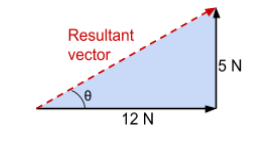
- When vectors are perpendicular to each other, you can use Pythagoras' theorem to find the resultant vector's magnitude and trigonometry to determine its direction.
Example
Example:
- Two forces of and act perpendicular to each other. To find the resultant force :
- To find the angle from the horizontal:
- Resultant Direction: from the horizontal.
- Scale Drawing (for Non-Perpendicular Vectors):
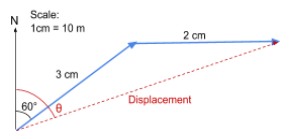
- For vectors at arbitrary angles, use a scale diagram. Draw each vector to scale, using a ruler and protractor, then measure the resultant vector's magnitude and direction.
Example
Example:
- A ship travels m at a bearing of , then m east.
- Draw a scale diagram.
- Measure the resultant displacement's magnitude and angle.
Resolving Vectors
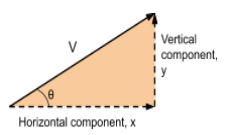
The process of breaking a vector into its horizontal and vertical components is called resolving. This is useful for analysing forces in different directions.
For a vector at an angle :
- Horizontal Component:
- Vertical Component: Tip: If moving through the angle to reach the component, use cos. If moving away from the angle, use sin.
Example
Example:
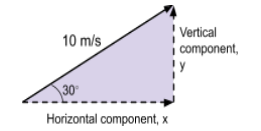
- A ball is projected at at :
Example
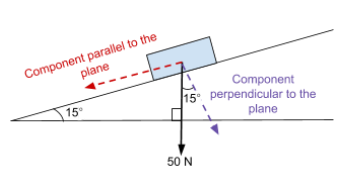
Example: Resolving Forces on an Inclined Plane For an object on a slope inclined at :
- If the object has a weight of N:
- Component parallel to the plane:
- Component perpendicular to the plane:
Equilibrium and Vector Triangles
An object is in equilibrium if the sum of all forces acting on it is zero, meaning it has no resultant force and remains at rest or in uniform motion (Newton's First Law).
To show equilibrium:
- Add horizontal and vertical components of forces to check if they balance.
- For three forces, draw a scale triangle: if it forms a closed triangle, the object is in equilibrium.
Note
Key Points
- Scalars vs. Vectors: Scalars have magnitude only; vectors have both magnitude and direction.
- Adding Vectors:
- Use Pythagoras and trigonometry for perpendicular vectors.
- Use a scale diagram for non-perpendicular vectors.
- Resolving Vectors: Break vectors into horizontal and vertical components using trigonometry.
- Equilibrium: Occurs when forces balance, shown by a closed triangle or zero net components.