Momentum (AQA A-Level Physics): Revision Notes
📚Revision Notes
4.1.6 Momentum
Momentum is the product of an object's mass and its velocity. It is given by the formula:
Momentum is always conserved in any interaction where no external forces are present. This principle is known as the Conservation of Momentum, which states that the total momentum before an event (such as a collision) is equal to the total momentum after the event.
Worked Example – Conservation of Momentum
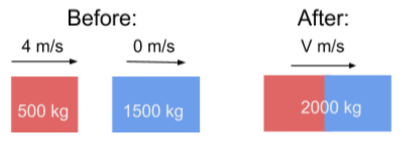
A car of mass 500 kg, moving at 4 m/s, collides with a stationary truck of mass 1500 kg. They join together and move with a combined velocity . Find .
- Calculate the total momentum before the collision:
- Apply conservation of momentum:
Thus, the combined velocity after the collision is 1 m/s.
Impulse
Newton's 2nd law can be rephrased to show that force is the rate of change of momentum. Given by:
Rearranging, we get:
Where:
- is known as impulse.
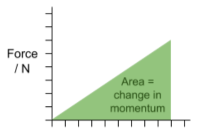
- Impulse represents the change in momentum over a specific period of time. The area under a force-time graph is also equal to the change in momentum.
Note
Example – Calculating Impulse
A baseball bat hits a ball with a force of 100 N over an impact time of 0.5 s. Find the change in momentum of the ball.
- Using the impulse formula:
Therefore, the change in momentum is 50 kg m/s.
Applications of Impulse in Safety
Impulse calculations are essential in designing safety features like crumple zones, seat belts, and airbags in cars. These features increase the impact time, which reduces the force experienced by passengers, decreasing the risk of injury.
Types of Collisions
- Elastic Collisions
- Both momentum and kinetic energy are conserved.
- Inelastic Collisions
- Only momentum is conserved. Some kinetic energy is transformed into other forms (e.g., heat, sound).
- If objects stick together after collision, it is classified as an inelastic collision.
Note
An explosion is also considered an inelastic collision because the kinetic energy after the explosion is greater than before.