Young modulus (AQA A-Level Physics): Revision Notes
📚Revision Notes
4.2.2 Young modulus
Note
Definition of Young Modulus
- The Young modulus (E) quantifies the stiffness of a material. It is a measure of a material's resistance to deformation under stress.
- For materials that obey Hooke's law (up to the limit of proportionality), stress is directly proportional to strain. This constant ratio of stress to strain is what defines the Young modulus.
Formula for Young Modulus
- The Young modulus can be defined as:
- Breaking down this relationship:
- Tensile Stress: The force per unit cross-sectional area applied to stretch or compress the material.
- Tensile Strain: The ratio of the extension of the material to its original length.
- Using formulas from stress and strain:
Where:
- = applied force (),
- = original length (),
- = cross-sectional area (),
- = extension ().
Finding Young Modulus from a Stress-Strain Graph
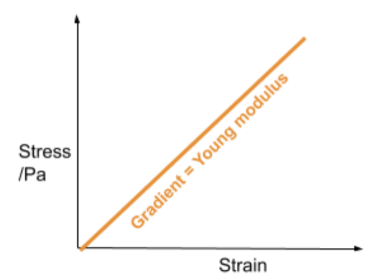
- On a stress-strain graph, the gradient of the straight-line portion (where Hooke's law is obeyed) represents the Young modulus.
- Gradient = Young modulus
- This part of the graph typically shows a linear relationship between stress and strain, indicating the material's proportionality limit.
Note
Example Calculation of Young Modulus
Suppose we have a material with the following data:
Force applied () = N,
Original length () = m,
Cross-sectional area () = ,
Extension () = .
To find the Young modulus ():
- Substitute the values into the formula:
- Calculate each part:
- Numerator:
- Denominator:
- Divide:
So, the Young modulus of the material is MPa (megapascals).
Importance of Young Modulus
- Young modulus helps in assessing whether a material is suitable for specific structural applications where resistance to deformation is crucial.
- A high Young modulus indicates a stiff material that does not easily deform, like steel.
- A low Young modulus suggests a flexible material, such as rubber.