Current-voltage characteristics (AQA A-Level Physics): Revision Notes
📚Revision Notes
5.1.2 Current-voltage characteristics
Ohm's Law
For an ohmic conductor, the current is directly proportional to the potential difference across it, provided that all physical conditions (such as temperature) remain constant. This relationship means that the resistance of an ohmic conductor is constant.
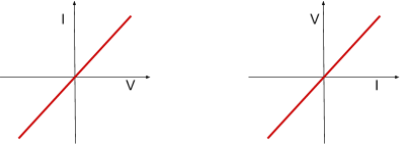
In understanding current-voltage () characteristics, it's essential to be able to interpret the graphs of various components, which depict either current or voltage on the y-axis. Different components have unique characteristics that can be identified through these graphs:
- Ohmic Conductor:
- This component follows Ohm's law.
- Its graph is a straight line passing through the origin, showing that current and voltage are proportional.
- Examples include resistors at a constant temperature.
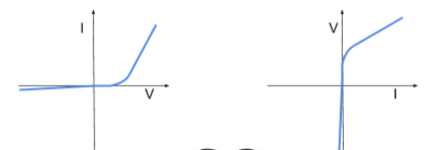
- Semiconductor Diode:
- A diode has two distinct regions: forward bias and reverse bias.
- In forward bias (positive voltage), the diode allows current to flow after a certain threshold voltage is reached (the minimum voltage needed for current to flow).
- In reverse bias (negative voltage), the diode has very high resistance, allowing minimal current to flow, shown by a flat line near the x-axis.
- This I-V graph is highly asymmetric, as current primarily flows in one direction.
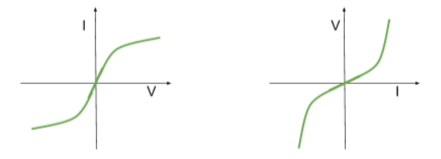
- Filament Lamp:
- A filament lamp's resistance increases as it heats up with higher current.
- At low currents, the filament's resistance is low, and the lamp obeys Ohm's law, resulting in a straight line through the origin.
- As current increases, the filament heats up, which increases resistance. This causes the graph to curve as voltage continues to rise but current increases at a slower rate.
Note
Key Points for Circuit Measurement:
- Ammeters are assumed to have zero resistance so they do not affect the circuit's current.
- Voltmeters are assumed to have infinite resistance to ensure that no current flows through them, allowing accurate measurement of potential difference across a component.
Note
Example for Understanding Diode Characteristics:
Imagine an graph with a semiconductor diode. When the voltage is positive (forwards bias), there's no current until the voltage reaches the threshold. After this point, current flows sharply upwards. When the voltage is negative (reverse bias), the current remains nearly zero regardless of the voltage. This difference in behaviour is due to the high resistance in reverse bias and lower resistance once the threshold is surpassed in forwards bias.