Determination of Young's Modulus (AQA A-Level Physics): Revision Notes
📚 Revision Notes
Determination of Young's Modulus
Equipment
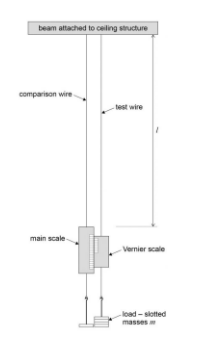
- Two steel wires ( m each): One for testing and one as a reference to control for effects such as sagging.
- Main scale and vernier scale: To measure the extension of the test wire accurately.
- kg masses and holders: Used to apply force incrementally to the test wire.
- Micrometer: To measure the diameter of the test wire for calculating the cross-sectional area.
- Metre ruler: For measuring the initial length of the test wire.
infoNote
Method
- Setup:
- Arrange the apparatus as shown in the diagram, with both the test wire and the reference wire attached to the beam.
- Measure the initial length of the test wire with the metre ruler.
- Apply Initial Load:
- Attach a 1 kg mass to both wires to make them taut, and record the initial reading on the scale for the test wire.
- Incremental Loading:
- Add an additional 1 kg mass to the test wire only. Record the new scale reading and calculate the extension by subtracting the initial reading.
- Repeat this process, adding 1 kg at a time up to around 8 kg, and measure the extension for each mass.
- Repeat for Accuracy:
- Repeat the experiment twice more for each mass to find the mean extension for each applied load .
- Measure Diameter:
- Measure the diameter of the test wire at several points along its length using the micrometre. Take the mean value to calculate the cross-sectional area .
Graphs and Calculations
- Calculate Cross-Sectional Area:
- Using the average diameter , calculate the cross-sectional area of the wire:
- Calculate Force:
- For each mass , calculate the force applied on the test wire by using , where g ≈ 9.81 m/s².
- Graph of Force vs. Extension:
- Plot a graph of force on the y-axis against extension on the x-axis.
- Draw a line of best fit. The gradient of this graph represents .
- Calculate Young Modulus :
- Use the formula for the Young modulus:
- Multiply the gradient by the initial length and divide by the cross-sectional area to determine .
infoNote
Safety
- Wire Tension: The wire will be stretched tightly and could snap, which could injure eyes or other parts of the body. Wear safety goggles during the experiment.
- Falling Weights: If the wire breaks, the weights may fall. Place a sand tray beneath the masses to cushion any potential impact.
Improvements and Notes
- Comparison Wire: The reference wire compensates for any sagging of the beam or thermal expansion. This ensures that only the test wire's extension is measured.
- Length Accuracy: Use a long test wire (1.5 m or more) to minimise errors in measuring small extensions and to reduce percentage uncertainty in length measurements.
infoNote
Key Concepts
- Young Modulus : A measure of stiffness, calculated as the ratio of stress (force per unit area) to strain (extension per unit length).
- Stress and Strain Relationship: Under small deformations, Hooke's Law applies, meaning stress is proportional to strain, and the constant of proportionality is .
- Graphical Analysis: The gradient of the force vs. extension graph provides a proportional relationship, allowing us to calculate for the material.