Origins, Beliefs, and Strands (AQA A-Level Politics): Revision Notes
📚Revision Notes
Origins, Beliefs, and Strands
Anarchism is a political ideology that fundamentally rejects the state and all forms of coercive authority. While anarchism encompasses many different traditions and approaches, all anarchists share a common belief that society can and should exist without the state, and that such a society would maximise individual freedom and choice.
Note
It's important to understand that anarchism does not mean chaos or disorder. In its original definition, anarchy simply means "without a ruler" and describes a society organised without a state. Anarchists believe that removing the state will actually create order, not destroy it.
Origins of anarchism
Anarchism emerged as a coherent political ideology in the late eighteenth century, drawing inspiration from growing individualism and demands for social progress. The ideology developed in direct response to several key catalysts:
- The emergence of the modern state and its claim to authority
- The rise of nationalism as an ideology
- The development of capitalism and the Industrial Revolution
- The oppressive power of the Church
Anarchism positioned itself in direct opposition to these forces, seeing them as sources of oppression that restricted human freedom and autonomy.
Key thinkers and the anarchist movement
The nineteenth century witnessed the emergence of anarchism's most influential thinkers:
Max Stirner (1806-56) developed an extreme form of individualism that rejected not only the state but also society itself and all forms of restriction on individual freedom. His approach was stark and uncompromising.
Pierre-Joseph Proudhon (1809-65) is often regarded as the founder of anarchism. He argued that only a society without government could bring peace, order and stability. This idea is captured in his famous phrase "Anarchy is order".
Mikhail Bakunin (1814-76) took Proudhon's ideas further, passionately advocating for revolution to overthrow capitalism, the state and the Church. He believed an ordered society could be built on the twin principles of freedom and solidarity.
Peter Kropotkin (1842-1921) attempted to ground anarchism in scientific principles, developing an approach based on the concept of mutual aid found in nature. His version of anarchism followed the principle "from each according to his ability, to each according to his needs".
Emma Goldman (1869-1940) sought to balance individualism with collective interests and introduced a critical feminist dimension to anarchist thought.
The autonomy of the individual
At the heart of anarchism lies the belief that individuals should govern themselves and refuse to be governed by others. Anarchists insist that people are fully capable of self-governance.
Important
The anarchist argument for autonomy follows a four-step process:
- In moral philosophy, individuals bear responsibility for their own actions
- This responsibility assumes that individuals are free to make their own choices about how to act
- Since individuals are rational beings, they should use reason to reflect on what they ought to do, thereby setting their own moral laws
- Therefore, individuals are free to act according to the moral laws they have decided for themselves
This reasoning makes freedom the central theme of anarchism. For anarchists, freedom means being free from restraint to do as one likes and to fulfil one's dreams and potential. Crucially, this freedom is only real when it is real for all people.
Different conceptions of freedom
Anarchist thinkers have debated the precise meaning of freedom, creating a spectrum from extreme individualism to collectivism:
Max Stirner represented the individualist extreme. He argued that each person is unique and egoistical (self-interested and self-reliant). For Stirner, there could be no restriction on freedom whatsoever. He stated: "Whether I am in the right or not there is no judge but myself." Stirner feared that individual freedom would be limited by social duty to the collective.
Pierre-Joseph Proudhon and Emma Goldman sought a middle ground between individual and collective interests. Proudhon feared the tyranny of the collective, while Goldman worried about the oppression of "uniformity". However, both believed that individuals naturally complement each other by working together to solve common problems.
Peter Kropotkin and Mikhail Bakunin endorsed the widest possible freedom but defined it differently from Stirner. They argued that individual freedom can only be achieved in the company of others. Bakunin stated that "the isolated individual cannot possibly become conscious of his freedom".
Note
This contrasts sharply with the liberal view. While liberals argue that the state is necessary to protect individual liberty, anarchists insist that freedom can only be achieved without the state.
Opposition to the state
Anarchists view the state as an artificial construct, separate from society, which acts as a tool of oppression and causes social conflict and unrest. They accept Max Weber's definition of the state as "a body which claims the monopoly over the legitimate use of force within a given territory".
Authority and command
The state claims authority – the right to command and the right to be obeyed. This command to obey the law restricts individual autonomy by stripping people of responsibility for their actions, thereby removing both their freedom and their rationality.
Power and coercion
The power of the state manifests in several ways:
- Visible power: laws, police, courts and the military
- Hidden power: ideology (particularly nationalism), education, work structures and even the concept of time itself
This power means the state's relationship with the individual is one of coercion – it forces individuals to comply, removing their ability to think for themselves and express their independent judgement. This led Stirner to declare: "I am free in no state."
The corrupting nature of power
Anarchists believe that power in any form is corrupting:
- Bakunin argued that power corrupts those who hold it, leading them to develop contempt for the masses and an inflated view of their own abilities
- Power also brutalises the masses, turning them into unthinking people who meekly accept their position and become anti-social, aggressive and competitive in fighting for scraps from the table of the rich and powerful
Rejection of all forms of state
Anarchists reject the state in all its forms. They argue against:
Liberal democracy: The social contract does not exist. No state can legitimately have power over anyone who rejects the contract, and it's illogical to expect individuals to consent to every single law. Government by consent (through elections) is nonsense – if people were truly sovereign, they wouldn't hand over their autonomy to the state. As Emma Goldman observed: "If voting changed anything, they'd make it illegal."
The Marxist state: While Marxists and anarchists share the end goal of a stateless society, anarchists fundamentally oppose the Marxist concept of the dictatorship of the proletariat. Anarchists see this "red" state as equally corrupting, with Bakunin warning that "socialism without freedom is slavery and brutality".
The nation state: Rudolf Rocker argued that "the state created the nation, and not the nation the state". Emma Goldman saw nationalism and patriotism as ideological weapons used to cultivate unthinking obedience to the state, to divide people, undermine social harmony and solidarity, and to grow the state's coercive powers.
The capitalist state: Collectivist anarchists view the state as a relatively recent creation that emerged alongside economic inequality, private property and class relations. They see the state as unjust because it expresses social conflict, managed by the few to protect their wealth and property while keeping the masses in poverty. Anarcho-capitalists, conversely, see the state as unjust because it acts as a parasite that robs individuals of their property through taxation, backed by the threat of law, police and imprisonment.
Opposition to and abolition of coercive relationships
Anarchists oppose not only the state and government but all forms of coercive relationships within society, as these limit individual choices.
Authority in society
Coercive relationships in society are based on the idea that certain individuals and ideas have authority and that others should obey. Clear examples include the authority of the Church or business leaders.
Anarchism as revolt
Anarchism represents a revolt against existing society and those who guard it, to allow individuals to be free:
- Proudhon rejected all "official persons" such as philosophers, priests, academics, politicians and journalists, who view people as "a monster to be fought, muzzled and chained down"
- Stirner offered the most radical critique, arguing that individuals must throw out "the vagabonds of the intellect" – by which he meant religion, existing morality (including sexual morality), and the morality programmed into children by parents and teachers. Only then can the individual be truly free and autonomous
Important
Bakunin's statement captures this opposition powerfully: "The idea of God implies the abdication of human reason and justice; it is the most decisive negation of human liberty."
The importance of anarchism's opposition to coercive relationships can be seen in modern movements for feminist, black and LGBT+ liberation, as well as in anti-capitalist and globalisation movements, most notably the Mexican Zapatistas.
Society without the state
Anarchists believe that without the interference of the state and other coercive relationships based on authority, a harmony of interests will naturally emerge among humans. This harmony is a spontaneous order – humans are capable of creating social order far more effectively than when it is imposed by authority. As Proudhon expressed it, "freedom is the mother not the daughter of order".
Individualist perspective on order
For individualist anarchists, order emerges through the meeting of individual interests:
- Individuals are egoistical; they possess self-ownership, autonomy and freedom to determine their own identity
- Individuals come together in free, voluntary contracts that serve their own interests and can be revoked at any time
- By coming together, individuals increase their own strength and fulfil themselves more completely than they could in isolation
Collectivist perspective on order
For collectivist anarchists, order emerges when the state and authority are overthrown, allowing humanity's natural tendencies to flourish:
- Proudhon believed individuals hold within themselves "the principles of a moral code that goes beyond the individual", which enables voluntary cooperation to solve common problems
- Bakunin believed that human conscience and reason would lead people to choose to work collectively
- Kropotkin found in nature the concept of mutual aid, where the most successful species work together. He argued that humanity has natural tendencies toward sociability and cooperation
Utopianism and anarchism
The idea that society without the state is both possible and desirable has led to anarchism being closely linked with utopianism:
- In a positive sense, utopianism is a particular way of political thinking where constructing an ideal future society helps us see the failings of current arrangements and the path to achieving that ideal
- In a negative sense, utopianism is seen as unrealistic thinking that provides a vision based on false assumptions or ideas not grounded in reality
Note
However, ongoing examples such as the Zapatista rebellion in Mexico and the Rojava rebellion in Syria demonstrate societies based on anarchist principles, suggesting that anarchism is achievable rather than merely utopian.
Individualist anarchism
Individualist anarchism places the individual and autonomy at the centre of its approach. Its key features include:
- People are fundamentally self-seeking or egoistical
- Individual autonomy should not be restricted in any way, so existing state, societal and economic relations must be replaced
- There must be the widest possible choice for all individuals
- There is a genuine fear that the individual will be subjected to the desires of the collective. Goldman feared the "uniformity" of society strangling freedom, while Proudhon worried that ending private property would leave individuals at the mercy of the majority's wishes
- A meeting of mutual interests through voluntary contracts will provide natural and spontaneous order
Note
Individualist anarchism contains two main currents: egoism and anarcho-capitalism. While both put the individual, freedom and autonomy first, they disagree fundamentally over the role of private property and capitalism.
Egoism (associated with Max Stirner)
The ego is the concept of the individual based on the idea that life should only be lived in the interest of the self rather than in the interest of others.
Key principles of egoism:
- The individual is the ego, characterised by self-ownership, autonomy and freedom to determine one's own identity
- There can be no restrictions on the ego, so all "fixed ideas" about the political, social and economic world must be cleared from our minds
- These "spooks" of the mind include authority, the state, the Church, morality, private property and capitalism
- By throwing out these "spooks", existing ideas will crumble into dust, taking the institutions with them
- This will leave a "Union of Egoists" where individuals come together in voluntary arrangements that suit their own interests
Anarcho-capitalism (associated with Murray Rothbard)
Key principles of anarcho-capitalism:
- Individual freedom is the supreme value and an end in itself. Liberty is central to each person's thriving and flourishing
- The ideal society is stateless because the state is incompatible with liberty – it has the power to tax and control coercive powers
- The state should be replaced by the market, which acts as an invisible hand allowing private interests to coincide and create general good through voluntary and mutually beneficial exchanges
- All current functions of the state would be replaced by market-based services. Education, roads, policing, law courts and environmental protection could all be provided more efficiently through the market, which provides both choice and competition
Important
While individualist anarchism and liberalism both endorse the individual and autonomy, anarchists do not support even the minimal "night-watchman state" of classical liberals, as any state is a restriction on autonomy and freedom.
Max Stirner (1806-56)
Max Stirner is perhaps the most radical and challenging of all anarchist thinkers. In his work The Ego and Its Own (1844), he offered an uncompromising defence of individualism and freedom.

Key ideas:
- The state restricts freedom: "I am my own only when I am master of myself"
- Stirner attacked all "fixed ideals" or "spooks" which limit autonomy, arguing that "God, conscience, duties and laws are all errors which have been stuffed into our minds and hearts"
- Among the key ideals to be overthrown are private property and the division of labour between owner and worker
- All should be free, but freedom is not something given by others – it comes from self-liberation. Stirner focused on the individual rebel, not the revolution
- The rebel's personal act of revolt involves clearing out fixed ideals so that the existing state, society and economy perish and rot
- Stirner offered no clear blueprint for the new society but argued that as more people become egoists, they will recognise the uniqueness of others, creating natural order
- This "Union of Egoists" is based on equality and freedom, where individuals come together in voluntary agreements in their own interest while sacrificing nothing
Collectivist anarchism
The collectivist anarchist tradition encompasses all types of anarchism that share these common ideas:
- Human nature is essentially social, with altruistic tendencies that lead humans to want to work together rather than compete
- Human nature is shaped by the world around us. The domination of the many by the few has created the faults in human nature we see today
- The absence of the state and relationships based on dominance (like capitalism, a relationship between master and wage slave) will allow true human nature to flourish and grow
- The collectivist tradition rejects private ownership of the means of production and distribution, believing that individuals can only be truly free through equal and free relationships with others
Important
It's important not to confuse collectivist anarchism (a range of anarchist ideas) with collectivism (which is only one strand within it).
Collectivist anarchism comprises four main streams: mutualism, collectivism, anarcho-syndicalism and anarcho-communism. The key differences between these strands emerge over economic organisation.
Mutualism (associated with Pierre-Joseph Proudhon)
Mutualism is a system of voluntary association for the free and fair exchange of goods and services at cost (without profit). It is proposed as an alternative to both capitalist and socialist economic organisation.
Key principles of mutualism:
- Private property in capitalism is a relationship of domination, where owners dominate workers through low wages that don't reflect their labour, and by charging high rents and interest rates
- Private property should be replaced with possessions – the right to ownership based on use (for example, the tools you use in your work, the house you live in). This form of property is vital because under collective ownership, the individual becomes the servant of the collective and is oppressed
- There would be individual ownership of farmland and small-scale production
- Large-scale production would be achieved by cooperatives (voluntary organisations run and owned by the workers)
- Commodities could be exchanged based on labour notes (listing the hours of labour that went into the product), which is equal and fair
- The individual would keep the fruits of their labour: "from each according to his ability, to each according to his deeds (work)"
- Cooperatives would form together into voluntary federations to support each other, building solidarity, mutual aid and support
- This strategy is reformist – the new basis for society can be built within the shell of the existing state, eventually replacing the state and capitalism
Note
Mutualism can be seen as a balance between individualist and collective anarchist traditions, as it protects the individual from the collective while opposing capitalism and its version of private property.
Pierre-Joseph Proudhon (1809-65)
Proudhon is regarded as the starting point for anarchism, developing an approach that was non-violent, rational and anti-utopian because it was based on potential within existing society. His work has inspired both individualist and collectivist traditions.

Key ideas:
- "Property is theft": The concept of property allows owners to exploit users. For example, property owners charge high rent for a flat, or factory owners pay wages far lower than the actual value of labour, because they own the factories and tools
- "Property is despotism": Property creates social relations based on domination, leading to exploitation of humans by humans
- "Possessors without masters": A society where individuals have the right to possess the land, property or tools which they use
- Workers' associations and cooperatives: Each worker has an equal share in the cooperative, which is managed by the workers, with each worker rewarded for the work done
- Federations: Workers' associations and cooperatives join voluntarily together in federations for administration purposes
- A mutual bank: A People's Bank would provide free credit to cooperatives, allowing workers to create their own means of production
- Building the new world: The new world of the People's Bank and workers' cooperatives can be built within the shell of the existing world and, over time, replace the existing structures of the state, society and economy
- "Anarchy is order": Without the power of the state and authoritarian relationships in society, natural order will spontaneously emerge
Important
Proudhon's famous quote "property is theft" is often misapplied to present him as an opponent of all forms of private property. However, he was a strong supporter of possessions based on use rights.
Collectivism (associated with Mikhail Bakunin)
Collectivism, like mutualism, is a sub-strand of the collectivist anarchist tradition, but it's most closely associated with Mikhail Bakunin.
Key differences from mutualism:
- All private property should be collectivised into common ownership that is self-managed by workers
- Workers would keep the products of their labour, as in mutualism, so the main principle would be "from each according to his ability, to each according to his work"
- Society would be organised from the bottom up through voluntary collectives into a great federation to administer production and distribution of all goods
- Collectivism is revolutionary, arguing that the masses need to rise up to destroy the existing political, social and economic structures
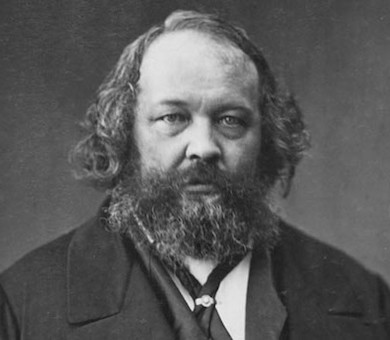
Mikhail Bakunin (1814-76)
Bakunin was a revolutionary activist and thinker who saw himself as a fanatical lover of liberty. He shaped collectivist anarchism, most famously in his unfinished work God and the State (1882).
Key ideas:
- He rejected the individualism of liberalism, arguing that true freedom is only possible when economic and social equality exists
- Freedom is not a product of being isolated and independent but is realised through connections with others
- Bakunin rejected all forms of authority, hierarchy and the state, as all assume that the masses are incapable of governing themselves. Only by returning power to the collective and through workers' self-management in their collectives can freedom exist
- He opposed the Church and religion, arguing that "if God is, man is a slave"
- He opposed the capitalist state as "the organised authority, domination and power of the possessing classes over the masses"
- The socialist state would simply replace one oppressive master with another, forcing the individual to submit to the collective interests of the "Red bureaucracy". This warning proved an accurate prediction of the Soviet state under Stalin
- He opposed capitalism, seeing labour as a "sort of voluntary and transitory serfdom" and private property as the right to live "by exploiting the work of someone else"
- Bakunin believed in the power of the masses to rise up and overthrow the state, and saw a key role for anarchists in inspiring the collective struggle
- He saw revolution as necessary, probably initially needing to use violence to create conditions for the new society, as "the passion for destruction is a creative passion, too"
- The general strike was a key method for revolution and would create the "great cataclysm which forces society to shed its old skin"
Anarcho-syndicalism
Syndicalism is the practice of workers organising into unions to fight for their interests by taking direct action.
Anarcho-syndicalism merges the currents of syndicalism and anarchism, drawing inspiration from Mikhail Bakunin.
Key principles:
- Mass meetings, factory committees and workers' councils should be established. As Bakunin stated, these create "not only the ideas but also the facts of the future", as these bodies will form the basis of the new society
- Unions should fight for improved conditions using direct action such as strikes, occupations and sabotage of the factory by workers, becoming the "elementary school of socialism" (Rudolf Rocker)
- The new world order can only be created by revolution, not reform, and this would involve "taking over of the management of all plants by the producers themselves" (Rocker)
Example
Historical Example: The Spanish CNT
The Confederación Nacional del Trabajo (CNT) during the Spanish Civil War from 1936 provides a powerful demonstration of anarcho-syndicalist principles in action. Free collectives successfully organised both industrial production and agriculture in Catalonia, creating a functioning alternative to state-based systems until the experiment was crushed by nationalist forces under General Franco.
Anarcho-communism (associated with Peter Kropotkin)
Key principles of anarcho-communism:
- Private property and capital must be abolished and replaced by common ownership
- Anarcho-communists extend common ownership to the fruits of an individual's labour. This doesn't mean sharing hairbrushes, but that all products are "at the disposal of all, leaving to each the liberty to consume them as he pleases in his own home" (Kropotkin)
- Anarcho-communism is based on the principle "from each according to his ability, to each according to his needs"
- Society would be based around small, localised communes that are self-managing, with all wealth under common ownership
- Membership of communes is voluntary, and communes would voluntarily enter into federations to work together at local, regional and international levels, but with key decisions always lying with the individual communes
Note
Communes are associations where members own everything in common, including the fruits of the individual's labour.
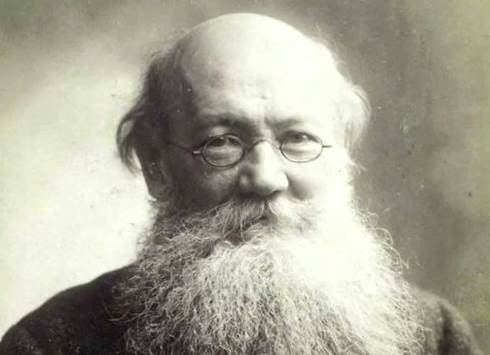
Peter Kropotkin (1842-1921)
Peter Kropotkin was the key exponent of anarcho-communism. Through his book Mutual Aid (1902), he attempted to provide a scientific basis for anarchist theory.
Key ideas:
- Kropotkin aimed to give a philosophical basis to anarchism through his study of the natural world
- In Mutual Aid, he argued that the prevailing view of nature based on competition between individuals (like capitalism) was not accurate
- The struggle for survival is best achieved by mutual aid among members of a species, so this is the best route for individuals to take
- Kropotkin applied this to humanity, showing that mutual aid is crucial both for humanity's survival and ongoing evolution
- Society is natural and voluntary cooperation is natural, but the state is unnatural
- The removal of coercive institutions will allow natural society to flourish in spontaneous order, which will nourish humanity's social and cooperative nature
- Kropotkin used this argument to make a case for anarcho-communism based on:
- Private property replaced by common ownership
- Free communism – the commune is a voluntary organisation where people freely share the products of their labour and common resources with others, as it's in their best interests
- A free federation of communes that work together in the spirit of mutual aid and solidarity
- Communes based on mass participation by their members to build new societies around the ideas of liberty, equality and solidarity
Summary
Key Points to Remember:
-
Anarchism rejects the state in all its forms, viewing it as an artificial construct that oppresses individuals through authority, power and coercion. For anarchists, "anarchy is order" – society functions better without state interference.
-
Individual autonomy is central to anarchism. Anarchists believe people are capable of governing themselves through reason and moral responsibility. Freedom means being free from restraint to fulfil one's potential, and this freedom is only real when it's real for all.
-
Anarchism divides into individualist and collectivist traditions. Individualist anarchists (like Stirner) emphasise egoism and voluntary contracts. Collectivist anarchists (like Bakunin and Kropotkin) believe human nature is essentially social and cooperative, emphasising mutual aid and solidarity.
-
Key thinkers shaped different strands: Stirner developed egoism; Proudhon created mutualism; Bakunin developed collectivism; Kropotkin advocated anarcho-communism; Goldman balanced individual and collective concerns while adding a feminist perspective.
-
Anarchists oppose all coercive relationships, not just the state. This includes opposition to capitalism, the Church, nationalism, and any authority that restricts individual autonomy. Modern anarchist principles can be seen in feminist, anti-capitalist and liberation movements worldwide.