A-Level Paper 1 Exam (Edexcel A-Level Business): Revision Notes
📚Revision Notes
A-Level Paper 1 Exam
Advance planning for effective revision
Creating a structured approach to revision is essential for exam success. Follow these key strategies:
Develop a realistic revision timetable that spreads your study over several weeks rather than cramming everything into a few days. Set weekly targets for the number of topics you aim to cover, ensuring you maintain steady progress throughout your preparation period.
Note
Prioritising Your Revision
Allocate more revision time to areas where you feel less confident. Revisit difficult concepts multiple times to build understanding and familiarity. This approach ensures you don't leave weak areas unaddressed.
Important
Avoid Question Spotting
Attempting to predict specific questions and only revising those topics is risky and unreliable. Instead, revise comprehensively so you feel confident about all aspects of the specification. Remember, you must answer all questions in Paper 1 with no choice available.
Paper 1 structure and format
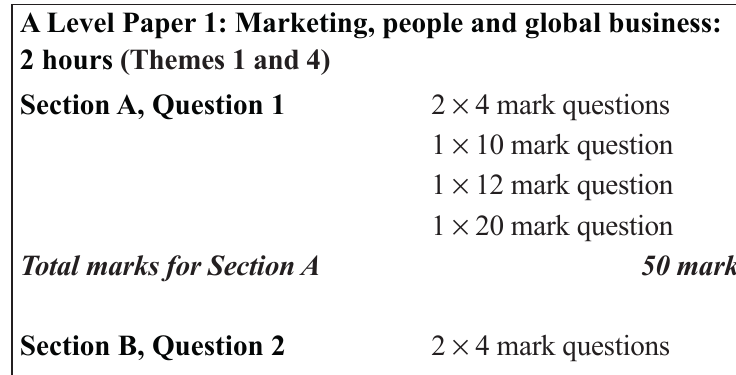
Paper 1 examines Marketing, people and global business and assesses your knowledge of Themes 1 and 4. The examination lasts 2 hours and is worth 100 marks in total. You must answer all questions—there is no option to choose between questions.
The paper divides into two sections, each worth 50 marks:

Section A requirements
Section A provides Extracts A, B and C as stimulus material. You must answer Question 1, parts a–e, which include:
- Two 4-mark questions testing basic knowledge and understanding
- One 10-mark question requiring application and analysis
- One 12-mark question demanding deeper analysis
- One 20-mark extended response question requiring comprehensive analysis and evaluation
Section B requirements
Section B provides Extracts D, E and F as stimulus material. You must answer Question 2, parts a–e, which follow the same structure as Section A:
- Two 4-mark questions
- One 10-mark question
- One 12-mark question
- One 20-mark extended response question
The paper provides lined spaces after each question where you write your answers. Use the mark allocation as your guide for how much time and detail each question requires.
Assessment objectives: the four essential skills
Paper 1 tests four distinct skills called assessment objectives (AOs). Understanding these is crucial for structuring effective answers.
AO1 – Knowledge
Knowledge questions test whether you can demonstrate understanding of business terminology, concepts and theories. You must also show you understand how businesses and individuals are affected by and respond to various business issues.
Note
Recognising Knowledge Questions
These typically carry just 4 marks and test knowledge alone. However, all questions will test knowledge to some extent, even those requiring additional skills.
Example requirements:
- Define business terms accurately
- Explain business concepts clearly
- Describe business theories correctly
- Identify how business issues affect organisations
AO2 – Application
Application requires you to connect your business knowledge to the specific context provided in the question. This means your answers must relate directly to the business, industry or situation described in the stimulus material.
Demonstrating application involves:
- Using formulas in appropriate circumstances (e.g., calculating price elasticity of demand for the specific product mentioned)
- Applying theories to explain why the particular business has chosen a specific course of action
- Using frameworks to show the impact of decisions on the business in the context
Important
Context is Essential
Most exam questions require application. Generic answers that could apply to any business will not score well. You must discuss the specific implications for the business or industry described in your question.
AO3 – Analysis
Analysis requires you to deconstruct information and understand its implications. You must show you can identify how external and internal factors impact individuals and organisations.
Analytical skills include:
- Explaining cause-and-effect relationships (e.g., recognising from a graph that falling sales might result from new market competition)
- Identifying specific causes of business problems (e.g., realising inefficiency stems from reduced staff motivation following pay cuts)
- Using appropriate analytical techniques (e.g., applying the net profit ratio to assess business performance)
- Constructing logical arguments that explain reasons for events
- Discussing advantages and disadvantages of different courses of action
Example
Worked Example: Demonstrating Analysis
Question: Analyse the impact of a 10% price increase on customer demand for luxury watches.
Step 1: Identify the relationship Price elasticity of demand for luxury goods is typically inelastic, meaning demand changes proportionally less than price changes.
Step 2: Apply to context A 10% price increase for luxury watches may only reduce demand by 3-5%, as customers purchasing luxury items are less price-sensitive.
Step 3: Explain implications The business could increase revenue despite lower sales volume, as the higher profit margin per unit compensates for reduced quantity sold.
Note
Mark Guidance for Analysis
Questions carrying more than 4 marks will require analysis. Some 4-mark questions may also test analytical skills.
AO4 – Evaluation
Evaluation involves making informed judgements based on the evidence available. You must assess both qualitative and quantitative information to propose evidence-based solutions to business problems.
Evaluation requires:
- Weighing up the relative importance of different points or arguments
- Drawing justified conclusions from the evidence you present
- Assessing which issues matter most to the specific business
- Recommending courses of action supported by logical reasoning and evidence
Important
Multiple Valid Conclusions
Business studies rarely has one "right" answer. Examiners assess whether your judgement is plausible and whether you've constructed a strong argument supporting your conclusion. Different conclusions can be equally valid if well-justified.
Note
Mark Guidance for Evaluation
Questions worth 8 marks or more typically test evaluation skills. The 20-mark questions in each section are extended responses requiring comprehensive evaluation.
Quantitative skills requirements
All three A-Level papers test your numeracy and quantitative abilities. You must demonstrate competence in nine specific quantitative skills:
- QS 1: Calculate, use and understand ratios, averages and fractions
- QS 2: Calculate, use and understand percentages and percentage changes
- QS 3: Construct and interpret a range of standard graphical forms
- QS 4: Interpret index numbers
- QS 5: Calculate cost, revenue and break-even
- QS 7: Interpret values of price and income elasticity of demand
- QS 8: Use and interpret quantitative and non-quantitative information in order to make decisions
- QS 9: Interpret, apply and analyse information in written, graphical and numerical form
Note
QS 6 Exclusion
QS 6 (investment appraisal) is not part of Paper 1 content for this specification.
Exam technique tips
Time management: With 2 hours for 100 marks, you have just over 1 minute per mark. A 20-mark question should take approximately 22-24 minutes.
Important
Context is Crucial
Every answer must link specifically to the business scenario provided. Generic textbook answers will lose marks. Always reference the specific business details from the stimulus material.
Extended responses: The 20-mark questions require structured arguments with clear introduction, developed analysis, and justified evaluation leading to a conclusion.
Note
Reading Mark Allocations
Mark allocations signal required skills:
- 4-mark questions focus on knowledge
- 10-12 marks require analysis
- 20-mark questions demand evaluation
Summary
Key Points to Remember:
- Paper 1 lasts 2 hours, covers Themes 1 and 4, and is worth 100 marks total
- Both sections follow identical structures: 2×4, 1×10, 1×12, 1×20 marks (50 marks each)
- You must answer all questions—there is no choice
- The four assessment objectives are Knowledge, Application, Analysis and Evaluation (KAAE)
- Application is essential: always link your answers to the specific business context provided
- Higher-mark questions (8+ marks) require evaluation and justified judgements
- Develop a comprehensive revision timetable avoiding question spotting
- Master all nine quantitative skills as they appear across all papers