A-Level Paper 2 Exam (Edexcel A-Level Business): Revision Notes
📚Revision Notes
A-Level Paper 2 Exam
Introduction to Paper 2
Paper 2 focuses on business activities, decisions and strategy, covering content from Themes 2 and 3 of the A-Level Business specification. The exam assesses your understanding of business finance, operations, decision-making and strategic management.
Note
You must demonstrate the ability to make connections between the two themes throughout your answers. For example, when analysing growth strategies from Theme 3, you should consider the financial implications and funding requirements from Theme 2.
This is a written examination lasting 2 hours with a total of 100 marks available. You must answer all questions in both sections—there is no choice of questions. While this removes the need to select questions, it means you must be prepared across the full breadth of Themes 2 and 3.
Advance planning for revision
Effective preparation requires careful planning and a strategic approach to revision.
Start by creating a revision timetable spread over several weeks. Rather than cramming, aim to cover a set number of topics each week, allowing time for the content to consolidate in your memory. Focus additional time on topics you find challenging, revisiting them multiple times to build confidence and understanding.
Important
Avoid the temptation to "question spot" by trying to predict which topics will appear. This strategy is risky and can leave significant gaps in your knowledge. Instead, revise comprehensively so you feel confident tackling any question on Themes 2 and 3.
Exam structure
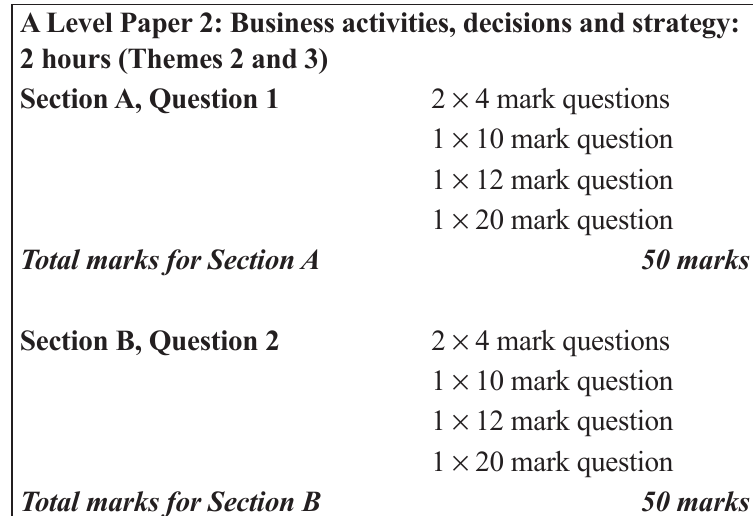
Paper 2 is divided into two equal sections, each worth 50 marks. The question pattern is identical in both sections, making it easier to prepare once you understand the format.
Section A overview
Section A provides you with Extracts A to D as stimulus material. These extracts contain business information, data, and context that you must use to answer Question 1 parts a to e. The question parts vary in depth and complexity based on their mark allocation:
- Two questions worth 4 marks each (testing knowledge and potentially some application)
- One question worth 10 marks (requiring application and analysis)
- One question worth 12 marks (requiring detailed analysis)
- One question worth 20 marks (extended response requiring evaluation)
Note
The final 20-mark question is an extended question requiring you to construct a detailed, evaluative answer with clear judgement.
Section B overview
Section B follows an identical structure to Section A. You receive Extracts E to H as stimulus material and must answer Question 2 parts a to e. The mark distribution mirrors Section A exactly, with the same requirements for depth and skill demonstration.
Both sections test your ability to read, interpret and apply business concepts to real-world scenarios presented in the extracts.
Use the mark allocation as your guide for time management. Roughly speaking, aim to spend approximately one minute per mark, though you may need slightly more time for extended questions that require planning and structured responses.
Assessment objectives
The exam tests four distinct skills called assessment objectives (AOs). Understanding what examiners look for in each AO helps you target your responses effectively.
AO1: Knowledge and understanding
Knowledge means demonstrating that you recognise and understand business terminology, concepts, theories and models. You must also show understanding of how businesses and stakeholders are affected by and respond to various business issues.
Note
Every question tests knowledge to some extent. Questions testing knowledge alone typically carry only 2 or 4 marks. These might ask you to define a term, state a formula, or identify a business concept from the stimulus material.
Example
Examples of Knowledge Questions:
- "Define the term 'diseconomies of scale'"
- "State one way a business could improve its cash flow"
Important
While these questions appear straightforward, precision matters. Use accurate business terminology and provide complete definitions that demonstrate full understanding.
AO2: Application to context
Application requires you to take your business knowledge and apply it directly to the specific context provided in the question. This means showing how the concepts, theories or models you discuss relate to the particular business, industry or situation described in the stimulus material.
Most exam questions require application marks. Strong application involves:
- Using evidence from the extracts to support your points
- Discussing the specific implications for the named business
- Explaining why a theory or concept is relevant to this particular context
- Applying calculations or business models to the data provided
Example
Applying to Context:
Rather than generally discussing Ansoff's Matrix, you should explain which specific growth strategy would suit the business in the question based on the market conditions and resources described in the extracts. Similarly, when calculating financial ratios, you must interpret what the result means for this specific business.
Important
Weak answers make generic points that could apply to any business. Strong answers are tightly focused on the context, repeatedly referencing specific details from the stimulus material.
AO3: Analysis and development
Analysis means breaking down information to identify causes, effects and relationships. You must explain the implications of business decisions and external factors for organisations and stakeholders.
Analysis involves:
- Explaining chains of reasoning (cause and effect)
- Identifying specific causes of problems or outcomes
- Breaking down data to reach conclusions (e.g., interpreting trends, calculating and explaining financial ratios)
- Developing points by explaining consequences and further implications
- Using phrases like "this means that...", "as a result...", "consequently..." to show development
Note
Questions worth more than 4 marks typically require analytical skills. You construct chains of reasoning by taking a business concept and explaining step-by-step how it affects the business.
Example
Example of Strong Analysis:
Introducing lean production leads to reduced waste, which lowers costs, which improves profit margins, which provides funds for reinvestment.
This demonstrates a clear chain of reasoning showing cause and effect relationships.
Important
Analysis is about depth not breadth. It's better to develop fewer points thoroughly than to make many superficial points.
AO4: Evaluation and judgement
Evaluation involves making informed judgements based on the evidence you have analysed. You must weigh up different factors, assess relative importance and reach justified conclusions.
Effective evaluation includes:
- Weighing up both sides of an argument before reaching a conclusion
- Assessing which factors are most significant for the specific business
- Drawing conclusions that follow logically from your analysis
- Recommending courses of action with justified reasoning
- Considering short-term versus long-term implications
- Acknowledging that judgements may depend on circumstances
Note
Questions worth 8 marks or more test evaluation. Extended 20-mark questions particularly reward strong evaluative skills.
Important
In business studies, there is rarely one "right" answer. Examiners assess whether your judgement is plausible and whether you have supported it with sound reasoning. You might conclude that a business should expand internationally, while another student concludes they should consolidate in the domestic market—both could achieve high marks if the reasoning is well-developed and contextual.
Strong evaluation uses phrases like "overall", "on balance", "the most significant factor", "it depends on" and "however, in this context". Avoid sitting on the fence—you must reach a clear judgement while acknowledging the factors that influenced your decision.
Remember!
Summary
Key Points to Remember:
- Paper 2 lasts 2 hours and covers Themes 2 and 3, focusing on business activities, decisions and strategy
- You must answer all questions in both Section A and Section B—there is no choice
- Each section follows the same pattern: 2×4 marks, 1×10 marks, 1×12 marks, 1×20 marks
- Application is crucial—always link your answers to the specific business context provided in the extracts
- Extended 20-mark questions require evaluation—make clear judgements supported by developed reasoning
- Use mark allocations to guide your time—roughly one minute per mark
- All four assessment objectives matter: knowledge provides the foundation, application ensures relevance, analysis develops your points, and evaluation demonstrates higher-level thinking
- Plan comprehensive revision—avoid question spotting and ensure you're confident across all of Themes 2 and 3