Exchange Rates (Edexcel A-Level Business): Revision Notes
📚Revision Notes
Exchange Rates
What are exchange rates?
An exchange rate is the price of one currency expressed in terms of another currency. Exchange rates exist because countries around the world use different currencies for their transactions. For example, the United States uses the dollar ($), Japan uses the yen (¥), many European Union countries use the euro (€), and the United Kingdom uses the pound sterling (£).
Note
When international trade occurs, buyers typically need to pay suppliers in the supplier's currency. This creates the need for currency conversion. For instance, an Indian tourist visiting Britain cannot spend rupees (₹) directly - they must first exchange their rupees for pounds.
The number of pounds they receive depends on the current exchange rate between these two currencies. If the exchange rate is £1 = ₹100, then 150,000 rupees would convert to £1,500 (calculated as ₹150,000 ÷ ₹100). This rate tells us how many rupees are needed to purchase one pound, or conversely, how many rupees one pound can buy.
Calculating with exchange rates
Understanding how to convert between currencies is essential for businesses engaged in international trade. The mathematical process depends on the direction of conversion.
Important
Currency Conversion Rules:
When converting FROM pounds TO foreign currency: multiply the pound amount by the exchange rate.
When converting FROM foreign currency TO pounds: divide the foreign currency amount by the exchange rate.
Memory aid: Multiply to go FROM pounds, divide to go TO pounds.
Example
Worked Examples: Currency Conversions
Example 1: A French business purchases goods from a UK company costing £400,000. With an exchange rate of £1 = €1.25, the cost in euros is:
Example 2: A British firm buys £55,000 worth of goods from an American supplier. If £1 = $1.50, the cost in US dollars is:
Example 3: A UK business imports $300,000 of goods from the USA. At an exchange rate of £1 = $1.50, the sterling cost is:
Example 4: A Japanese visitor to London has ¥100,000 to exchange. With £1 = ¥190, they will receive:
Appreciation of exchange rates
Appreciation occurs when the exchange rate rises, meaning the domestic currency increases in value relative to foreign currencies. Like all prices, exchange rates are determined by market forces of supply and demand. For example, if global demand for UK exports increases, foreigners will need more pounds to purchase these goods. This increased demand for sterling will push up the pound's value, causing the exchange rate to appreciate.
Important
When the pound appreciates, the prices of both exports and imports change in opposite directions, which affects demand for these goods:
- Exports become MORE expensive for foreign buyers → demand for exports falls
- Imports become CHEAPER for domestic buyers → demand for imports rises
Impact of appreciation on exports
Consider a scenario where the pound appreciates from £1 = $1.50 to £1 = $2.00. A UK manufacturer selling goods worth £2 million to a US customer will see the dollar price change significantly.
Example
Worked Example: Appreciation Effect on Exports
Initial situation:
- Exchange rate: £1 = $1.50
- UK export value: £2 million
- US dollar price: £2{,}000{,}000 \times 1.50 = \3{,}000{,}000$
After appreciation:
- New exchange rate: £1 = $2.00
- UK export value: £2 million (unchanged)
- New US dollar price: £2{,}000{,}000 \times 2.00 = \4{,}000{,}000$
Result: The $4 million - $3 million = $1 million increase represents a 50% price rise for the American customer. UK exports become more expensive for foreign buyers, so demand for UK exports typically falls because they are now less competitive internationally.
Impact of appreciation on imports
Using the same appreciation example (£1 = $1.50 to £1 = $2.00), consider a UK business importing goods worth $600,000 from an American supplier.
At the original rate, the sterling cost is £400,000 ($600,000 ÷ 1.50). After the pound appreciates, the cost falls to £300,000 ($600,000 ÷ 2.00).
The stronger pound means UK businesses can now purchase the same imports for 25% less in sterling terms. This makes imports cheaper, so demand for imported goods typically rises.
Depreciation of exchange rates
Depreciation occurs when the exchange rate falls, meaning the domestic currency loses value against foreign currencies. The effects on trade are the opposite of appreciation.
Important
When the pound depreciates, prices change in the opposite direction to appreciation:
- Exports become CHEAPER for foreign buyers → demand for exports rises
- Imports become MORE EXPENSIVE for domestic buyers → demand for imports falls
Impact of depreciation on exports
Suppose the pound depreciates from £1 = $1.50 to £1 = $1.20. A UK exporter selling £2 million worth of goods will find their products become cheaper for foreign buyers.
Example
Worked Example: Depreciation Effect on Exports
Initial situation:
- Exchange rate: £1 = $1.50
- UK export value: £2 million
- US dollar price: £2{,}000{,}000 \times 1.50 = \3{,}000{,}000$
After depreciation:
- New exchange rate: £1 = $1.20
- UK export value: £2 million (unchanged)
- New US dollar price: £2{,}000{,}000 \times 1.20 = \2{,}400{,}000$
Result: The $3 million - $2.4 million = $600,000 decrease represents a 20% price reduction for the American customer. UK exports become more competitive in international markets. Foreign buyers find British goods cheaper, so demand for UK exports typically increases.
Impact of depreciation on imports
With the same depreciation (£1 = $1.50 to £1 = $1.20), a UK business buying $600,000 of American goods will face higher costs in pounds.
The original sterling price of £400,000 ($600,000 ÷ 1.50) rises to £500,000 ($600,000 ÷ 1.20) after the pound weakens.
The weaker pound makes imports 25% more expensive for UK businesses. This higher cost typically reduces demand for imported goods as they become less affordable.
Summary of exchange rate effects
The relationship between exchange rate movements and international trade follows a clear pattern. The table below summarizes how changes in the pound's value affect both the price and demand for exports and imports.
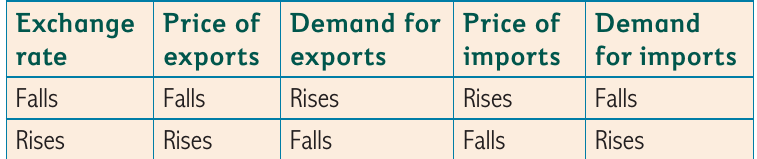
This inverse relationship creates winners and losers in the economy depending on whether a business exports or imports goods and services.
Note
Helpful Mnemonics:
SPICED: Strong Pound, Imports Cheaper, Exports Dearer
- When the pound is strong (appreciates), imports become cheaper and exports become dearer (more expensive)
WPIDEC: Weak Pound, Imports Dearer, Exports Cheaper
- When the pound is weak (depreciates), imports become dearer (more expensive) and exports become cheaper
Impact on businesses
Exchange rate movements affect businesses differently depending on their involvement in international trade. The effects can be beneficial or harmful.
Effects on exporters and importers
When a currency depreciates (falls in value), exporters benefit because their products become cheaper for foreign customers, potentially increasing sales and revenue. However, importers suffer because they must pay more in domestic currency for the same foreign goods, increasing their costs and potentially reducing profit margins.
Conversely, when a currency appreciates (rises in value), the situation reverses. Importers benefit from cheaper foreign goods and lower costs, while exporters struggle as their products become more expensive for international customers, potentially losing market share.
Uncertainty and planning challenges
Fluctuating exchange rates create significant uncertainty for businesses engaged in international trade. Companies cannot predict future exchange rate movements with certainty, making it difficult to forecast export demand or the cost of imported materials and components.
Important
The Challenge of Exchange Rate Uncertainty:
This unpredictability complicates financial planning and budgeting. A business might agree to a contract today at a certain price, but by the time payment is due, exchange rate movements could significantly alter the actual revenue received or cost incurred.
This exchange rate risk can turn profitable contracts into loss-making ones, or vice versa, making long-term international contracts particularly risky.
Commission and transaction costs
Every currency conversion incurs a cost. Financial institutions typically charge a commission of around 2% to exchange one currency for another. For businesses frequently trading internationally, these commission charges accumulate and represent a direct cost that reduces profit margins.
Note
Example of Commission Costs:
A business importing €500,000 worth of goods would pay approximately €10,000 (2% of €500,000) in currency conversion fees alone, before considering any other costs. These fees are unavoidable for importers and represent a significant overhead that affects competitiveness and profitability.
Remember!
Summary
Key Points to Remember:
-
Exchange rates show the price of one currency in terms of another and are necessary because different countries use different currencies
-
Appreciation (rising exchange rate) makes exports more expensive and imports cheaper, reducing export demand but increasing import demand
-
Depreciation (falling exchange rate) makes exports cheaper and imports more expensive, increasing export demand but reducing import demand
-
Winners and losers: Currency depreciation helps exporters but hurts importers; currency appreciation helps importers but hurts exporters
-
Business challenges: Fluctuating rates create uncertainty, complicate planning and budgeting, and incur commission costs of approximately 2% per transaction