Profit (Edexcel A-Level Business): Revision Notes
📚Revision Notes
Profit
Understanding profit is fundamental to analyzing business performance. Profit represents the money left over after all costs have been deducted from revenue, and it belongs to the business owners. However, profit isn't a single figure – accountants calculate several different types of profit, each revealing different aspects of a business's financial performance.
Understanding different types of profit
When analyzing a business's financial performance, we need to understand three key measures of profit. Each type tells us something different about how well the business is performing and where costs are being incurred.
Note
The three main types of profit build upon each other in a cascading structure: gross profit shows profit after direct costs, operating profit shows profit after overheads, and net profit shows the final profit after all costs including interest.

Gross profit
Gross profit shows how much profit a business makes after paying for the direct costs of producing or purchasing its goods. For a retailer, the cost of sales is what they paid to buy stock. For a manufacturer, it includes raw materials, factory wages, and other production costs. For a service provider, it covers direct labour costs.
The formula is:
Where:
- Revenue (also called turnover or sales revenue) = Price × Quantity sold
- Cost of sales = Direct costs of the business
Gross profit tells us whether the business is making money on its core trading activities before considering any overhead costs.
Operating profit
Operating profit takes into account the business's overhead costs (also called indirect costs or operating expenses). These overheads include selling expenses and administrative expenses such as rent, utilities, marketing costs, and office salaries.
The formula is:
Operating profit reveals how profitable the business is after covering both its direct costs and its day-to-day running costs. This is a crucial measure because it shows the profit generated from regular business operations.
Profit for the year (net profit)
Profit for the year (also known as net profit) is the final profit figure after deducting all costs, including interest payments on loans and any exceptional items. This can be calculated before or after taxation is deducted.
The formula is:
Net profit represents the actual profit available to the business owners or shareholders after all financial obligations have been met. This is the most comprehensive measure of profitability.
Note
In business, you may see "revenue" and "turnover" used interchangeably, as well as "profit for the year" and "net profit". These terms mean the same thing.
Worked calculation example
Example
Worked Example: Calculating Three Types of Profit
Let's see how these profit calculations work in practice. Consider a paper manufacturer with the following figures:
- Revenue: $46 million
- Cost of sales: $23.5 million
- Operating expenses: $12.4 million
- Interest paid: $2.1 million
Step 1: Calculate Gross Profit
Step 2: Calculate Operating Profit
Step 3: Calculate Net Profit
Interpretation: This shows the business made $22.5m after direct costs, $10.1m after overheads, and $8m after all costs including interest.
Statement of comprehensive income
At the end of each financial year, businesses prepare a statement of comprehensive income (previously called a profit and loss account). This document shows all income and expenses during the year and is used to calculate the three types of profit discussed above.
The layout of this statement follows a standard format, making it easier to compare performance across different businesses and time periods. The statement always includes figures for both the current year and the previous year, enabling year-on-year comparison.
Here's an example of a statement of comprehensive income structure:
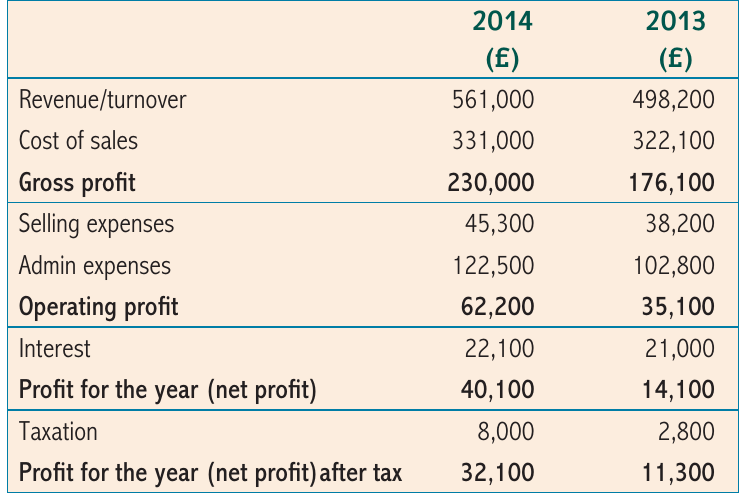
The statement begins with revenue at the top and works downward, subtracting costs at each stage to arrive at the final profit after tax. This cascading structure clearly shows how profit decreases as different categories of costs are deducted.
Note
Key features of the statement include:
- Revenue/turnover at the top
- Cost of sales deducted to give gross profit
- Operating expenses deducted to give operating profit
- Interest deducted to give net profit before tax
- Taxation deducted to give final profit after tax
By comparing the current year with the previous year, stakeholders can quickly identify trends and assess whether the business's performance is improving or deteriorating.
Measuring profitability using profit margins
While absolute profit figures are important, they don't tell the whole story. A business making $100,000 profit might seem successful, but if it has revenue of $10 million, that's quite different from a business making the same profit on revenue of $500,000. This is where profit margins become invaluable.
Profit margins measure profitability relative to revenue, showing how much profit is made per $1 of sales. They're expressed as percentages and allow for meaningful comparisons between different businesses and different time periods.
Gross profit margin
The gross profit margin shows what percentage of revenue remains as gross profit after direct costs have been paid. It reveals how efficiently a business manages its direct production or purchasing costs.
Formula:
A higher gross profit margin is generally better because it means more profit is being made per $1 of sales. However, acceptable margins vary significantly between industries. Businesses with fast inventory turnover (like supermarkets) can operate successfully with lower margins than those with slower turnover (like car dealerships).
The gross profit margin can be improved by:
- Raising prices - increases revenue per unit sold (though may reduce sales volume)
- Reducing cost of sales - finding cheaper suppliers or negotiating better deals
Operating profit margin
The operating profit margin indicates what percentage of revenue remains after both direct costs and overheads have been paid. This ratio measures pricing strategy and operating efficiency combined.
Formula:
A higher or increasing operating margin is preferable because it means the business is making more money on each $1 of sales from its core operations. Operating margin excludes interest, exceptional items, and taxes, focusing purely on operational performance.
This margin reflects how well the business controls its operating expenses relative to its revenue. An improving operating margin suggests better efficiency or pricing power.
Profit for the year (net profit) margin
The net profit margin takes everything into account - direct costs, overheads, interest payments, and exceptional items. It's usually calculated before tax deduction and represents the final profit as a percentage of revenue.
Formula:
This is the most comprehensive profitability measure because it includes all costs. A higher net profit margin means more profit remains after all deductions. This margin is particularly important for investors as it shows what's actually available for distribution or reinvestment.
Calculating and interpreting profit margins
Example
Worked Example: Calculating and Comparing Profit Margins
Let's work through a complete example using a car dealership's figures:
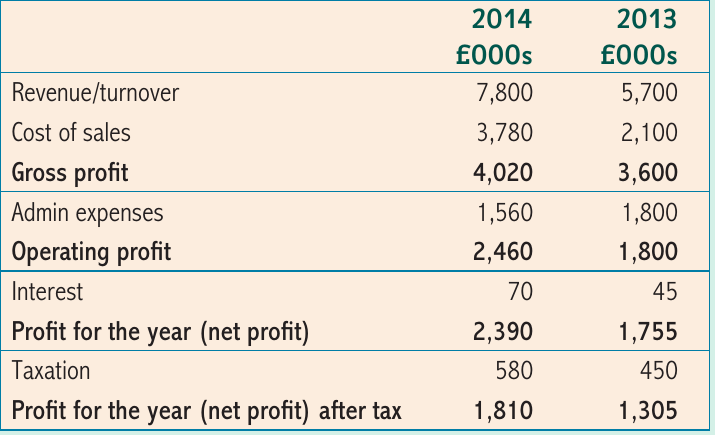
2014 Calculations:
Step 1: Calculate Gross Profit Margin
Step 2: Calculate Operating Profit Margin
Step 3: Calculate Net Profit Margin
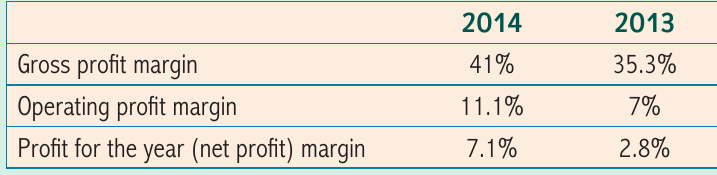
Interpretation: Notice how the margins decrease as more costs are included:
- The gross margin (41%) is the highest
- The operating margin (11.1%) is lower after overheads
- The net margin (7.1%) is the lowest after all costs
Comparing with 2013, all three margins have improved significantly, suggesting better performance through improved efficiency, better cost control, or possibly higher prices.
Important
Important considerations when analyzing profit margins:
- Gross profit margin is always the highest of the three
- Net profit margin is always the lowest
- Higher margins are better than lower ones
- Increasing margins over time indicate improving performance
- Margins vary significantly across different industries
- Comparisons between businesses are only meaningful if they operate in the same sector with similar business models
Strategies to improve profitability
All businesses aim to improve their profitability because better performance benefits stakeholders - owners receive higher returns, employees may get bonuses, and the business can invest in growth. There are two main approaches to improving profit margins.
Raising prices
Increasing prices generates more revenue per unit sold. If costs remain constant, this directly improves profitability. However, this strategy carries risks:
Advantages:
- Immediate increase in revenue per sale
- Can be implemented quickly
- May improve brand perception (premium positioning)
Disadvantages:
- Usually causes a fall in demand (law of demand)
- Competitors may not follow, losing market share
- Customer backlash if not justified
- May only work if demand is price inelastic
Note
The success of price increases depends on price elasticity of demand. If demand isn't too responsive to price changes, higher prices can generate more total revenue even with lower sales volume. However, raising prices is risky because competitor reactions are unpredictable.
Lowering costs
Reducing costs while maintaining revenue improves profit margins. There are two main approaches to cost reduction.
Buying cheaper resources
Businesses can seek lower-cost suppliers for:
- Raw materials and components
- Utilities (electricity, gas, water)
- Services (telecommunications, insurance, IT support)
- Labour (potentially relocating production overseas)
Benefits:
- Direct reduction in cost of sales or operating expenses
- Can be significant savings, especially from relocation
- Increased competition in many sectors provides opportunities
Potential problems:
- Cheaper suppliers may offer lower quality
- Reliability and guaranteed supply may be compromised
- Relocating overseas can be disruptive
- Job losses damage company reputation
- Hidden costs (managing distant suppliers, quality control issues)
Important
When sourcing cheaper resources, businesses must carefully evaluate whether lower prices come at the cost of quality, reliability, or other important factors. The cheapest option may not always be the most cost-effective in the long run.
Using existing resources more efficiently
Improving efficiency means getting more output from current inputs, reducing waste, and maximizing productivity:
Methods include:
- Introducing new working practices to increase labour productivity
- Training staff to improve skills and efficiency
- Upgrading to more efficient machinery (capital productivity)
- Reducing waste through recycling and better processes
- Implementing lean management techniques
Benefits:
- Lower costs without compromising quality
- Often improves employee skills
- Can reduce environmental impact
- Builds competitive advantage
Potential challenges:
- Workers may resist new practices
- New technology can have teething problems
- Initial investment required (training, equipment)
- Disruption during implementation
Note
Efficiency improvements often provide the most sustainable route to better profitability because they don't rely on finding cheaper suppliers or risking customer reactions to price increases.
Distinction between cash and profit
Important
A critical concept in business finance is understanding that profit and cash are not the same thing. At the end of a trading year, the profit figure will almost certainly differ from the cash balance. This distinction causes confusion but is essential to understand.
Why profit and cash differ
Several factors cause differences between profit and cash:
Trade credit (receivables): If a business makes $200,000 in sales with costs of $160,000, its profit is $40,000. However, if $12,000 worth of goods were sold on credit and payment hasn't been received, the cash balance would only be $28,000. The profit is $40,000 but cash is just $28,000 - profit exceeds cash.
Timing differences:
- Cash received at the start of the year from last year's credit sales increases cash but doesn't affect this year's profit
- Goods purchased on credit increase costs (reducing profit) but don't reduce cash until payment is made
Capital introduced: When owners invest personal money into the business, the cash balance increases. However, this isn't treated as business revenue, so profit remains unchanged. The same applies to bank loans - they increase cash but not profit.
Fixed asset purchases: Buying fixed assets (machinery, vehicles, buildings) reduces the cash balance, sometimes substantially. However, this isn't treated as a business cost in the profit calculation, so profit is unaffected. Only depreciation of the asset affects profit, and this is spread over many years.
Fixed asset sales: Selling fixed assets increases cash but doesn't affect profit unless a profit or loss is made on disposal. The sale proceeds aren't included in business turnover.
Opening cash balance: At the start of the year, the cash balance is unlikely to be zero. If a business starts the year with $23,000 in cash and makes $40,000 profit during the year, the closing cash balance would be approximately $63,000 (assuming no other differences), not $40,000.
Why this matters
Understanding the cash-profit distinction is crucial because:
- A profitable business can still face cash flow problems
- Cash management requires different strategies from profit management
- Stakeholders need both measures to assess financial health
- Banks focus heavily on cash flow when making lending decisions
Note
A business might show healthy profits on paper while struggling to pay bills because customers haven't paid yet, or because it has invested heavily in new equipment. Conversely, a business might have good cash flow from selling assets or receiving capital injections while actually making losses in its trading operations.
Summary
Key Points to Remember:
- Gross profit = Revenue - Cost of sales (profit after direct costs)
- Operating profit = Gross profit - Operating expenses (profit after overheads)
- Net profit = Operating profit - Interest and exceptional costs (final profit)
- The statement of comprehensive income shows income and expenses for the year, allowing calculation of all profit types
- Profit margins measure profitability relative to revenue: Gross margin = (Gross profit/Revenue) × 100%, Operating margin = (Operating profit/Revenue) × 100%, Net margin = (Net profit/Revenue) × 100%
- Higher margins are better and indicate greater efficiency or pricing power
- Profitability can be improved by raising prices (risky - may reduce demand) or lowering costs (through cheaper resources or better efficiency)
- Profit does not equal cash - differences arise from credit sales, timing differences, capital introduced, loan receipts, and fixed asset transactions