Stock Control (Edexcel A-Level Business): Revision Notes
📚Revision Notes
Stock control
What is stock?
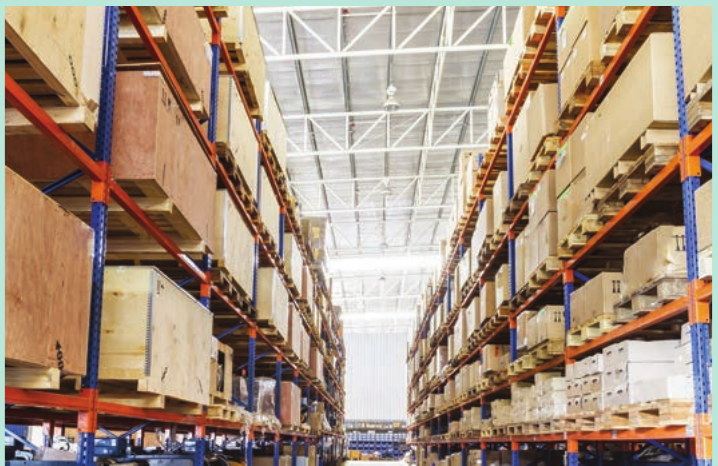
Stock, also known as inventory, refers to all the materials and goods a business holds at any point in time. These materials are essential for production and meeting customer demand.
Note
Businesses typically hold three main types of stock, each serving a different purpose in the production and sales process.
Raw materials and components are items purchased from suppliers before production begins. A washing machine manufacturer, for instance, might buy electric motors, circuit boards, rubber belts, nuts, bolts, and sheet metal. These materials are kept in storage to ensure production can continue smoothly even if there are delivery delays or supplier problems. Having raw materials available means the business doesn't have to halt production while waiting for new deliveries.
Work-in-progress refers to partly finished goods currently being manufactured. In a television assembly plant, work-in-progress would include televisions on the production line that are only partially assembled. These items are between the raw material stage and the finished product stage.
Finished goods are completed products ready for sale to customers. The primary reason businesses hold finished goods is to respond quickly to changes in demand. When there's an unexpected surge in orders, the business can supply customers immediately from existing stock rather than rushing to increase production. This helps maintain customer satisfaction and prevents lost sales.
Factors affecting stock levels
Managing stock effectively means maintaining the right balance - keeping levels low enough to minimise costs, but high enough to prevent running out. Several key factors influence how much stock a business decides to hold:
Important
The Stock Balancing Act
The fundamental challenge in stock management is maintaining the right balance - keeping levels low enough to minimise costs, but high enough to prevent running out. This balance is influenced by multiple interconnected factors.
Demand patterns play a crucial role in determining stock levels. Businesses must hold sufficient stock to meet normal customer demand, plus extra to cover potential growth or unexpected spikes. The additional stock held for unforeseen situations is called buffer stock - emergency inventory kept to protect against sudden increases in demand or supply disruptions.
Stockpiling strategies are used when businesses anticipate predictable changes in demand. Toy manufacturers, for example, build up large stock levels in the months before December to prepare for Christmas sales. Similarly, coal-fired power stations accumulate fuel during summer when electricity demand is lower and coal prices are cheaper, ensuring they have adequate supplies for winter peaks while making cost savings.
Example
Worked Example: Seasonal Stockpiling
A toy manufacturer prepares for the Christmas season:
- August-October: Gradually increase production and build stock from 10,000 units to 50,000 units
- November-December: High sales period - stock depletes as orders are fulfilled
- January-July: Lower production levels with minimal stock holding
This strategy allows the manufacturer to meet peak demand without maintaining expensive high stock levels year-round.
Stock holding costs directly impact how much inventory a business keeps. When storage expenses are high, businesses keep minimal stock levels. Furniture retailers often maintain low stock because the cost of storing large items is substantial and sales patterns are unpredictable.
Working capital availability constrains stock purchasing. A business experiencing cash flow difficulties may be unable to buy more stock, even when it's needed for production or sales.
Note
Perishability and Obsolescence
Stock characteristics determine how long items can be held. Perishability isn't just about fresh food - products can also become obsolete when new models are released, effectively shortening their useful 'life'.
Stock characteristics determine how long items can be held. Perishable products like fresh food and ingredients must be kept in very small quantities, with almost entire stock levels sold daily. However, obsolescence isn't limited to perishability - products can become outdated when new models are released, effectively shortening their useful 'life'.
Lead time is the total duration from placing an order to having stock ready for use, including ordering, delivery, inspection, and preparation. Longer lead times require businesses to hold higher minimum stock levels to avoid running out during the waiting period.
External factors can prompt changes to normal stock policies. Concerns about future shortages - perhaps due to political instability, trade disruptions, or supply chain problems - may encourage businesses to hold higher levels of raw materials as a precautionary measure.
Understanding stock control diagrams
Stock control diagrams provide a visual representation of how stock levels change over time and help businesses plan their ordering patterns. These diagrams show the relationship between stock usage, ordering points, and delivery times.
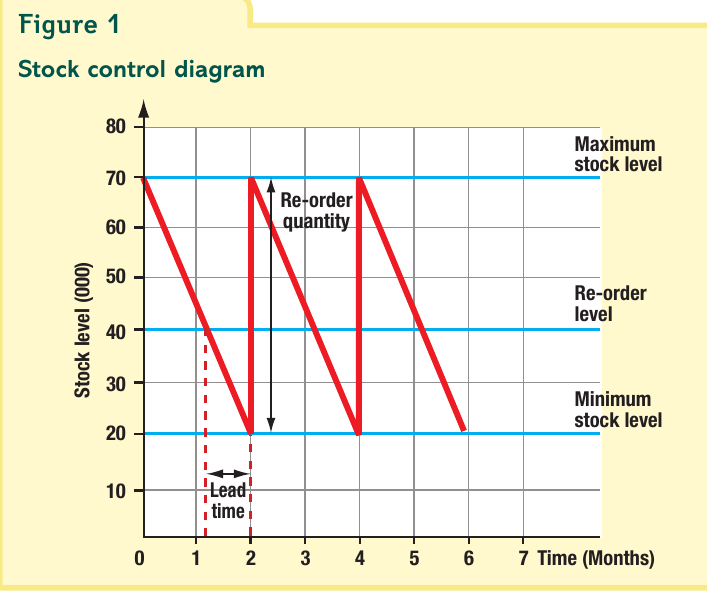
A typical stock control diagram displays several critical elements:
Maximum stock level is the highest quantity of stock the business wants to hold. This is the upper limit shown on the diagram. Stock should never rise above this point as it would indicate excessive inventory with associated high holding costs.
Minimum stock level represents the lowest point stock should reach before new supplies arrive. This level acts as a safety buffer to protect against delays in delivery or unexpected increases in usage. Stock falling below this minimum could result in production halts or lost sales.
Re-order level is the stock quantity that triggers a new order. When stock falls to this point, the business places an order with suppliers. The re-order level is set above the minimum stock level to account for lead time - the period between ordering and receiving stock.
Re-order quantity is the amount ordered each time. In the diagram shown, this appears as the vertical jump when new stock arrives. The re-order quantity should be sufficient to bring stock back up to or near the maximum level.
Lead time is illustrated as the horizontal gap between when an order is placed (at the re-order level) and when it arrives (shown by the stock level jumping back up). This period typically includes order processing, manufacturing or preparation by the supplier, delivery, and inspection.
Note
Understanding the Sawtooth Pattern
The diagram shows a characteristic sawtooth pattern where stock decreases steadily as it's used in production, then jumps back up when new deliveries arrive. This regular pattern helps businesses predict when to reorder and maintain optimal stock levels.
The diagram shows a sawtooth pattern where stock decreases steadily as it's used in production, then jumps back up when new deliveries arrive. In the example shown, stock depletes at a rate of 25,000 units per month, with orders placed when stock reaches 40,000 units and deliveries of 50,000 units arriving after approximately one month.
Important
Reality vs. Theory
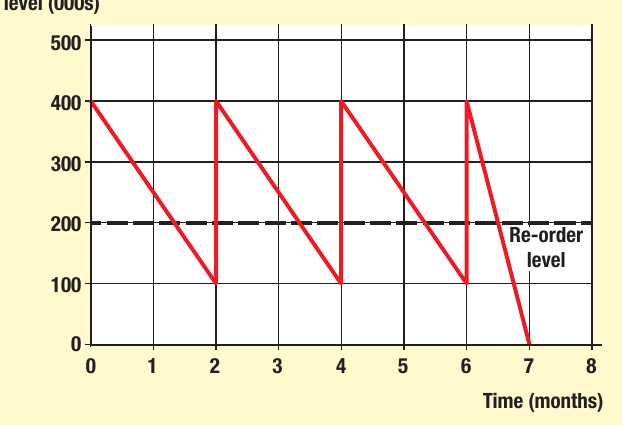
In reality, this idealised pattern rarely occurs exactly as shown. Deliveries may be late, requiring the business to dip into buffer stocks. Usage rates fluctuate based on production schedules and customer demand. Re-order quantities may need adjustment if suppliers offer bulk discounts or if the business identifies opportunities to reduce costs.
Buffer stocks
Buffer stocks are emergency reserves held to protect the business against stock shortages. These additional quantities serve as insurance against unexpected events that could disrupt production or sales.
Businesses maintain buffer stocks of finished goods when they experience significant demand fluctuations. If demand suddenly spikes and the business cannot fulfil orders from existing stock, it loses immediate sales opportunities. More seriously, failing to meet customer needs can damage relationships and result in losing regular customers - a severe long-term problem for the business. Companies facing sharp, unpredictable changes in demand are most likely to need substantial buffer stocks of finished goods.
Important
Critical Production Protection
Buffer stocks of raw materials or components protect against supply disruptions. A break in supply can halt production entirely, which could be catastrophic for certain production processes.
Buffer stocks of raw materials or components protect against supply disruptions. A break in supply can halt production entirely, which could be catastrophic for certain production processes. For example, if soda ash supply to a sheet glass manufacturer is interrupted, an enormous manufacturing plant worth hundreds of millions of pounds in labour and capital could be forced to shut down. The costs of such stoppages far exceed the expense of holding buffer stocks.
Some specific industries require large buffer stocks due to their operational characteristics. Coal-powered electricity generators keep substantial coal reserves to cope with sudden surges in electricity demand, such as during cold weather in winter. These buffer stocks ensure continuous electricity generation even when demand exceeds normal levels.
Note
Competitive Advantage through Stock Availability
Buffer stocks can also provide competitive advantages. Businesses able to respond quickly to customer orders because they have stock readily available may win more business than competitors who cannot fulfil orders as rapidly. In competitive markets, this responsiveness can be a crucial differentiator.
Remember!
Summary
Key Points to Remember:
-
Stock includes three main types: raw materials and components, work-in-progress, and finished goods - each serving different purposes in the production and sales process
-
Stock control diagrams show maximum level, minimum level, re-order level, re-order quantity, and lead time - understanding these elements helps manage inventory efficiently
-
Buffer stocks are emergency reserves held to protect against unexpected demand increases or supply disruptions - particularly important for businesses with demand fluctuations or critical supply chains
-
Lead time is the total period from ordering to having stock ready for use - longer lead times require higher minimum stock levels
-
Multiple factors influence stock levels including demand patterns, holding costs, working capital availability, stock characteristics, and external market conditions