Expansion of Trading Blocs (Edexcel A-Level Business): Revision Notes
📚Revision Notes
Expansion of Trading Blocs
Trading blocs have become increasingly important in shaping global business patterns. As countries seek to strengthen regional ties and reduce trade barriers, understanding how these agreements work is essential for businesses operating internationally.
What are trading blocs?
A trading bloc is a group of countries that have signed a regional trade agreement (RTA) to reduce or eliminate barriers to trade between themselves. These barriers include tariffs, quotas, and other protectionist measures. Trading blocs play a significant role in determining how businesses expand and compete globally.
Countries naturally prefer to trade within their geographical region. This preference exists because:
- Lower transport costs – shipping goods shorter distances reduces logistics expenses
- Cultural familiarity – neighbouring countries often share similar cultures and business practices
- Established relationships – regional markets are easier to understand and navigate
Note
Despite efforts by the General Agreement on Tariffs and Trade (GATT) and the World Trade Organization (WTO) to promote global free trade, regional trade agreements have continued to grow. There are now over 300 RTAs worldwide, covering countries across all continents.
Types of trading blocs
Trading blocs exist on a spectrum of economic integration. As countries become more integrated, they move through different stages, each offering deeper levels of cooperation.
Preferential trading areas (PTAs)
Preferential trading areas represent the most basic form of economic integration. In a PTA, member countries agree to charge reduced tariff rates on certain specified products traded between them. This is the first step toward closer economic ties.
Example
Example: ASEAN-China PTA
ASEAN has a preferential trading area agreement with China, where specific products enjoy lower tariffs.
PTAs often evolve into free trade areas over time as countries build trust and see the benefits of closer cooperation.
Free trade areas (FTAs)
A free trade area goes further by eliminating all trade barriers (tariffs and import quotas) between member states. However, each member country maintains its own independent trade policies with non-member countries.
Important
Key feature: To protect the region from goods entering through the country with the lowest external tariffs, FTAs use rules of origin. These are certificates that prove a defined proportion of a product was actually made within the trading bloc. For example, when goods move from the US to Canada under NAFTA, they must be accompanied by documentation proving their origin.
Example
Example: NAFTA
NAFTA (North American Free Trade Agreement) is a free trade area covering Canada, Mexico, and the United States.
Customs unions
A customs union builds on the free trade area concept by adding a common external tariff. This means all member states apply the same tariffs and trade rules to non-member countries.
Advantage: Products entering the customs union at any border can then move freely throughout all member countries without additional customs checks. Only one set of rules applies across the entire union.
Example
Example: CARICOM
CARICOM (Caribbean Community) is a customs union of 15 Caribbean nations and territories working toward deeper integration.
Common markets
A common market represents significant integration. Beyond removing trade barriers, common markets allow the free movement of:
- Goods – products can be sold anywhere in the market
- Services – businesses can offer services across borders
- Labour – workers can relocate and work in any member country
- Capital – investment flows freely across borders
This level of integration requires member states to coordinate economic and political policies closely to ensure the market functions smoothly.
Example
Examples: ASEAN and Mercosur
ASEAN and Mercosur (Southern Common Market in South America) are developing common markets.
Single markets
A single market takes the common market concept to its fullest extent. Almost all trade barriers are eliminated, and member countries harmonise laws, standards, regulations, and taxes. The goal is to make doing business across borders as easy as doing business within a single country.
Example
Example: European Union Single Market
The European Union operates as a single market where businesses face minimal barriers when trading between member states.
Economic and monetary unions
An economic union combines a customs union with a common market, aiming for close economic, political, and cultural ties. When members also adopt a common currency, it becomes an economic and monetary union.
Example
Example: The European Union
The European Union is an economic and monetary union. Many (though not all) EU members use the euro as their shared currency.
Levels of integration compared
Note
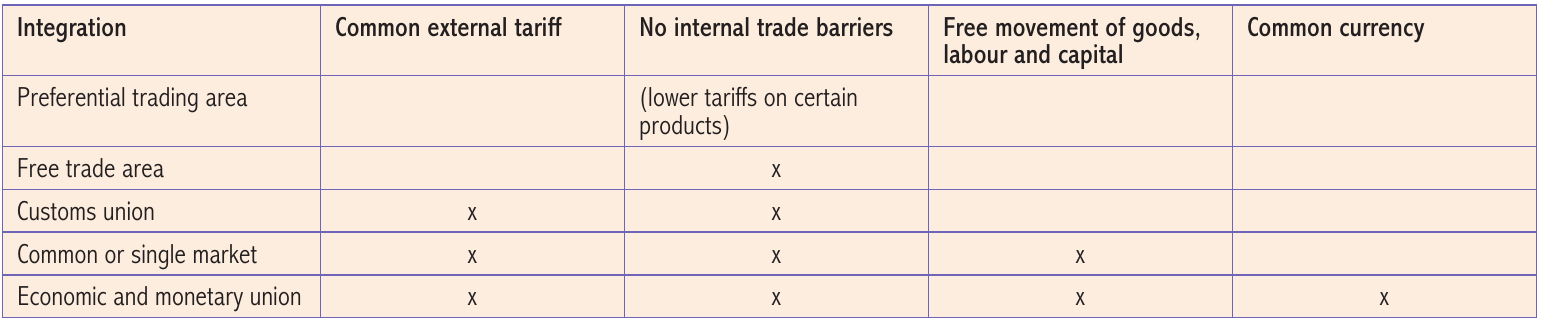
The table above shows how trading blocs progress through stages of increasing integration. Each stage builds on the previous one:
- PTAs offer reduced tariffs on selected products
- FTAs eliminate internal trade barriers completely
- Customs unions add a common external tariff
- Common/single markets enable free movement of labour and capital
- Economic and monetary unions introduce a common currency
The three major trading blocs
Three trading blocs have particular significance for global business: the EU, ASEAN, and NAFTA.
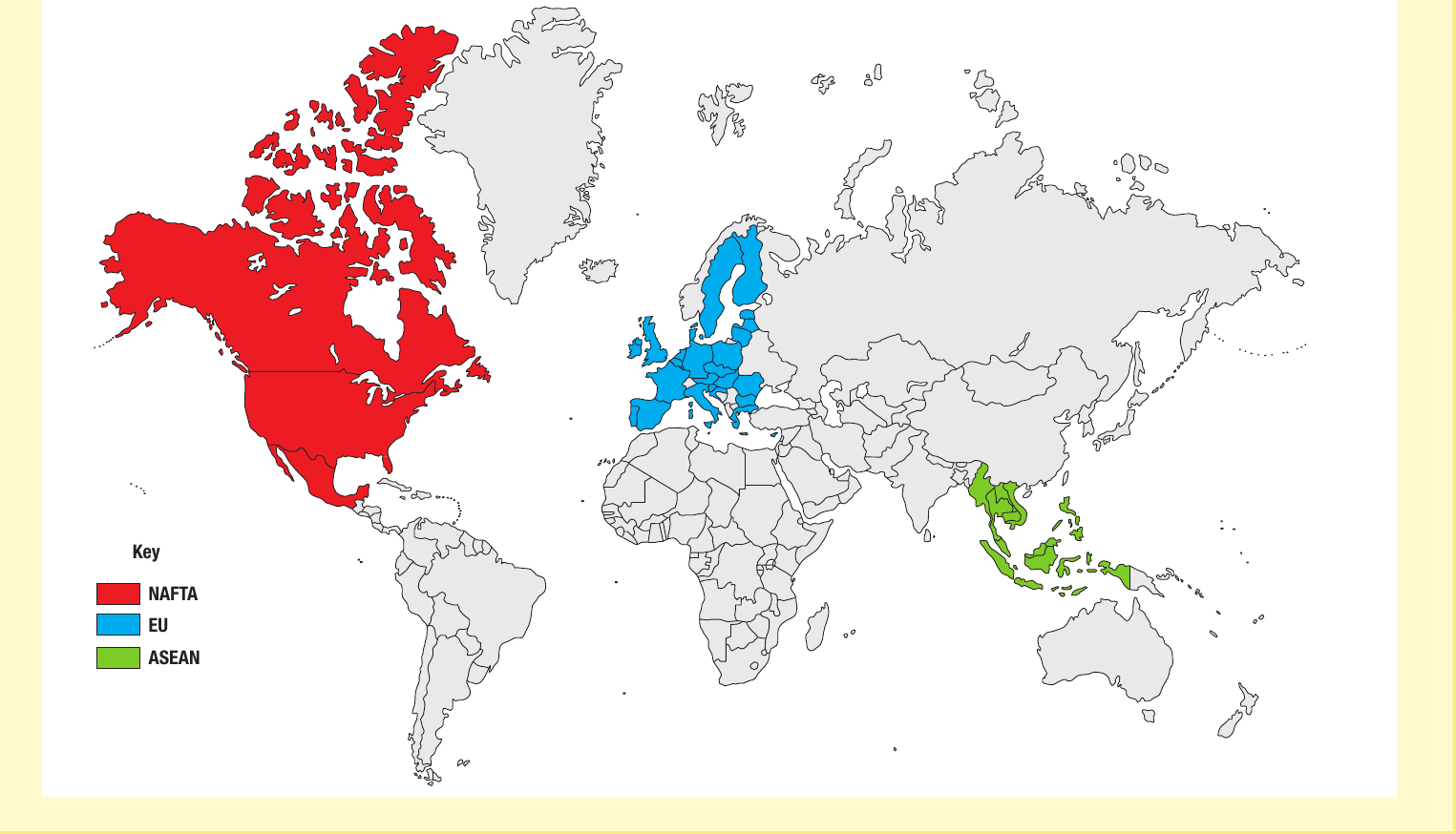

The European Union (EU) and the single market
The European Union is the world's most powerful and integrated trading bloc. It began in 1993 with six founding members and has expanded to 28 member countries (as of 2015), covering most of Europe.
Key developments:
- Single European Act (1987) – supported internal liberalisation and began removing barriers to cross-border trade
- Maastricht Treaty (1992) – formally created the European Union
- Monetary union (2002) – introduced the euro as a common currency for most members
Single market features:
The EU operates as a single market, which guarantees:
- Free movement of people – EU citizens can live and work in any member state
- Free movement of goods – products entering at any EU border can move freely throughout the bloc without customs duties, taxes, or quotas
- Free movement of services – businesses can offer services across all member states
- Free movement of capital – investment and financial flows face no restrictions
- Harmonised standards – laws, policies, and regulations are aligned across key areas
- Common currency – the euro is used by most (but not all) member states
Note
Benefits for businesses:
Businesses operating in EU countries can:
- Compete equally across all member states
- Operate to similar standards and regulations everywhere
- Use a single currency (euro) for most transactions
- Move goods without customs delays or costs
- Recruit workers from any member country
Important
Important exceptions:
Integration is not complete. Some European countries (Iceland, Norway, Liechtenstein, Switzerland) are not EU members. Additionally, the UK, Denmark, and Sweden chose not to adopt the euro, retaining their own currencies. Cultural differences also persist – countries maintain distinct languages, customs, and traditions.
ASEAN free trade agreement
The Association of Southeast Asian Nations (ASEAN) was established in 1967 to promote growth, social progress, and regional stability in Southeast Asia. It includes 10 member countries: Indonesia, Malaysia, Philippines, Singapore, Thailand, Brunei, Cambodia, Laos, Myanmar, and Vietnam.
Current status:
ASEAN operates as a free trade area covering over 500 million people. Members have eliminated tariffs between themselves and completed additional free trade agreements with major partners including China, Korea, Japan, Australia, India, and New Zealand.
Future plans – ASEAN Economic Community (AEC):
ASEAN is working toward becoming a common market called the ASEAN Economic Community. This would enable:
- Free flow of goods and services
- Free movement of investment, labour, and capital
- Coordinated policies across multiple areas
Areas of cooperation:
- Macroeconomic and financial policy
- Labour policies, education, and professional qualifications
- Infrastructure and communications
- E-commerce
- Regional sourcing
Note
Challenges:
Progress toward full integration varies. More developed members (Singapore, Thailand, Philippines, Malaysia, Indonesia, Brunei) are ready for deeper integration, while others (Cambodia, Vietnam, Laos, Myanmar) are still working to eliminate tariffs completely.
Significance:
Southeast Asia is economically, politically, and culturally diverse. ASEAN's success in creating a functioning free trade area demonstrates that regional cooperation can work even among very different countries.
NAFTA (North American Free Trade Agreement)
NAFTA was established in 1994 as a free trade area linking Canada, Mexico, and the United States. It is one of the world's largest trading blocs by economic size.
Key features:
NAFTA covers:
- Trade in goods (eliminating tariffs on most manufactured products)
- Investment (treating foreign investors from member countries as domestic investors)
- Labour standards
- Financial dealings
- Intellectual property rights
- Environmental issues
Important
What NAFTA does NOT include:
Unlike the EU, NAFTA does not have:
- A common external trade policy (each country negotiates independently with non-NAFTA countries)
- Coordinated exchange rate policies
- Free movement of labour
- Aspirations to become a common market
Sovereignty concerns:
The United States dominates NAFTA, with a GDP ten times larger than Canada and Mexico combined. This raises dependency concerns for the smaller members. To address this, NAFTA includes a dispute resolution system designed to balance each member's rights and obligations, though critics argue enforcement is weak.
Note
Benefits:
NAFTA has delivered benefits including:
- Lower prices for agricultural products (especially for US and Canadian consumers)
- Larger, more diverse markets for sellers
- Access to lower-cost production locations closer to home
Important
Criticisms:
Some argue NAFTA has harmed Mexico, particularly small farmers. When heavily subsidised US corn flooded the Mexican market, it initially benefited consumers through lower prices. However, the competition drove many small Mexican farms out of business. Later, when the US diverted corn to ethanol production, supplies to Mexico dried up, but the farms that once grew corn no longer existed. This caused corn prices to surge, hurting Mexican consumers who depend on corn for tortillas, a staple food.
Impact on businesses
Trading blocs significantly affect how businesses operate and expand internationally. Understanding these impacts is crucial for strategic decision-making.
Opportunities:
- Market access – businesses can reach larger markets without tariff barriers
- Lower costs – reduced logistics costs and no customs duties within the bloc
- Labour mobility – (in common markets and single markets) ability to recruit workers from across the region
- Simplified regulations – harmonised standards make compliance easier
- Investment flows – easier to invest and establish operations in member countries
Challenges:
- Competition – businesses face more competitors from across the bloc
- Rules of origin – must prove products meet local content requirements
- External barriers – trading blocs may create higher barriers against non-member countries
- Regulatory complexity – must understand and comply with bloc-wide rules
- Political risks – changes to bloc membership or rules can disrupt business plans
Summary
Remember!
-
Trading blocs are groups of countries that reduce or eliminate trade barriers between members through regional trade agreements (RTAs).
-
Trading blocs exist on a spectrum of integration: preferential trading areas → free trade areas → customs unions → common markets → single markets → economic and monetary unions. Each level adds deeper cooperation.
-
The three major trading blocs are the EU (economic and monetary union), ASEAN (free trade area moving toward common market), and NAFTA (free trade area).
-
The EU single market is the most integrated trading bloc, with free movement of goods, services, labour, and capital, plus harmonised standards and a common currency (euro) used by most members.
-
Rules of origin in free trade areas require products to contain a specified amount of content from within the bloc to qualify for tariff-free treatment.
-
Trading blocs create both opportunities (larger markets, lower costs) and challenges (increased competition, complex regulations) for businesses.