Market Failure and Externalities (Edexcel A-Level Economics A): Revision Notes
📚Revision Notes
Market Failure and Externalities
Understanding market failure
Markets typically help allocate resources efficiently through the price mechanism. However, situations arise where free markets fail to produce the best outcome for society. This happens when the market equilibrium moves away from the socially optimum position.
Note
Market failure occurs when free markets do not lead to the best possible allocation of resources for society. This means either too much or too little of a good is produced and consumed compared to what would be ideal from society's perspective.
This chapter focuses particularly on one important cause of market failure: situations where market prices fail to reflect the full costs and benefits of transactions. Many economic activities involve costs or benefits that affect people who are not directly part of the transaction.
Causes of market failure
Market failure can occur for several reasons:
- Externalities: Costs or benefits that affect third parties not involved in market transactions
- Information gaps: When buyers or sellers lack complete information about market conditions
- Public goods: Goods that cannot be provided efficiently by free markets due to their special characteristics
Important
When these issues exist, the market equilibrium diverges from the position where marginal social cost equals marginal social benefit. The market therefore fails to reach the socially optimum position.
What are externalities?
An externality refers to a cost or benefit that falls on third parties who are not directly involved in a market transaction. Because these costs or benefits are external to the market mechanism, they are not reflected in market prices.
When externalities exist, a price emerges in the market that does not equal the 'true' marginal cost. This creates a divergence between what is best for individual decision-makers and what is best for society as a whole.
Note
Key Concept: When producers and consumers make decisions, they consider only the private costs and benefits they personally face. They do not account for any additional costs or benefits their actions impose on others in society. This means decisions based purely on private considerations will not align with society's best interests.
Components of social costs and benefits
To understand externalities fully, we need to distinguish between private and social costs and benefits:
Note
Understanding Costs and Benefits
Costs:
- Private cost: The cost incurred directly by a firm or consumer in their economic activities
- External cost: Additional costs imposed on third parties that are not reflected in market prices
- Social cost: The total cost to society, calculated as private cost plus external cost
Benefits:
- Private benefit: The benefit received directly by the individual firm or household engaged in the economic activity
- External benefit: Additional benefits received by society beyond those captured by the individual
- Social benefit: The total benefit to society, calculated as private benefit plus external benefit
Types of externalities
Externalities can be classified in two ways:
By impact:
- Negative externalities: Where external costs are imposed on third parties
- Positive externalities: Where external benefits are enjoyed by third parties
By source:
- Production externalities: Arising from the production activities of firms
- Consumption externalities: Arising from the consumption activities of individuals
Negative production externalities
When firms produce goods, they may impose costs on society that exceed the private costs they face. This creates a negative production externality.
Example
Example: Toxic Fumes from a Factory
Consider a factory located in a town centre that emits toxic fumes during production. Nearby residents must wash their clothes more frequently and face higher medical bills from breathing the polluted air. These residents bear costs resulting from the factory's production, even though they are not involved in the transaction between the factory and its customers.
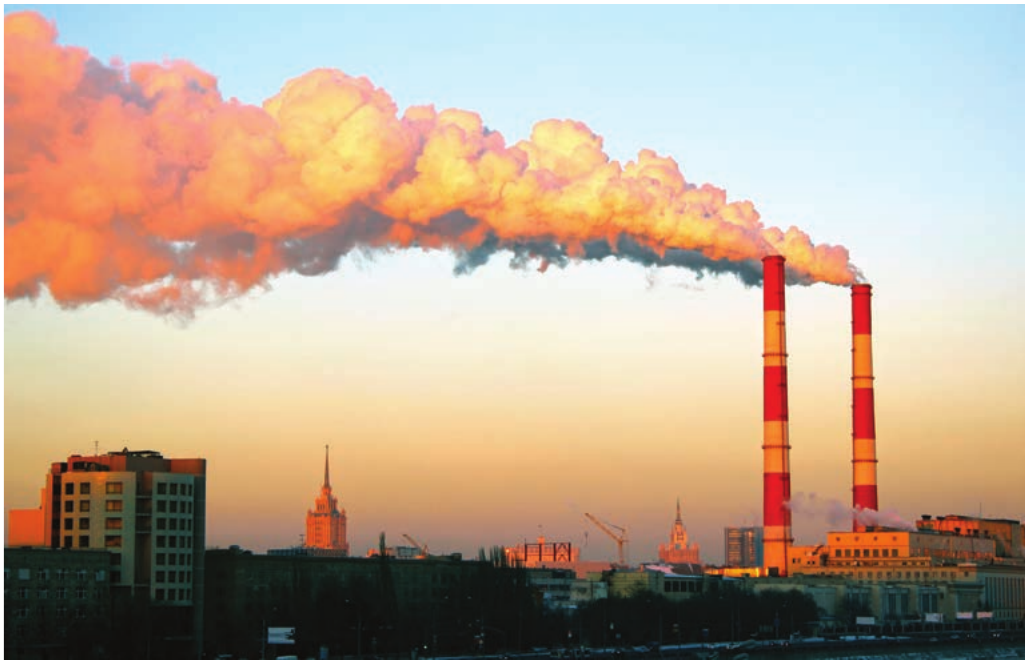
The factory makes production decisions based only on its private costs, ignoring the external costs it imposes on local residents. This means the social cost of production (which includes both private and external costs) is higher than the private cost the firm actually faces.
Diagram analysis: negative production externality
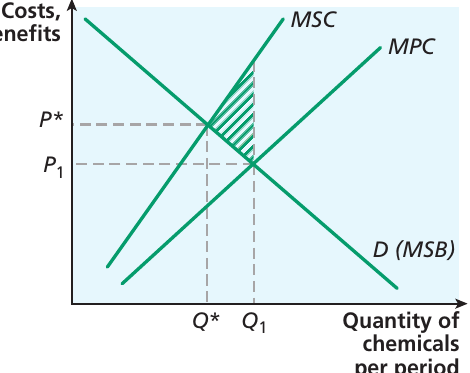
This diagram illustrates the negative production externality situation. The key elements are:
- D (MSB): The demand curve represents the marginal social benefit consumers receive from the good
- MPC: The marginal private cost curve shows the costs faced by producers
- MSC: The marginal social cost curve includes both private and external costs
Because producers only consider their private costs, they will supply where MPC intersects demand, producing quantity at price . However, the socially optimum quantity is , where marginal social benefit equals marginal social cost, at price .
The market produces too much of the good ( instead of ). The shaded triangular area represents the welfare loss to society - the difference between marginal social cost and marginal social benefit for all units produced between and . Each unit beyond imposes higher costs on society than the benefit it provides.
Important
Key Insight for Exams: When negative production externalities exist, overproduction occurs. The free market equilibrium involves producing too much of the good compared to the socially optimal level.
Positive consumption externalities
Some consumption activities create benefits that extend beyond the individual consumer. This creates a positive consumption externality.
Example
Example: Christmas Decorations
Imagine residents on a street who decorate their homes with elaborate Christmas lights during December. While these residents gain personal enjoyment from their decorations, passers-by and neighbours also benefit from the festive atmosphere created. The social benefit of the decorations exceeds the private benefit received by the decorators themselves.
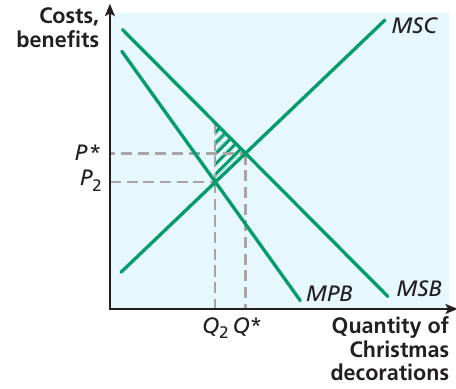
In this diagram:
- MPB: The marginal private benefit curve shows what residents are willing to pay based on their personal enjoyment
- MSB: The marginal social benefit curve includes both private benefits and the external benefits enjoyed by the wider community
- MSC: The marginal social cost of providing the lights
Residents decide how many decorations to provide by balancing their marginal private benefit against the marginal cost, choosing quantity . However, if the full social benefits were considered, the optimal quantity would be , where marginal social benefit equals marginal social cost.
The market provides too few decorations ( instead of ). The shaded triangle shows the potential welfare gain that society misses out on - the additional social benefit that could be achieved by moving from to .
Important
Key Insight for Exams: When positive consumption externalities exist, under-consumption occurs. The free market provides too little of the good compared to the socially optimal level.
Positive and normative considerations
The Christmas lights example reminds us about the distinction between positive and normative analysis. Economists might agree that Figure 6.2 correctly shows the effects of a beneficial consumption externality. However, not everyone would agree that elaborate Christmas decorations provide such benefits. Some might argue the decorations are excessive, create distractions for drivers, or are inappropriate. This represents where normative judgements come into play.
Examples of externalities in different markets
Externalities appear throughout the economy and represent a significant source of market failure. Understanding real-world examples helps illustrate why externalities prevent optimal resource allocation.
Environmental externalities
Environmental issues are particularly prone to externality problems, as environmental costs often fall on people who are not directly involved in the economic activities causing the damage.
Global warming and climate change
Greenhouse gas emissions from transport and industry warm the planet, causing sea level rises and extreme weather conditions including heat waves, forest fires, storms and flooding. The issue is particularly challenging because actions taken by one country affect other countries.
Note
Wealthier nations causing most pollution face only partial costs, while poorer nations often suffer the worst consequences. For example, Bangladesh experiences severe flooding almost annually, with sometimes three-quarters of the land area underwater during flood peaks.
This resembles the factory pollution example - it is a negative production externality where nations causing damage face only part of the total costs. Without regulation, too much pollution is produced.
International cooperation attempts to address this include:
- The Kyoto Protocol (1997) - aimed for 6% reduction in greenhouse gas emissions by 2010
- The Paris Agreement (2015) - established a coordinated framework to tackle climate change
- The agreement faced setbacks when President Trump withdrew the USA in 2017
- President Biden rejoined the Paris Agreement in 2021
- Recent UN Climate Change Conferences (COP26 in Glasgow 2021, COP27 in Sharm el-Sheikh 2022) have reinforced commitments
Acid rain
Scandinavian countries have suffered from acid rain caused by pollution from other European nations, including the UK. Forest fires burning in Indonesia have caused air pollution in neighbouring Singapore and Malaysia. These are further examples of negative production externalities crossing international borders.
River water
Major rivers like the Nile pass through several countries on their journey to the sea. The Nile is crucial for Egypt's economy. If upstream countries increased their water usage through new irrigation projects, this could have disastrous effects on Egypt. The upstream countries would not face the full cost of their actions, as Egypt (a third party) would suffer the consequences.
Note
Property Rights and Externalities
This difficulty in enforcing property rights creates the externality problem. If countries imposing costs could be forced to compensate affected parties, this would help bring costs back within the market mechanism - a process known as 'internalising the externality'.
Biodiversity
When rainforest is cleared for soya beans or timber, plant and animal species may be eliminated before they are even discovered. Many modern medicines are based on chemicals occurring naturally in the wild. Destroying species before they have been discovered means possible scientific advances are lost forever.
Important
Measuring the value of lost biodiversity presents particular challenges, as we cannot easily value something that might not even exist yet.
Transport externalities
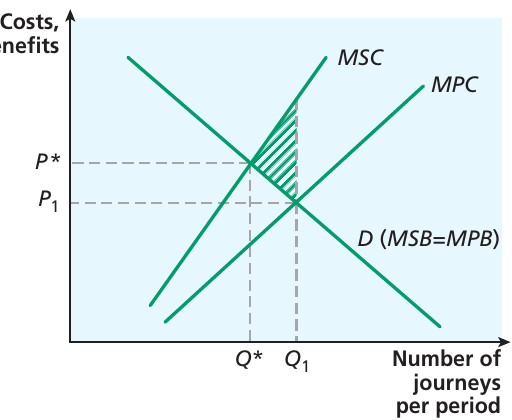
Traffic congestion imposes heavy costs on road users. When traffic volume reaches certain levels, congestion slows traffic flow significantly. This represents another form of externality.
The diagram shows the demand curve D (MSB) for car journeys along a particular road stretch. Drivers balance the marginal benefit from making journeys against the marginal cost they face, shown by MPC. When roads are congested, drivers who decide to make journeys add to congestion and slow traffic. The MPC curve incorporates the cost to motorists of joining congested roads.
However, adding to congestion imposes marginal cost increases on all other road users. Therefore, the marginal social cost (MSC) of journeys is higher than the cost faced by individual motorists. Society would be better off with fewer journeys ( instead of ), where marginal social benefit equals marginal social cost.

Note
The London Congestion Charge
The London congestion charge attempts to make drivers face at least part of the external costs they impose when using congested roads. By charging motorists to enter central London, the authorities try to ensure drivers account for some of the social costs of their journeys.
Exam Consideration: Why might a flat annual road tax not effectively control congestion? Because it doesn't vary with the actual journeys undertaken or target congested areas specifically.
Health externalities
Vaccination programmes
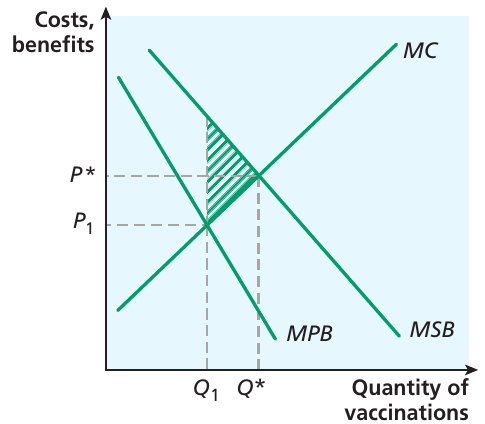
Healthcare often involves externality effects. Consider vaccination against diseases like measles. An individual deciding whether to be vaccinated will balance the marginal expected private benefit (reduced probability of contracting the disease) against the marginal cost (financial cost of vaccination, possible needle phobia, concerns about side-effects).
Individuals will choose to be vaccinated only if their marginal expected benefit is at least as large as the marginal cost. They balance marginal private benefit against marginal private cost at .
However, society gains additional benefits. When individuals are vaccinated, there is less chance of them passing the disease to others. If many people decide not to be vaccinated, a widespread epidemic becomes possible, which would be costly and damaging to many people.
Note
The social benefits to society of vaccination exceed the private benefits individuals perceive. Therefore, marginal social benefits exceed marginal private benefits. Private individuals balance marginal private benefit against marginal private cost at , whereas society would prefer more people to be vaccinated at .
This parallels the positive consumption externality discussion - society benefits more from vaccination than individuals perceive, so too few people get vaccinated from society's perspective.
The COVID-19 pandemic
During the COVID-19 pandemic, externalities became vitally important. With no vaccines initially available and little knowledge about treating the virus, containing the spread relied on individuals acting in socially desirable ways. Lockdowns and face coverings were central to preventing virus spread.
This strategy addressed the negative externalities from infected people (possibly unknowingly) passing the virus to others. Countries slow to recognise this importance, or who failed to believe in sufficient healthcare pressure, suffered huge pressure on services and substantial loss of life. Some individuals breaking social distancing rules imposed heavy costs on others. When vaccines became available, further action was needed to persuade people to be vaccinated.
Important
Dealing with these externalities had enormous economic costs, with many industries and activities closed down during lockdown periods. This created difficult decisions for political leaders balancing economic costs of lockdown against human costs of allowing the virus to spread.
Education externalities
Education represents another area where externalities are important. When you decided to study A levels (including economics), several factors probably influenced your decision. Perhaps you intend to pursue further education at university. Your decision process likely considered that education improves your future earnings potential.
Research shows that, on average, graduates earn more during their lifetimes than non-graduates. This partly reflects a productivity effect - becoming educated cultivates skills that make you more productive in later life, explaining why you can expect higher lifetime earnings. There is also a signalling effect - having a degree signals to potential employers that you have the ability to cope with university study and have gained a range of skills.
Note
External Benefits of Education
However, society gains additional benefits. Evidence suggests that not only does education improve individual productivity, but a group of educated workers cooperating become even more productive. This is an externality effect, depending on interaction between educated workers. Each individual perceives only the individual benefit, not the benefits of cooperation.
When you decide to undertake education, you do so based on expected private benefits you hope to gain. However, you do not account for the external benefits through cooperation that society will gain. This is another example of a positive consumption externality.
Waste disposal and recycling
Modern society and governments face a major problem with waste disposal. Landfill is one waste management method, but it has long-term environmental effects and imposes negative externalities on people living near landfill sites.
Recycling offers an alternative, but also suffers from externality effects. Positive consumption externalities are associated with recycling - the benefits to society exceed the benefits to individuals (MSB > MPB). In such situations, there will be 'too little' recycling relative to society's best outcome, and governments or local authorities may need to find ways of encouraging households to recycle more.
Tourism externalities
As international transport has become easier and cheaper, more people want to travel to new and different destinations. For developing countries, this offers opportunities to earn much-needed foreign exchange.
However, criticism exists. Building luxury hotels amidst poverty in many developing countries is said to have damaging effects on local populations by emphasising differences in living standards. The COVID-19 pandemic's impact in hindering international travel damaged economies heavily dependent on tourism, highlighting their vulnerability.
Conversely, constructing infrastructure that tourists need may have beneficial effects on the domestic economy. Improved roads and communication systems benefit local businesses. This effect can be interpreted as an externality - local firms face lower costs as a result of facilities provided for the tourist sector.
Example
Worked Example: Pollution in a Market
| Quantity produced (thousands per week) | Marginal social benefit (\£) | Marginal private cost (\£) | Marginal social cost (\£) |
|---|---|---|---|
| 10 | 80 | 5 | 10 |
| 20 | 75 | 10 | 20 |
| 30 | 70 | 20 | 35 |
| 40 | 60 | 32 | 60 |
| 50 | 48 | 48 | 90 |
| 60 | 30 | 75 | 125 |
| 70 | 8 | 110 | 175 |
This table shows a market where pollution is generated by the production process. We can use this data to identify:
1. Socially optimal output: Where marginal social benefit equals marginal social cost - this occurs at 40,000 units per week (both equal \£60)
2. Free market output: In an unregulated competitive market, firms produce where marginal social benefit equals marginal private cost - this occurs at 50,000 units per week (both equal \£48)
3. Excess production: The market produces 10,000 units more than the socially optimal level (50,000 vs 40,000)
Conclusion: This demonstrates how negative production externalities lead to overproduction when external costs are not accounted for in decision-making.
Key diagrams for analysis
Important
Essential Diagram Knowledge for Exams
Understanding how to analyse externality diagrams is crucial for exam success. When drawing diagrams:
For negative externalities:
- MSC lies above MPC (social cost exceeds private cost)
- The shaded area represents welfare loss from overproduction
- The vertical distance between MSC and MPC represents the external cost
For positive externalities:
- MSB lies above MPB (social benefit exceeds private benefit)
- The shaded area represents potential welfare gain from moving to optimal production
- The vertical distance between MSB and MPB represents the external benefit
Essential elements:
- Demand represents consumers' willingness and ability to purchase - this is their marginal private benefit (MPB)
- Where society receives more or less benefit from consumption than consumers perceive, this affects the marginal social benefit (MSB), which includes external benefits
- Supply represents firms' willingness and ability to supply - this is their marginal private cost (MPC)
- Where society incurs more or less cost from production than firms face, this affects the marginal social cost (MSC), which includes external costs
Be very careful when identifying the welfare loss area in diagrams. The shaded triangle should be between the relevant curves over the range of output between the optimum output and the free market level of output.
Case study: healthcare provision
The NHS was founded in 1948. Seventy years later, it faced crisis, with much media discussion about failures in providing care and long waiting lists. This revitalised debate about whether healthcare should be state-provided, or whether market forces should be given a greater role.
In the UK, market forces have played an increasing part in allocating resources within the public health sector through the operation of internal markets. However, debate over public versus private provision continues. The proportion of health expenditure undertaken by the public sector has changed over time.
Economic analysis justifies public provision of healthcare based on market failure. Several reasons explain why some form of market failure might exist in healthcare provision:
Note
Vaccination Programmes and Market Failure
The justification rests on externality benefits. When vaccinations are provided by a private competitive market, individuals face costs of treatment (both financial and possible risks of being vaccinated). Benefits of vaccination may be perceived as relatively low if individuals see a low probability of infection.
However, the benefits of vaccination from society's viewpoint may be much greater, because a widespread vaccination programme not only reduces infection risk for each individual, but also reduces epidemic likelihood.
The onset of the COVID-19 pandemic focused attention on these issues. The UK government intervened with a range of measures to combat the virus. Crucial parts of these efforts were campaigns to encourage vaccine take-up when it became available, despite reluctance from some people. The campaigns highlighted the externality benefits of vaccination in helping protect the NHS and the lives of others.
Case study: plastic oceans
The contamination of the natural marine environment by plastics has been increasing, causing a range of negative effects. These include endangering marine life, damaging maritime industries and infrastructure, and potentially having impacts on human health and well-being.
This issue has been prominent in the media, and studies have sought to analyse plastics' impact on the environment. A prime source of ocean contamination is litter - about 70% of ocean litter is plastic. Much of this comprises single-use packaging, as well as rope, netting and sewage-related debris.
Note
A government report published in 2017 noted that if plastic litter continues to enter the marine environment at current rates, this would far exceed the possibility of clean-up removal. The impact of plastics on the oceans was strongly highlighted by David Attenborough's Blue Planet II documentary series on BBC TV.
Packaged goods have become a way of life, as any supermarket visit will demonstrate. Plastic is cheap and convenient, and firms facing pressure to keep costs low to remain competitive have been reluctant to use more expensive but more environmentally friendly materials.
This leads to a divergence between private and social costs. However, supermarkets now charge for plastic bags and have introduced some measures to reduce wasteful packaging. Environmentalists argue that much more could be done in this area.
Summary
Key Points to Remember:
-
Market failure occurs when free markets fail to produce the best allocation of resources. Too much or too little of a good is produced compared to the socially optimum position.
-
Externalities arise when costs or benefits are external to market transactions. These costs and benefits affect third parties not involved in the transaction and are not reflected in market prices.
-
Social cost equals private cost plus external cost. Social benefit equals private benefit plus external benefit. Markets fail because decision-makers consider only private costs and benefits.
-
Negative externalities lead to overproduction. When external costs exist (e.g., pollution), the free market produces more than the socially optimal quantity because firms don't face the full costs of production.
-
Positive externalities lead to under-provision. When external benefits exist (e.g., vaccination, education), the free market provides less than the socially optimal quantity because consumers don't perceive the full benefits to society.