The Nature of Economics (Edexcel A-Level Economics A): Revision Notes
📚Revision Notes
The Nature of Economics: Further Exploration
The three key economic questions
Economics explores fundamental questions about how societies manage their limited resources. The American economist Paul Samuelson, who won the Nobel Prize for Economic Sciences in 1970, identified three core questions that every economic system must address:
Note
The Three Fundamental Economic Questions:
1. What should be produced? This question asks which goods and services a society should produce from its scarce resources. Should the economy focus on smartphones or potatoes? Banking services or computers? Resources are limited, so choices must be made about what to prioritise.
2. How should production occur? Once society decides what to produce, it must determine the best way to use productive resources to create these goods and services. This involves decisions about production methods, technology, and resource allocation.
3. For whom should production take place? After goods and services are produced, the economy must decide how to distribute them among the population. Who will receive the output, and how will consumption be allocated?
These three questions arise because of scarcity – the fundamental economic problem that resources are finite whilst human wants are unlimited. Since choices must be made, every decision involves an opportunity cost, which represents the value of the next-best alternative that must be sacrificed.
The production possibility frontier
Economists use diagrams extensively to analyse economic concepts. One particularly useful tool for understanding opportunity cost is the production possibility frontier (PPF).
The PPF is a curve that shows the maximum combinations of goods or services that can be produced during a specific period when all available resources are fully and efficiently used. This diagram helps illustrate the constraints that scarcity places on production possibilities.
Understanding the PPF through an example
Consider a student named Asif who has limited time to complete his homework. He must answer economics questions and maths exercises, but each type takes the same amount of time. What are his options?
Asif could devote all his time to maths exercises and complete none of the economics questions. Alternatively, he could complete all the economics questions and no maths problems. Or he could find a middle ground, completing some of each subject.
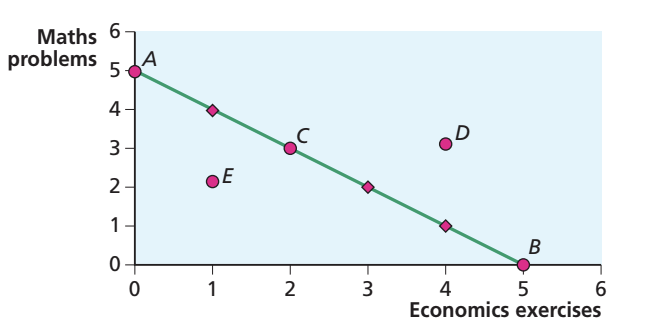
The diagram above illustrates Asif's production possibility frontier. The line represents all the maximum combinations of work he can complete. Several important points emerge:
- Point A: Asif completes 5 maths problems but no economics exercises
- Point B: Asif completes 5 economics exercises but no maths problems
- Point C: A balanced approach with both maths and economics completed
- Point D: This point lies outside the frontier and is unattainable – Asif would need more time than available to reach this combination
- Point E: This point sits inside the frontier, indicating inefficiency. Asif could complete more work without additional time by using his resources more effectively (perhaps by watching less television)
The frontier shows that as Asif moves from left to right along the line, he spends more time on economics and less on maths. The opportunity cost of tackling an additional economics question is the maths exercise he must forgo.
Applying the PPF to economic production
The same principles apply to an entire economy's production decisions. Consider a farmer with 10 hectares of land choosing between growing potatoes and onions.
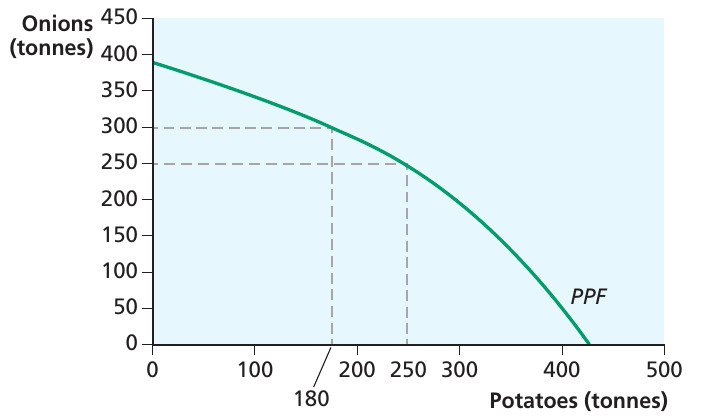
This PPF demonstrates the trade-offs the farmer faces. If 300 tonnes of onions are produced on part of the land, then 180 tonnes of potatoes could be produced from the remaining land. To increase potato production from 180 to 250 tonnes, the farmer must sacrifice 50 tonnes of onions. Therefore, the opportunity cost of producing 70 extra tonnes of potatoes is 50 tonnes of onions.
Why is the PPF curved?
Notice that in the agricultural example, the PPF curves rather than forming a straight line. This occurs because different plots of land have different characteristics, with some being better suited for potatoes and others for onions.
Note
The farmer can achieve a balanced approach by using each plot of land for the crop to which it is best suited. However, if the farmer were to specialise completely in onions (or only potatoes), the overall productivity of the land would decline. As more onions are produced, their opportunity cost in terms of potatoes increases (and vice versa). This is reflected in the steepening gradient of the PPF curve moving from left to right.
Opportunity cost and trade-offs
A trade-off occurs when choosing one alternative requires sacrificing another. In Asif's case, he faces a trade-off between time spent on economics and time spent on maths. He can only increase time on economics by reducing time on maths – he must trade off one against the other.
This concept is central to economic analysis. Throughout your studies, you will encounter many instances of trade-offs as societies and individuals make choices about resource allocation.
Consumption and investment
To understand production at the economy-wide level, we need to simplify reality. Imagine an economy that produces just two types of goods: capital goods and consumer goods.
Consumer goods are products intended for immediate use or consumption – items like food, clothing, and entertainment that satisfy current wants. Capital goods, by contrast, are goods used as part of the production process itself, such as machinery, factory buildings, and tools. Capital goods help increase the economy's future productive capacity.
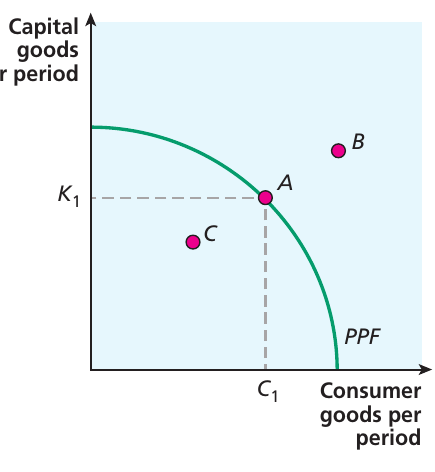
The diagram above illustrates society's options during a particular period. Given the available resources, the economy can produce any combination of capital and consumer goods along the PPF line. Point A represents one possible combination, where the economy produces C₁ consumer goods and K₁ capital goods.
Important
If society moves to the right along the PPF, it produces more consumer goods but at the expense of capital goods. The opportunity cost of producing additional consumer goods is the forgone opportunity to produce capital goods. This represents a trade-off between consumption today and investment for tomorrow.
As the economy moves towards complete specialisation in one type of good, factors of production are no longer being optimally deployed, and the opportunity cost changes. For example, if nearly all workers are engaged in producing consumer goods, it becomes increasingly difficult to produce even more, whilst those workers producing machinery find they have too few resources to work with effectively. The more consumer goods being produced, the higher their opportunity cost becomes.
Different points on the diagram
We can interpret the various points shown:
- Point A (on the frontier): The economy is productively efficient, fully utilising all resources
- Point B (outside the frontier): This combination is unattainable given current resources
- Point C (inside the frontier): The economy is not using its resources efficiently – there is unemployment or underutilisation of some resources. By making better use of available resources, the economy can move towards the frontier, reducing unemployment in the process. However, at any point on the frontier, production is productively efficient because all resources are being fully utilised.
Economic growth or decline
The previous analysis focused on a single time period. However, if the economy produces capital goods, its capacity to produce in the following period should increase, as more resources will be available for production.
The diagram can show this dynamic process. In the initial period, the production possibility frontier is at PPF₀. However, in the following period, the increased availability of capital resources enables greater production, and the frontier moves outward to PPF₁. This represents a process of potential economic growth – an expansion in the productive capacity of the economy through the increased availability of inputs.
Important
Key Principle: Producing more capital goods today means fewer consumer goods will be produced today, but this sacrifice provides more consumption possibilities in the future.
Economic growth (an outward shift of the PPF) can occur through:
- An increase in the availability of inputs (more workers, land, or capital)
- An increase in productivity, often through technological advance
- Better utilisation of existing resources
Conversely, there could be an inward shift of the PPF if:
- The availability of inputs decreases
- Productivity falls
- Resources become less usable (for example, if land floods or becomes over-farmed)
Total output in an economy
The PPF represents a simplified model of economic reality. In a real economy, many different goods and services are produced by numerous factors of production, making it impossible to draw diagrams showing all of them simultaneously.
The total output of an economy like the UK is measured by its gross domestic product (GDP), which represents the total value of economic activity carried out in an economy over a period.
By calculating the average level of GDP per person in a country, economists can derive a measure of the average amount of resources per person, or average income per head. This provides insight into living standards and economic wellbeing.
Specialisation and the division of labour
How many workers does it take to make a pin? The eighteenth-century economist Adam Smith calculated that the answer was about 10. He observed that when a single worker attempted to produce pins independently, carrying out all the various stages of the production process, the maximum number of pins that could be produced in one day was 20 – assuming the worker had the necessary technology and skills.
Example
Adam Smith's Pin Factory Observation:
When a single worker produced pins independently, carrying out all stages alone:
- Maximum output: 20 pins per day
However, when the production process was broken down into 10 separate stages, with one worker specialising in each stage:
- Maximum output: 48,000 pins per day
This represents a productivity increase of 2,400 times through specialisation!
This demonstrates the power of the division of labour – a process whereby the production procedure is broken down into a sequence of stages, with workers assigned to particular stages.
Why is the division of labour effective?
The division of labour proves effective for several reasons:
- Skill development: Individual workers become highly skilled at performing specialised tasks. By focusing on a particular stage, they become adept and efficient at carrying out that specific task.
- Natural variation: People are not all identical; some individuals are naturally better at certain activities. Specialisation allows workers to focus on tasks that suit their abilities.
- Reduced transition time: Workers do not waste time moving from one activity to another, increasing overall efficiency.
- Economies of scale: Specialisation may enable firms to operate on a larger scale of production, which can be advantageous in terms of costs and efficiency.
Advantages of the division of labour
Specialisation through the division of labour offers several benefits:
- Workers can focus on tasks they perform well, becoming more productive
- Training can be provided more cost-effectively when focused on specific tasks
- Working as a team allows greater overall output to be produced
- Firms can reduce production costs through increased efficiency
Disadvantages of the division of labour
However, specialisation can be taken too far, leading to problems:
- Workers performing narrow, repetitive tasks may find their work tedious or become bored and careless
- Boredom and dissatisfaction can lead to high staff turnover rates
- Over-specialisation makes a workforce inflexible – if a worker specialising in a key part of the production process becomes ill or leaves, it may be difficult to find cover
- Repetitive tasks may increase the risk of errors
- Workers may lose overall skills and understanding of the complete production process

This image shows employees at a BMW factory, where each worker specialises in a particular task, creating an efficient assembly line. This demonstrates the practical application of the division of labour in modern manufacturing.
Specialisation between firms and nations
The principle of division of labour extends beyond individual workers to firms and nations. In car manufacturing, for instance, the entire production process does not occur within a single firm. One firm may specialise in producing tyres, another in windscreens, whilst yet another focuses on assembling the final product. This specialisation enables efficiency gains throughout the industry.
Specialisation also occurs among nations. Some countries are better equipped to produce certain products than others due to their climate, natural resources, or expertise. For example, it would not make sense for the UK to attempt commercial production of pineapples or mangoes, as other countries have climatic conditions much more suitable for producing these products. Conversely, many Formula 1 racing teams have their headquarters in the UK, benefiting from the specialisation and expertise developed there.
Important
Potential Disadvantages of Specialisation for Firms and Nations:
-
Vulnerability to economic conditions: A firm that specialises may find itself vulnerable during recessions, or if it supplies another firm that encounters trading difficulties. If demand for its product falls, it may be forced to close down.
-
Lack of product diversification: Specialisation may discourage a firm from diversifying its product range, making it heavily dependent on a particular activity or product.
-
Strategic dependence: A nation may face particular challenges if it specialises in a strategically important product. If a country specialises in agricultural production and the price of its products falls relative to other goods, or if it becomes highly dependent on exporting goods and then experiences a global trade disruption, it can create serious economic problems. This was evident during the COVID-19 pandemic and the war in Ukraine, when countries heavily dependent on importing key items faced significant difficulties.
Markets
The term market appears frequently throughout economics, so understanding its meaning is essential. A market represents a set of arrangements that allows transactions to take place between buyers and sellers.
A market need not be a physical location, although it could be – you might think of a local farmers' market as an example of 'a set of arrangements that allows transactions to take place'. The COVID-19 pandemic accelerated the trend towards online shopping, demonstrating that everyone has become accustomed to buying and selling without direct physical contact between buyer and seller. Thus, the notion of an abstract market should not seem too unfamiliar.
For any particular product, a market brings together potential buyers and sellers, facilitating exchange and trade.
Note
Markets play a crucial role in resource allocation, with prices acting as key signals to potential buyers and sellers. If a firm discovers that it cannot sell its output at the price it has chosen, this sends a signal about how buyers perceive the product. Price represents one way that firms learn about consumers and their willingness to pay for particular products.
The functions of money
Imagine a world without money. It is lunchtime, and you fancy a banana. In your bag, you have an apple. Perhaps you can find someone with a banana who fancies an apple? But suppose the only person with a banana available fancies an ice cream. This creates a problem with such a barter system – you need to find someone who wants what you have and who has what you want. This is known as a double coincidence of wants.
If this problem were faced by an entire economic system, undertaking transactions would be so inefficient as to be impossible. This highlights the importance of money as a medium of exchange.
Money serves four essential functions in a modern economy:
1. Medium of exchange
Money must be something acceptable to both buyers and sellers. Nobody would accept money in payment for goods or services if they did not trust that they could use it for further transactions. For money to function effectively as a medium of exchange, it must be widely accepted and trusted.
2. Store of value
Money must act as a store of value – it must be possible to use it for future transactions. This quality of money means it can serve as one way of storing wealth for future purchases. Money must maintain its value over time to fulfil this function.
3. Unit of account
Money allows the value of goods, services, and other assets to be compared. It provides a common measure in which prices can be expressed. Without money, it would be difficult to compare the relative value of different goods and services. In this sense, prices of goods reflect the value that society places on them, and must be expressed in monetary terms. Money therefore serves as a measure of value.
4. Method of deferred payment
Money acts as a method of deferred payment. For example, a firm may wish to arrange a contract for the future delivery of a good, or may wish to hire a worker to be paid at the end of the month. Such contracts are typically agreed in terms of a money value, allowing for payment to be deferred to a future date.
Note
All of these functions of money are crucial to the smooth operation of markets and are essential if prices are to fulfil their role in allocating resources within society.
The coordination problem
With so many different individuals and organisations (consumers, firms, governments) making decisions, a fundamental question emerges: how does it all come together? How are all these separate decisions coordinated so that the overall allocation of resources in a society is coherent?
In other words, how can it be ensured that firms produce the goods and services that consumers wish to consume? And how can the distribution of these products be organised? These represent some of the basic questions that economics attempts to answer.
Market economy
A free market economy is one in which market forces are allowed to guide the allocation of resources within a society without intervention from government. Prices play a central role in this type of system, providing signals and incentives to producers and consumers.
Adam Smith argued that in such a system, resources would be allocated effectively (and fairly) through the operation of an 'invisible hand'. This invisible hand operates when individuals are free to pursue their own interests. Firms would produce the goods and services that consumers wish to consume, responding to price signals and market demand.
However, Karl Marx argued that in a capitalist society with private ownership of productive resources, the owners of capital would exploit their position at the expense of labour, eventually resulting in revolution. Although this did not occur as Marx expected, his critique led to a move in some countries away from private ownership of capital and towards state control of resource allocation through central planning.
Command economy
A command economy is one in which the government undertakes the coordination role, planning and directing the allocation of resources. Given the complexity of modern economies, reliance on central planning poses enormous logistical challenges.
To achieve a satisfactory allocation of resources across the economy, the government must make decisions on thousands of individual matters. For example, factories might be given production targets to fit within an overall plan for economic development. These targets then need to be met by factory managers, who face strong incentives to meet them.
Example
Problems with Central Planning: The Soviet Nail Factory
One historical example comes from the experience of central planning in Russia after the 1917 revolution. Factories were given production targets, but these were sometimes poorly designed:
- Some factories producing nails were given a target by number. They responded by producing large numbers of very small nails.
- Others were given targets by weight. They responded by producing a small number of very large nails.
Neither outcome matched what the planners intended.
Micromanagement on this scale proved costly to implement administratively. The collapse of the Soviet bloc in the 1990s largely discredited this approach, although a small number of countries (such as North Korea and Cuba) continue to use central planning. China has moved away from pure central planning by beginning to allow prices to be used as signals for resource allocation.
Mixed economy
In practice, most economies operate a mixed economy system, in which market forces are complemented by some state intervention. This approach recognises that free markets can sometimes lead to inequality in the distribution of resources in society.
It has been argued that any state intervention should be market-friendly – in other words, when governments intervene in the economy, they should do so in a way that helps markets to work more effectively, rather than trying to replace market forces entirely. In such an economy, the government plays a minimal role by setting the framework within which markets can operate.
Evaluation of economic systems
Famous economists such as Friedrich von Hayek and John Maynard Keynes were influential in shaping our understanding of different economic systems. After the Second World War, there was a move towards more government intervention in the economy, as some perceived that markets were not working effectively. For instance, Keynes had argued for more active government involvement during times of high unemployment, such as occurred in many countries during the 1930s.
Hayek, associated with the neo-Austrian School of economics, argued that such intervention would be damaging because governments face imperfect information, especially in a command economy. He maintained that markets would be more effective because they rely on people responding to signals and incentives, rather than on central direction.
Important
Comparing Economic Systems:
Free market and centrally planned economies tackle the problem of resource allocation in very different ways, but both extreme forms experience difficulties.
Advantages of free market systems:
- Prices guide resource allocation in line with consumer preferences
- Competition between firms drives innovation and efficiency in production
- Individuals have freedom to pursue their own economic interests
Disadvantages of free market systems:
- Markets do not always work effectively (as will be explored later in this course)
- Without government intervention, inequality between groups in society can arise
- The poor may not be adequately protected
Advantages of command economies:
- May achieve greater equality across society
- Government may ensure good provision of essential services
- Resources can be directed towards national priorities
Disadvantages of command economies:
- Inefficiency occurs when resource allocation is centrally directed
- Logistical problems in micromanaging a complex economic system
- Limits to inequality may be difficult to enforce if certain groups can secure more than their fair share of resources
Most modern economies operate as mixed economies, attempting to combine the benefits of market mechanisms with appropriate government intervention where markets fail to deliver optimal outcomes.
Incentives
An important concept at the heart of economic analysis is the idea that individuals respond to incentives. The coordination problem is handled differently in different forms of economy through the operation of different forms of incentive that influence decision making.
In a market economy, prices and profits provide incentives to producers and consumers. These financial signals guide economic decisions and resource allocation. In a centrally planned economy, by contrast, these incentives are replaced by state directives – the government tells producers what to produce and directs resource allocation through commands rather than market signals.
Understanding how incentives shape behaviour is crucial for analysing how different economic systems function and how individuals and firms make decisions.
Microeconomics and macroeconomics
Economic analysis can be applied in different ways, depending on whether the focus is on individual decisions or on the interactions between economic variables at the level of the whole economy.
Microeconomics deals with individual decisions taken by households or firms, or in particular markets. It examines how individual economic agents make choices and how these choices affect specific markets. For example, microeconomic analysis might investigate how a household decides how much to spend on different goods, or how a firm determines its production levels.
Macroeconomics examines the interactions between economic variables at the level of the aggregate economy. It looks at economy-wide phenomena and how different macroeconomic variables interact. For instance, macroeconomic analysis might study the overall level of prices in an economy, the overall rate of unemployment, or the average wage paid to workers in a particular industry.
In some ways, the division between these two types of analysis is artificial. The same sort of economic reasoning applies in both cases, but the focus differs. Understanding both microeconomic and macroeconomic perspectives is essential for developing a complete picture of how economies function.
Remember!
Summary
Key Takeaways:
-
The three fundamental economic questions (what, how, and for whom to produce) arise from scarcity and require every society to make choices involving opportunity costs.
-
The production possibility frontier (PPF) illustrates the maximum combinations of goods or services an economy can produce with given resources, showing the trade-offs and opportunity costs involved in production decisions.
-
Specialisation and the division of labour can dramatically increase productivity by allowing workers, firms, and nations to focus on tasks they perform most efficiently, though over-specialisation can create problems such as worker boredom and inflexibility.
-
Different economic systems (free market, command, and mixed economies) coordinate resource allocation in different ways, each with distinct advantages and disadvantages in terms of efficiency, equality, and innovation.
-
Markets and money are essential institutions that facilitate exchange and resource allocation, with money serving four key functions: medium of exchange, store of value, unit of account, and method of deferred payment.