Further Policies (Edexcel A-Level Economics A): Revision Notes
📚Revision Notes
Further Policies
Introduction to supply-side policies
While demand-side policies focus on managing the level of spending in the economy in the short run, there are also policies designed to directly influence the productive capacity of the economy. These are known as supply-side policies.
Supply-side policies are a range of measures intended to have a direct impact on aggregate supply, specifically targeting the potential output capacity of the economy. The goal is to shift the long-run aggregate supply (LRAS) curve to the right, enabling sustainable economic growth without causing inflation.
Supply-side policies can be classified into two main categories:
- Market-based policies: These rely on allowing markets to operate more freely and creating incentives for businesses and workers
- Interventionist policies: These involve direct government action to stimulate aggregate supply
Market-based policies
Market-based policies aim to improve the efficiency of markets by reducing barriers and creating better incentives for economic activity. Classical economists particularly favour this approach.
Incentive effects
One important consideration in supply-side policy is how the tax system affects people's willingness to work. The tax system needs to strike a careful balance.
Most people accept that income tax should be progressive, meaning those on higher incomes pay a higher proportion in tax. This helps redistribute income and reduce inequality. However, if marginal tax rates become too high, this can create problems:
- When marginal tax rates are very high, people keep only a small portion of any additional income they earn
- This reduces the incentive to work harder, take on extra hours, or seek promotion
- The resulting reduction in work effort can negatively affect aggregate supply
- Policy makers must balance the need for redistribution against these incentive effects
Important
Supply-side policies that improve incentives can help shift aggregate supply and increase the productive capacity of the economy. However, these policies take time to become effective, and evaluating their magnitude can be challenging.
Privatisation and deregulation
In the past, some industries were brought into public ownership with the intention of protecting consumers from exploitation. However, this approach often led to inefficiency due to inadequate incentives and accountability for managers.
Privatisation is the process of selling publicly owned enterprises back to the private sector. The intention is to improve efficiency by exposing these businesses to market competition and profit incentives.
Similarly, some industries have been heavily regulated, restricting their ability to operate efficiently. Deregulation has been proposed as a supply-side policy to remove unnecessary restrictions and allow markets to function more effectively.
Reforming the labour market
An important supply-side approach involves improving the flexibility of the labour market. Several policies fall under this category:
Limiting trade union power: Trade unions can sometimes create inflexibility in labour markets through:
- Resistance to new working practices that could improve productivity
- Pushing for wage increases that may reduce employment levels
Note
Any measures to limit union power must be balanced against the need to protect workers' rights.
Minimum wage considerations: Some economists have argued that abolishing the minimum wage would improve labour market flexibility. However, this must be carefully weighed against the need to protect low-paid workers from exploitation.
Macroeconomic stability and flexibility: Maintaining stable economic conditions through disciplined fiscal and monetary policy helps markets function more effectively. When the macroeconomy is stable, price signals work better, allowing producers to observe changes in relative prices more clearly. This promotes more efficient resource allocation.
Improving incentives
The level of unemployment benefit can significantly affect labour supply, particularly for low-income workers. If unemployment benefits are set too high:
- Some workers may find it more attractive to remain on benefits rather than accept low-skilled, low-paid employment
- This inhibits labour force participation and reduces aggregate supply
A reduction in unemployment benefit may encourage more people to seek work, shifting the aggregate supply curve to the right. However, this policy requires careful design because:
- It must provide adequate protection for those genuinely unable to find work
- Benefits shouldn't be reduced so much that workers become unwilling to leave jobs to search for better opportunities, as this reduces labour market flexibility
Income tax cuts can also be used to improve work incentives by allowing people to keep more of their earnings.
Interventionist policies
While market-based policies rely on freeing up markets, interventionist policies involve direct government action to stimulate aggregate supply.
Education and training
One of the most important interventionist supply-side policies is investment in human capital through education and training.
School and college education: Providing quality education prepares workers with skills needed for the workplace. Key points include:
- The curriculum should be designed to provide useful skills
- However, education doesn't have to be narrowly focused on workplace skills
- Problem-solving and analytical skills can be developed through studying a wide range of subjects

Adult education and retraining: Education and training for adults is also crucial. When the economy's structure changes, workers must be able to move between sectors and occupations. This is essential to prevent structural unemployment becoming a major problem.
Example
Real-World Application: Sector Transitions
Workers displaced from manufacturing may need retraining to find jobs in the service sector. Similarly, workers in agriculture in developing countries may need training before becoming productive members of the industrial workforce.
These examples demonstrate how education and training enable workers to adapt to economic changes and remain employable.
Market failures in training: The market may not deliver sufficient training because:
- Firms are reluctant to invest in training workers if competitors might poach them after training
- The government may need to provide incentives to encourage training
Note
The NEET problem: Young people aged 16-18 who are not in education, employment or training (known as "NEETs") represent a particular concern. In the first quarter of 2022, approximately 2.9% of 16-17 year-olds and 11.3% of 18-24 year-olds were in this category.
The diagram below shows how education and training policies can affect aggregate supply:
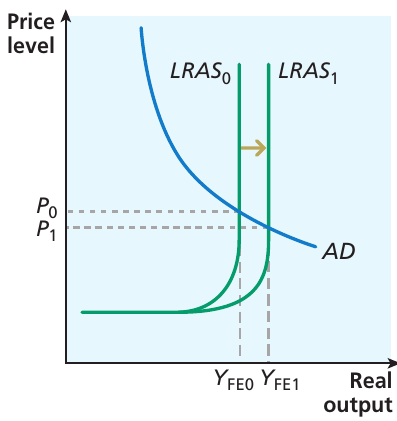
When education and training policies successfully increase the skill level and productivity of workers, the LRAS curve shifts from to . This increases the economy's potential output from to . Importantly, the price level falls from to , demonstrating that this growth is non-inflationary.
Infrastructure
Government expenditure on infrastructure is another crucial interventionist policy. Infrastructure includes:
- Efficient transport networks
- Communication systems
- Other facilities that enable markets to operate effectively
Important
Infrastructure has public goods characteristics, meaning markets will not provide adequate levels through the free market mechanism alone. Therefore, government intervention is necessary to ensure sufficient infrastructure provision.
Promotion of competition
International organisations like the World Bank and IMF have emphasised the importance of promoting competition in economies. Competition can improve aggregate supply in several ways:
Monopoly power: A monopoly firm in a market may use its market power to:
- Restrict output to raise prices and maximise profits
- If forced to face competition, the firm may increase output and reduce prices to protect its market share
Productive efficiency: The intensity of competition affects firms' willingness to improve productivity. In markets with little competition:
- Firms may become complacent
- There's less incentive to operate at maximum efficiency
This was particularly evident in the UK's formerly nationalised industries such as electricity and gas supply, which were believed to operate with widespread productive inefficiency. Policies promoting competition can therefore lead to efficiency improvements.
Plugging information gaps
Information gaps represent a form of market failure. One area where this creates problems is in the labour market. Workers may lack adequate information about:
- Job opportunities in other regions of the economy
- Available positions in different sectors
By providing information about job vacancies, authorities can encourage worker mobility, improving how the labour market operates. Subsidies for key workers in regions with high housing and transport costs may also encourage labour mobility and serve as a useful interventionist strategy.
Evaluation of supply-side policies
Strengths
Supply-side policies have several advantages:
- They target specific problems that can inhibit economic growth by limiting productive capacity
- They focus on long-term improvements to the economy's potential output
- There tends to be less uncertainty compared to demand-side policies about their general direction of effect
Weaknesses
However, supply-side policies also have limitations:
- Time lags: Education, training and infrastructure investment are long-term projects and not fast-acting
- Evaluation difficulties: The magnitude of effects can be challenging to predict
- Trade-offs: Some policies require careful balancing. For example, lowering unemployment benefits to encourage work may cause hardship for those genuinely unable to find employment
- Conflicting effects: Reducing benefits too much might make workers unwilling to leave jobs to search for better opportunities, potentially inhibiting labour market flexibility
Conflicts in the implementation of policy
Designing economic policy often involves juggling multiple objectives. Conflicts and trade-offs can arise between different policy targets.
Unemployment and inflation: The Phillips curve
In 1958, New Zealand-born economist Bill Phillips discovered an important empirical relationship. He found data showing an inverse relationship between the unemployment rate and the rate of change in money wages. This was generalised into a relationship between unemployment and inflation, known as the Phillips curve.
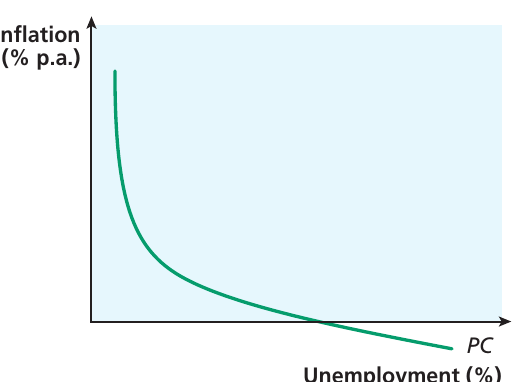
The basic Phillips curve shows a negative relationship between unemployment and inflation. The curve's logic is:
- When demand for labour is high (unemployment is low), firms bid up wages to attract workers
- These higher wages are passed on as higher prices
- Therefore, low unemployment tends to coincide with higher inflation, and vice versa
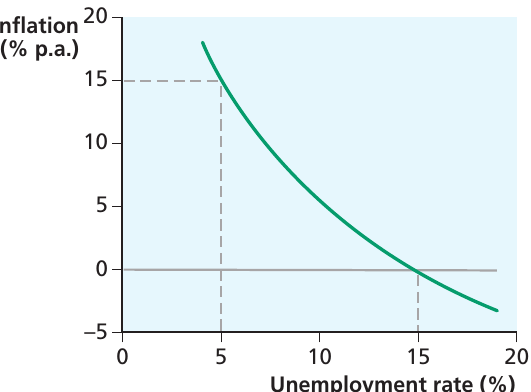
This more detailed Phillips curve shows specific values. For example, to achieve an unemployment rate of 5%, inflation might need to rise to 15% per annum, which would be unacceptable when people have become accustomed to lower inflation rates.
The Phillips curve trade-off
From a policy perspective, the Phillips curve suggests a trade-off between unemployment and inflation objectives:
- If the Phillips curve relationship holds, attempts to reduce unemployment are likely to increase inflation
- Conversely, reducing inflation is likely to result in higher unemployment
- This suggests it might be difficult to maintain full employment and low inflation simultaneously
Note
The Phillips curve offers a tempting prospect to policy-makers in the short run. For example, before an election, a government might reduce unemployment to create a "feel-good factor," accepting temporarily higher inflation. After the election, this process can be reversed. This suggests the possibility of a political business cycle, where governments manipulate the economy for electoral advantage.
Stagflation and the long-run Phillips curve
The 1970s challenged Phillips curve theory when the UK economy experienced both high unemployment and high inflation simultaneously. This combination became known as stagflation.
One explanation is that the Phillips curve had not disappeared but had shifted. This could occur if wage bargaining is based on expectations about future inflation. As inflation becomes embedded in an economy and people expect it to continue, these expectations become built into wage negotiations. This means expectations about inflation influence the position of the Phillips curve.
The Phillips curve appears to have moved around over time in the UK. Particularly, the move towards inflation targeting has altered the relationship, making the Phillips curve much flatter because monetary policy has kept inflation within a narrower band than previously.
Important
Stagflation is defined as a situation where both unemployment and inflation are high at the same time.
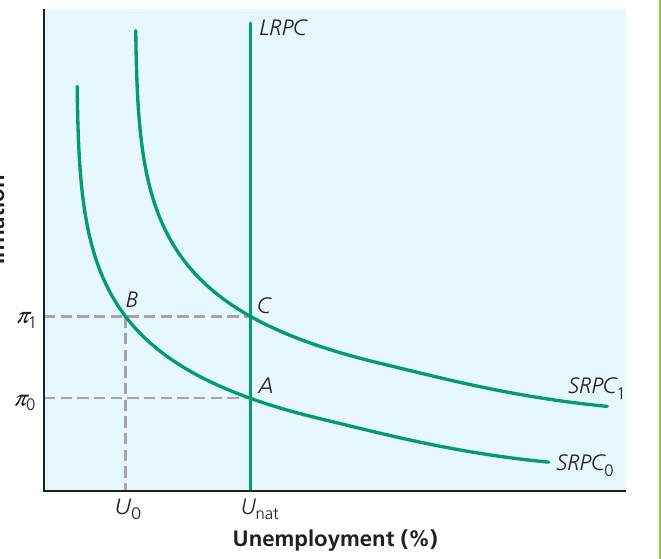
Extension: The Phillips curve in the short and long run
The Phillips curve trade-off can be reconciled with the concept of the natural rate of unemployment. The short-run Phillips curve (SRPC) shows how there can be short-run departures from the natural rate.
The long-run Phillips curve (LRPC) is vertical at the natural rate of unemployment (). If the economy always returns to the natural rate in the long run (similar to how LRAS is vertical), then the LRPC is also vertical at the natural rate.
If a government tries to exploit the Phillips curve by allowing inflation to rise to reduce unemployment below the natural rate (moving from point A to point B), problems arise:
- People realise inflation is now higher
- They adjust their expectations
- This eventually affects wage negotiations
- The Phillips curve shifts upward to a new position
- Unemployment returns to the natural rate (point C) but with higher inflation than before
Note
This natural rate of unemployment is sometimes called the non-accelerating-inflation rate of unemployment (NAIRU) because it's the rate at which the economy settles in equilibrium without accelerating inflation.
Economic growth and the current account
In some circumstances, conflict can arise between achieving economic growth and maintaining equilibrium on the current account of the balance of payments.
An increase in economic growth that raises real incomes may lead to:
- Higher imports of goods and services as UK residents spend more abroad
- A deficit on the current account
This was a major problem during the fixed exchange rate era of the 1950s and 1960s. Any deficit on the current account had to be met by running down foreign exchange reserves, leading to a "stop-go" cycle where:
- Growth would accelerate
- The current account would go into deficit
- Policy had to be adjusted to slow down growth to deal with the deficit
Economic growth and environmental sustainability
The pursuit of economic growth can have significant environmental consequences. This is clearly illustrated by the case of China in the early twenty-first century.
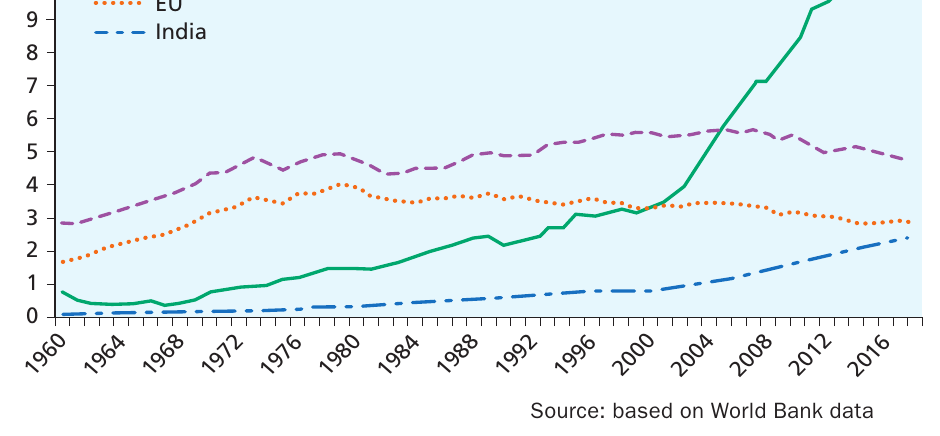
This graph shows carbon dioxide emissions for China, the USA, the EU and India from 1960 to 2016. China's rapid growth, particularly after 2000, led to dramatically increased emissions, and China became the world's largest emitter of carbon dioxide in 2005.
The connection between economic growth and environmental degradation is evident:
- During industrialisation, energy supplies must keep pace with demand
- Factories cannot operate effectively without reliable electricity and energy sources
- China became the world's biggest oil importer and the largest producer of coal
- Coal is not the cleanest energy technology
China has recognised this problem and has been attempting to reduce its dependence on coal.
Important
For economic growth to be sustainable, environmental effects must be considered. Otherwise, improved living standards today may come at the expense of future generations' quality of life.
This may require:
- Slowing growth in the short run to develop renewable and cleaner energy sources
- Devoting resources to environmental protection
However, this is politically and morally difficult to impose on newly emerging societies with widespread poverty, especially when richer nations continue to enjoy high standards of living while contributing to pollution.
Fiscal and monetary policy
Conflicts can also arise between fiscal and monetary policy. For example:
- If government increases expenditure to improve infrastructure or subsidise education and training, it may require higher borrowing
- This could push up interest rates
- Higher interest rates might lead to hot money inflows, affecting the exchange rate
- This could reduce the competitiveness of domestic goods in international markets
Note
This suggests there may be circumstances where fiscal and monetary policy conflict. Interest rates are a key part of monetary policy transmission, so coordinating fiscal and monetary policy can be naturally difficult. This is one reason why the Bank of England acts independently of the government in conducting monetary policy to meet the inflation target.
Designing the policy mix
In the context of the AD/AS model, demand-side and supply-side policies aim at achieving different objectives.
Different objectives for different policies
Demand-side policies (fiscal and monetary policy):
- Primarily aimed at stabilising the macroeconomy
- Focus on managing the level of aggregate demand in the short run
- Help prevent excessive fluctuations in economic activity
Supply-side policies:
- Geared towards promoting economic growth
- Focus on increasing the productive capacity of the economy
- Aim to shift the LRAS curve to the right
Policy coordination
The primary purpose of monetary and fiscal policies is to stabilise the macroeconomy. Fiscal policy has taken on a subsidiary role in recent decades, supporting monetary policy. This hasn't always been the case historically, and there have been periods when fiscal policy was used more actively to stimulate the economy.
Some countries still use fiscal policies very actively. For example, it has been suggested that much of Latin America's problem with high inflation stemmed from fiscal indiscipline, though not all economists accept this argument. The fact that fiscal policy has not always been well implemented doesn't mean it cannot be a valuable tool, but it does warn against misuse.
The UK experience
In the UK, using monetary policy with fiscal policy support worked reasonably effectively in the early years of the twenty-first century, at least until the global financial crisis pushed the economy into recession. The COVID-19 pandemic necessitated even stronger fiscal intervention, with significant consequences for national debt.
Long-run focus
In the long run, supply-side policies are perhaps the most important, as they contribute to raising efficiency and increasing the productive capacity of the economy. The key to effective policy design lies in enabling markets to operate as effectively as possible.
Balancing act
Designing economic policy can be seen as an elaborate balancing act. Different policy objectives need to be prioritised, and choices must be made about the balance between fiscal, monetary and supply-side policies.
The consensus view in the early twenty-first century was:
- Fiscal policy should achieve the desired balance between public and private sectors
- Monetary policy should focus on meeting the government's inflation target to create a stable macroeconomic environment
- This stability would encourage growth and enable improvements in living standards
- Problems arose when fiscal policy was forced into action to protect the economy, resulting in escalating public debt
Summary
Key Points to Remember:
-
Supply-side policies aim to increase the economy's productive capacity by shifting the LRAS curve to the right, enabling non-inflationary growth.
-
Market-based policies rely on improving incentives and market efficiency through measures like tax reform, privatisation, deregulation and labour market reforms, while interventionist policies involve direct government action such as education investment, infrastructure spending and competition promotion.
-
The Phillips curve suggests a trade-off between unemployment and inflation in the short run, though this relationship can shift over time, particularly due to inflation expectations. The 1970s experience of stagflation demonstrated that high unemployment and high inflation can occur simultaneously.
-
Policy conflicts are common - governments must balance competing objectives such as growth versus environmental sustainability, growth versus current account equilibrium, and the coordination of fiscal and monetary policy.
-
Effective policy design requires a balanced mix of demand-side policies (for short-run stabilisation) and supply-side policies (for long-run growth), with careful consideration of potential trade-offs and conflicts between different objectives.