Holy Sonnet VII ('At the round earth's imagined corners') (Edexcel A-Level English Literature): Revision Notes
📚Revision Notes
Holy Sonnet VII ('At the round earth's imagined corners')
Context
John Donne's Personal Life
- John Donne's personal life, marked by deep religious introspection and personal loss, profoundly influenced his poetry. Holy Sonnet VII ('At the round earth's imagined corners') reflects Donne's preoccupation with themes of mortality, judgement, and redemption, likely stemming from his own experiences with illness and the deaths of loved ones.
- Donne's career transition from a courtier and poet to a cleric in the Church of England is mirrored in the deep spiritual and theological concerns present in his Holy Sonnets. These sonnets often grapple with the complexities of faith, sin, and divine judgement.
Literary Context
-
Holy Sonnet VII is part of Donne's Holy Sonnets, a collection that delves into the metaphysical aspects of faith, death, and salvation. These sonnets are known for their intellectual rigour, emotional intensity, and use of elaborate conceits.
-
Donne's work fits within the broader context of metaphysical poetry, characterised by its use of paradox, irony, and a focus on the tension between the physical and the spiritual. In Holy Sonnet VII, this is evident in the imaginative imagery and theological depth.
-
The poem is influenced by the tradition of the Renaissance sonnet, which often explored themes of love and beauty, but Donne adapts this form to address spiritual and existential questions.
Historical and Political Background
- The early 17th century was a time of significant religious upheaval in England, including the tension between Protestant and Catholic factions. Donne's conversion from Catholicism to Anglicanism and his subsequent rise in the Church of England reflect these broader religious conflicts.
- The poem's imagery of the Last Judgement and the resurrection of the dead draws on contemporary religious beliefs and eschatological concerns, reflecting the era's preoccupation with the fate of the soul and the end of days.
- The Renaissance period was marked by a renewed interest in exploration, discovery, and the questioning of traditional beliefs. This era's intellectual curiosity and theological debates are reflected in Donne's exploration of the afterlife, resurrection, and divine judgement in Holy Sonnet VII.
Structure and Form
Form, Metre, and Rhyme
- The poem is a Petrarchan sonnet, consisting of 14 lines divided into an octave (eight lines) and a sestet (six lines).
- It follows a strict rhyme scheme of ABBA ABBA for the octave and CDCDEE for the sestet.
- The metre is iambic pentameter, giving the poem a steady, rhythmic quality that underscores its meditative tone.
Speaker and Setting
- The speaker addresses God and the angels, envisioning the Day of Judgement when all souls will rise to be judged.
- The setting is both cosmic and personal, as it spans the imagined corners of the earth and the intimate space where the speaker stands, pleading for God's mercy.
Poetic Devices
- Allusion: The poem alludes to biblical events such as Noah's flood and the final judgement by fire, grounding its themes in well-known Christian narratives.
- Apostrophe: The speaker directly addresses the angels and God, creating an intimate and urgent plea for divine mercy.
- Repetition: The use of repeated phrases like "arise, arise" emphasises the resurrection and the urgency of the Last Judgement.
- Asyndeton: The list of calamities that have caused death is presented without conjunctions, highlighting the overwhelming number of ways people have died and the inclusiveness of God's judgement.
Symbols
- Corners of the Earth: Symbolise the farthest reaches of the world, emphasising the universality of the Last Judgement.
- Blood: Symbolises Christ's sacrifice and the speaker's hope for redemption through divine grace.
- Trumpets: Represent the divine call to resurrection, a common biblical image associated with the end times.
Key Themes
God's Judgement and Mercy
"Teach me how to repent; for that's as good / As if thou hadst sealed my pardon with thy blood."
- The poem explores the balance between God's terrifying power to judge and His boundless mercy to forgive. The speaker seeks repentance, trusting in God's willingness to pardon even the greatest of sinners through the sacrifice of Christ.
Line by Line Analysis
Lines 1-4
At the round earth's imagined corners, blow
Your trumpets, angels; and arise, arise
From death, you numberless infinities
Of souls, and to your scattered bodies go:
"At the round earth's imagined corners, blow"
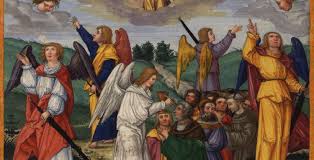
- The speaker begins with a dramatic invocation, asking angels to blow their trumpets at the earth's imagined corners.
- This phrase uses hyperbole to highlight the vast scope of the final resurrection, invoking the biblical imagery of the four corners of the earth.
"Your trumpets, angels; and arise, arise"
- The repetition of "arise" emphasises the urgency and magnitude of the resurrection.
- The trumpets signify the call to the Last Judgement, a common theme in Christian eschatology.
"From death, you numberless infinities / Of souls, and to your scattered bodies go:"
- The speaker commands the countless souls to rise from death and reunite with their bodies.
- The phrase "numberless infinities" underscores the vast number of souls, reflecting the universality of the resurrection.
Lines 5-8
All whom the flood did, and fire shall, o'erthrow,
All whom war, dearth, age, agues, tyrannies,
Despair, law, chance hath slain, and you whose eyes
Shall behold God, and never taste death's woe.
"All whom the flood did, and fire shall, o'erthrow,"
- This line references two significant biblical events: Noah's flood and the prophesied fire of the Last Judgement.
- The use of "did" and "shall" connects past and future divine judgments, creating a continuum of God's intervention in human history.
"All whom war, dearth, age, agues, tyrannies,"
- A list of various causes of death highlights the inevitability of mortality.
- The inclusion of war, famine (dearth), old age (age), disease (ages), and oppression (tyrannies) emphasises the widespread nature of human suffering.
"Despair, law, chance hath slain, and you whose eyes"
- The speaker includes psychological and arbitrary causes of death (despair, law, chance), broadening the scope of those who will be resurrected.
- The phrase "and you whose eyes" shifts focus to the living who will witness the resurrection.
"Shall behold God, and never taste death's woe."
- This line refers to those who will be alive during the Last Judgement and see God without experiencing death, drawing on the Christian belief in eternal life for the faithful.
Lines 9-12
But let them sleep, Lord, and me mourn a space,
For, if above all these, my sins abound,
'Tis late to ask abundance of thy grace
When we are there.
"But let them sleep, Lord, and me mourn a space,"
- The speaker shifts from addressing the angels to pleading directly with God.
- He asks for the dead to remain at rest ("let them sleep") and requests time ("a space") for personal mourning and repentance.
"For, if above all these, my sins abound,"
- Acknowledging his sins, the speaker fears that his transgressions outweigh those of others.
- The phrase "above all these" highlights the speaker's sense of personal guilt and unworthiness.
"'Tis late to ask abundance of thy grace / When we are there."
- The speaker reflects on the urgency of seeking forgiveness before the final judgement ("when we are there").
- He suggests that it would be too late to ask for God's grace at the moment of judgement, emphasising the need for immediate repentance.
Lines 12-14
Here on this lowly ground,
Teach me how to repent; for that's as good
As if thou hadst sealed my pardon with thy blood.
"Here on this lowly ground,"
- The speaker situates himself humbly ("lowly ground"), recognising his need for repentance in his earthly life.
"Teach me how to repent; for that's as good"
- He asks God for the ability to repent, equating true repentance with divine pardon.
- This line underscores the speaker's dependence on God's guidance for salvation.
"As if thou hadst sealed my pardon with thy blood."
- The speaker concludes by invoking the sacrificial imagery of Christ's crucifixion ("thy blood").
- This powerful metaphor highlights the speaker's belief in the redemptive power of Christ's sacrifice, equating sincere repentance with being absolved by Christ's blood.