Songs of Experience: London by William Blake (Edexcel A-Level English Literature): Revision Notes
📚Revision Notes
Songs of Experience: London by William Blake
Context
- "London" is part of William Blake's Songs of Experience, published in 1794.
- The poem reflects Blake's critique of the social, political, and economic injustices he observed in the city.
- Blake was a keen observer of the rapid changes brought about by the Industrial Revolution and the resulting impact on urban life.
- The poem serves as a powerful indictment of the corruption and oppression inherent in the institutions of Blake's time, highlighting the suffering of the marginalised and the failure of society to protect its vulnerable members.
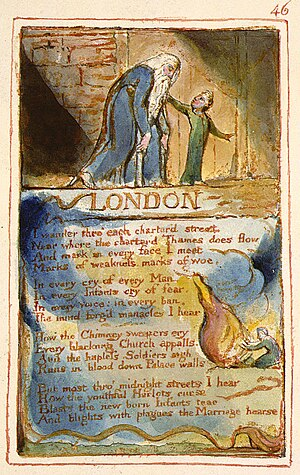
Structure and Form
- The poem consists of four quatrains.
- Each stanza follows an ABAB rhyme scheme.
- Written in iambic tetrameter, providing a rhythmic and steady beat that mirrors the relentlessness of the city.
- The regular metre and rhyme scheme create a sense of order, contrasting with the chaotic and bleak content of the poem.
Key Themes
Social Critique
- "I wander thro' each charter'd street, / Near where the charter'd Thames does flow."
- Highlights the pervasive control and regulation of public spaces and natural resources.
- Blake critiques the commodification and restriction of what should be freely accessible.
Suffering and Oppression
- "And mark in every face I meet / Marks of weakness, marks of woe."
- Describes the visible signs of suffering and despair on the faces of the people.
- Reflects the widespread impact of societal injustices on individuals.
Industrialisation and Dehumanisation
- "In every voice: in every ban, / The mind-forg'd manacles I hear"
- Refers to the psychological and emotional constraints imposed by industrial society.
- Blake uses the metaphor of "mind-forg'd manacles" to illustrate how oppression is internalised.
Corruption of Institutions
- "Every blackning Church appals, / And the hapless Soldiers sigh / Runs in blood down Palace walls"
- Criticises religious, military, and political institutions for their role in perpetuating suffering and violence.
- The imagery of blood and "blackning" highlights the moral decay within these institutions.
Loss of Innocence
- "How the youthful Harlots curse / Blasts the new-born Infants tear / And blights with plagues the Marriage hearse"
- Depicts the cycle of corruption and the destruction of innocence.
- The imagery of the harlot, infant, and marriage hearse symbolises the contamination of purity and the inevitable progression from innocence to experience.
Similar Poems
- "Songs of Innocence: Holy Thursday": Explores themes of innocence and institutional critique, focusing on the treatment of children by society.
- "The Sick Rose": Addresses themes of hidden corruption and the impact of unseen forces on purity, reflecting the darker aspects of human experience.
- "Ode to the West Wind" by Percy Bysshe Shelley: Examines themes of transformation and societal change, using natural imagery to reflect on human conditions.
- "Ode on Melancholy" by John Keats: Explores themes of transience and the interplay of joy and sorrow, reflecting the tension between innocence and experience.
Line by Line Analysis
Stanza 1
I wander thro' each charter'd street, Near where the charter'd Thames does flow. And mark in every face I meet Marks of weakness, marks of woe.
"I wander thro' each charter'd street, / Near where the charter'd Thames does flow."
- "Charter'd" refers to the regulated and controlled nature of the streets and river, highlighting the pervasive influence of authority.
- The repetition of "charter'd" emphasises the extent of this control, even over natural elements like the Thames.
"And mark in every face I meet / Marks of weakness, marks of woe."
- "Mark" functions as both a verb (to notice) and a noun (indications), emphasising the visible signs of suffering.
- The alliteration of "marks" and "woe" reinforces the sense of pervasive despair.
Stanza 2
In every cry of every Man, In every Infants cry of fear, In every voice: in every ban, The mind-forg'd manacles I hear
"In every cry of every Man, / In every Infants cry of fear,"
- The repetition of "every" emphasises the universality of suffering and fear in the city.
- Contrasts the cries of men and infants, highlighting the widespread impact of oppression on all ages.
"In every voice: in every ban, / The mind-forg'd manacles I hear"
- "Ban" refers to restrictions or prohibitions, adding to the sense of control and repression.
- "Mind-forg'd manacles" suggest psychological constraints imposed by society, indicating internalised oppression.
Stanza 3
How the Chimney-sweepers cry Every blackning Church appals, And the hapless Soldiers sigh Runs in blood down Palace walls
"How the Chimney-sweepers cry / Every blackning Church appals,"
- Highlights the exploitation of child labour and the church's complicity in societal injustices.
- "Blackning Church" suggests moral and literal pollution, critiquing religious hypocrisy.
"And the hapless Soldiers sigh / Runs in blood down Palace walls"
- "Hapless" emphasises the soldiers' helplessness and victimisation.
- The imagery of blood on palace walls symbolises the connection between military suffering and political power.
Stanza 4
But most thro' midnight streets I hear How the youthful Harlots curse Blasts the new-born Infants tear And blights with plagues the Marriage hearse
"But most thro' midnight streets I hear / How the youthful Harlots curse"
- "Midnight streets" evokes a sense of secrecy and darkness, emphasising the hidden suffering in the city.
- "Youthful Harlots curse" highlights the exploitation and corruption of young women.
"Blasts the new-born Infants tear / And blights with plagues the Marriage hearse"
- "Blasts" and "blights" suggest violent destruction and disease, indicating the pervasive impact of societal corruption.
- The juxtaposition of "Infants tear" and "Marriage hearse" symbolises the destruction of innocence and the contamination of sacred institutions.