Regions in Argand Diagrams (Edexcel A-Level Further Mathematics): Revision Notes
📚Revision Notes
1.1.6 Regions in Argand Diagrams
Overview
You also need to know how to represent regions on the Argand diagram.
A region represents a set of complex numbers that satisfy a particular condition, and these regions can take various shapes such as circles, half-planes, and areas between curves.
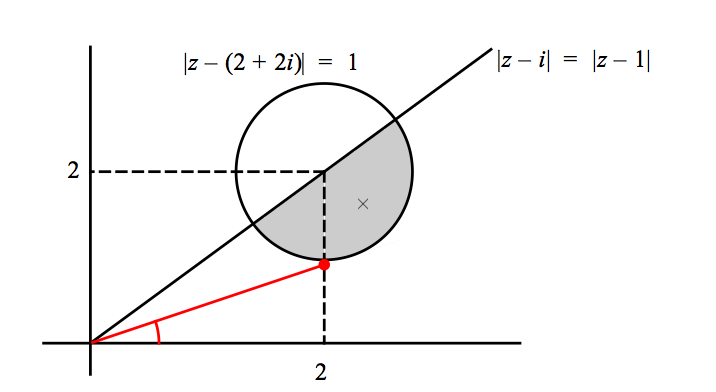
Shading Regions Based on Modulus
The modulus of a complex number gives its distance from the origin or another point on the Argand diagram. We can define regions by using inequalities involving the modulus.
Inequality of the form
- This represents the set of points inside a circle with centre at and radius
- The boundary of the circle, where , is not included in the region.
Example
Example
This inequality represents the region inside the circle with centre and radius .
All points closer than units to the point will be included in the region.
Inequality of the form
- This represents the set of points outside a circle with centre at and radius .
- The points outside the circle, but not on its boundary, are included in the region.
Example
Example
This inequality represents the region outside the circle with centre and radius .
All points farther than units from are included in the region.
Shading Regions Based on Argument
The argument of a complex number gives the angle that the line joining the point to the origin makes with the positive real axis. We can define regions using inequalities involving the argument.
Inequality of the form
- This represents a sector between two rays (lines starting from at angles and ).
- The region includes all points whose arguments fall between the two specified angles.
Example
Example
This represents the region in the first quadrant, where both the real part and imaginary part of are positive.
All complex numbers with arguments between and radians are in this region.
Combining Modulus and Argument Conditions
We can combine conditions on the modulus and argument to define more specific regions.
Example
Example and
This represents the region inside a circle with radius , but only in the first quadrant.
The points satisfy both the condition that the modulus is less than and the condition that the argument is between and
Worked Example:
Note
Question Find the region represented by and
Step 1**: Interpret the modulus inequality**
This represents the region outside the circle with centre at (i.e., the point ) and radius .
Step 2**: Interpret the argument inequality**
This represents the region below the ray that makes an angle of radians with the positive real axis.
Step 3**: Combine the two conditions**
The region is outside the circle centred at and lies below the line at an angle of
Note
Key Takeaways:
- Regions in Argand diagrams represent sets of complex numbers that satisfy conditions involving the modulus or argument (or both).
- represents the region inside a circle, and represents the region outside a circle.
- represents a sector between two rays with angles and
- Regions can be more complex when combining conditions on modulus and argument. Understanding regions helps in solving more advanced problems involving inequalities with complex numbers.