Probability Density Function (Edexcel A-Level Further Mathematics): Revision Notes
📚Revision Notes
16.1.3 Probability Density Function
Probability Density Function (P.D.F.)
- A P.D.F. is a function where areas represent probabilities. It has the following features:
- (i.e., total probability = 1)
- (i.e., no negative areas, no negative probabilities)
Worked Examples
Example
Example Give reasons why the following are not valid probability density functions.
a) — not a valid P.D.F.
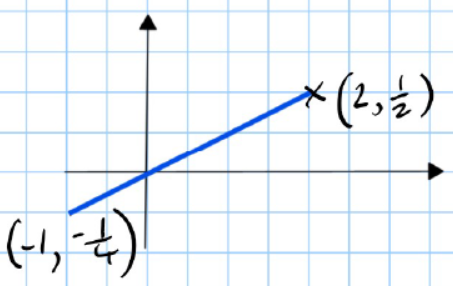
b)
, so it is not a valid P.D.F.
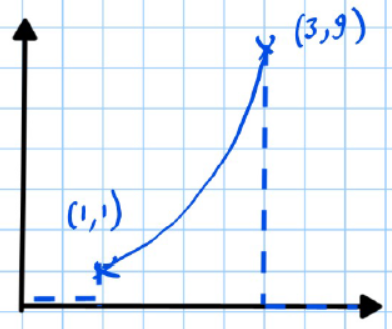
Example
Example The continuous random variable has a probability density function given by:
a) Find the value of .
b) Find
a) (Hint: Use )
b)
(Note: (infinitely thin strip))
Cumulative Distribution Function (CDF)
If is a P.D.F., the associated CDF is denoted by a capital letter, i.e., .
Main Features of CDFs
= 1 , where is the upper limit of the range/domain of validity.
= 0 , where is the lower bound of the domain of validity.
Example
Example The continuous random variable X has a probability density function given by:
Find
- Only need to go up to the specified domain of the function. Thus:
Example
Example The continuous random variable has a cumulative distribution function given by:
Find the probability density function,
- (PDF is the differential of CDF)
Thus:
Skewness of Probability Density Function
Positive Skew
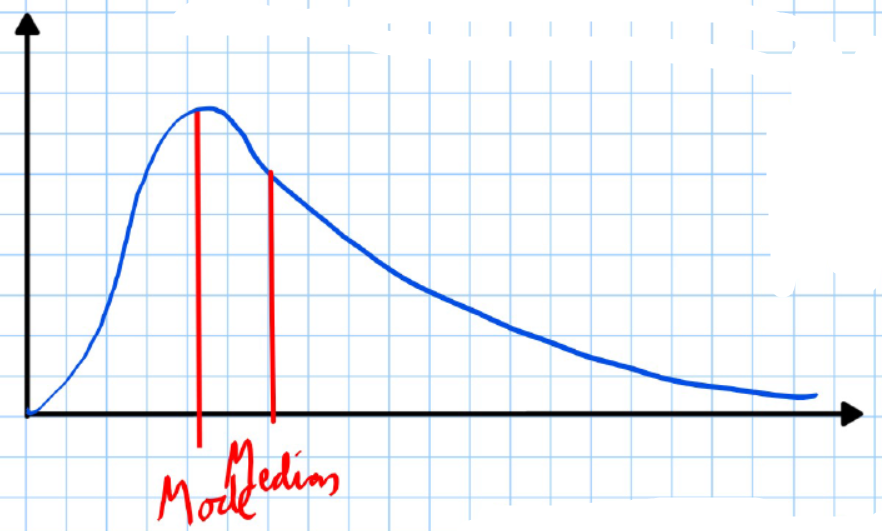
- Positive skew refers to a function that looks like it has been stretched in the positive direction.
Positive Skew
Negative Skew
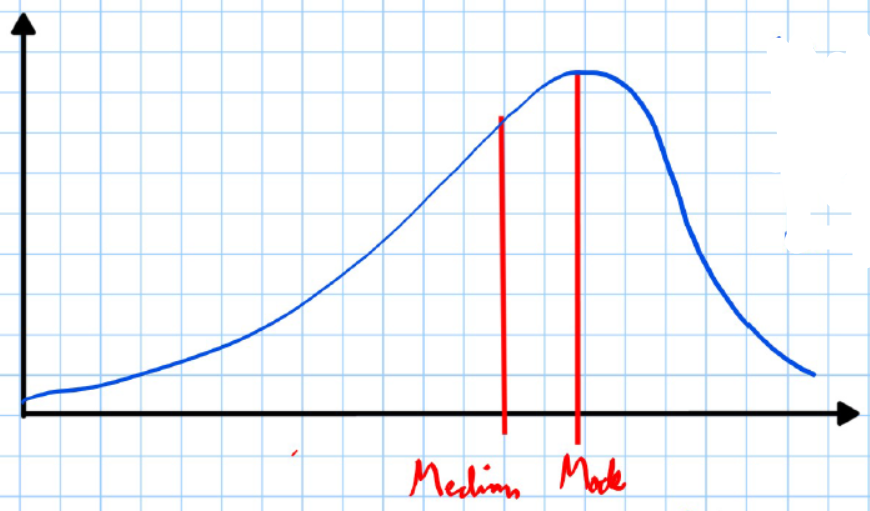
- Negative skew refers to a function that looks like it has been stretched in the negative direction. Negative Skew