Linear Transformations of DRVs (Edexcel A-Level Further Mathematics): Revision Notes
📚Revision Notes
16.1.6 Linear Transformations of DRVs
Linear Transformation of Distribution (Coding)
A linear transformation of a distribution is performing a transformation to a variable of the form
.
Example
Example Take the variable with the distribution:
Now take the distribution of :
Reason for relationship:
Consider the point:

- The mean/middle point (). If we multiply by :

- Everything is 3 x bigger and 3 x more spread out.
- The middle is 3 times bigger
- Since the spread is bigger and the variance measures squares of spreads, the new variance will be multiplied by 9.
Example
Example Consider the distribution of :
| 4 | 5 | 6 | |
|---|---|---|---|
Moving all points the same distance moves the centre of the data set that distance but does nothing to the spread.
Example
Example The random variable has mean and variance .
Find:
Combinations of Random Variables
The Sum of Two Normal Distributions
e.g., Say , and are independent. Then the sum of the two distributions is also normal:
This is proved using the Probability Density Function (P.D.F.) of the normal distribution.
This also applies to the difference of two normal distributions:
Example
Example: If and are independent, find .
Step 1: Rearrange to the form
Step 2: State the distribution of the LHS (left-hand side) of the inequality, possibly performing a substitution for presentation purposes.
- Therefore,
Step 3: Calculate the probability:
Sum / Difference of Two Poisson Distributions
The sum of two Poisson distributions leads to another Poisson distribution.
If and are independent, then:
(Table showing distributions for Binomial B(n, p) , Uniform, Geometric, and Poisson with their respective probability formulas, expectations, and variances.)
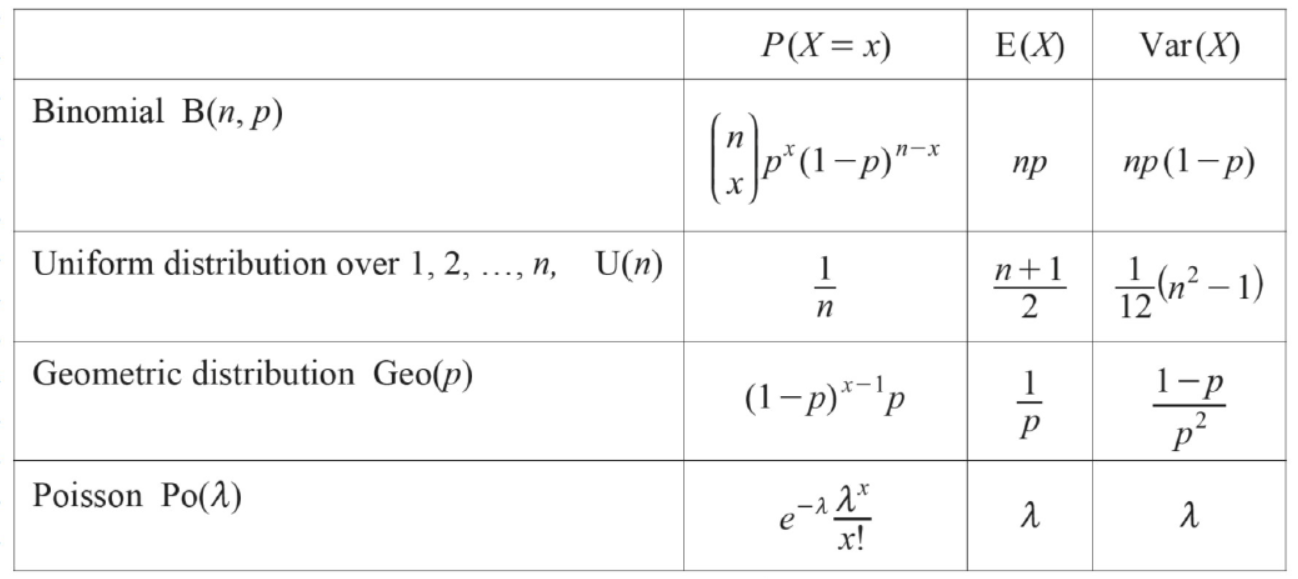
Notice the Poisson distribution has the same mean as the variance. This means that in the above definitions of and :
Therefore, X + Y has the same mean as variance.
Now consider - :
The two are different, meaning that the difference between the two Poisson distributions cannot be itself Poisson.