Spearman's Rank Correlation Coefficient (Edexcel A-Level Further Mathematics): Revision Notes
📚Revision Notes
17.1.2 Spearman's Rank Correlation Coefficient
Spearman's Rank Correlation Coefficient:
Sometimes, instead of using raw data, it's more appropriate to analyse the ranking of the data, especially when comparing subjective judgments or when raw scores are inconsistent.
Example
Example Data: The table shows the scores that two judges gave five contestants in a dance competition.
| Contestant | 1 | 2 | 3 | 4 | 5 |
|---|---|---|---|---|---|
| Judge A | 7.6 | 4.2 | 3.8 | 9.6 | 8.7 |
| Judge B | 21 | 14 | 11 | 6 | 9 |
Clearly, the judges have different views on how to score system works, the raw data seem less meaningful. However, what is important is low well the judges think constants did compared to each other.
Calculate Spearman's Rank Correlation Coefficient:
Ranking the Data:
Using a consistent ranking system:
| Contestant | 1 | 2 | 3 | 4 | 5 |
|---|---|---|---|---|---|
| Judge A (Rank) | 3 | 4 | 5 | 1 | 2 |
| Judge B (Rank) | 1 | 2 | 3 | 5 | 4 |
Differences and Squared Differences:
Calculate the difference in ranks, , and then the square of the differences, :
| Contestant | 1 | 2 | 3 | 4 | 5 |
|---|---|---|---|---|---|
| 2 | 2 | 2 | -4 | -2 | |
| 4 | 4 | 4 | 16 | 4 |
Total .
Apply the Formula:
The formula for Spearman's Rank Correlation Coefficient :
Substituting the values:
Conclusion:
- Conclude (using the word "agreement" rather than "correlation".
- There seems to be fairly strong disagreement between the two judges about the relative performance of the dancers.

Note that "no agreement" is different than "disagreement".
Calculating on a calculator:
Follow the method for '' but simply input rankings.
Least Squares Regression Line for Coded Data
Coding is the transformation of data to make it easier to work with, read, and analyse.
Example
Example:
- The following data is to be analysed and the least squares regression line calculated:
To make the data easier to input, it makes sense to transform it using coding:
Let and let .
Step 1: This variable appears to have been controlled, so we should calculate on .
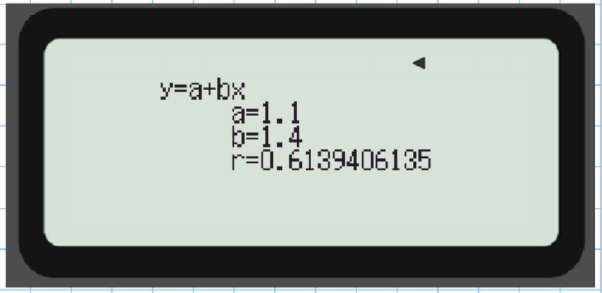
Using the regression formula :
Thus, the equation becomes:
Step 2: To get the original equation back, simply reverse the substitution:
Verifying: