Central Limit Theorem (Edexcel A-Level Further Mathematics): Revision Notes
📚Revision Notes
18.1.1 Central Limit Theorem
Central Limit Theorem
We already know that if .
The central limit theorem states that for any distribution with mean \mu and variance \sigma^2, the sample mean is distributed as follows:
For non-normal populations with large sample size n, this relationship is only approximate. For normal populations, it is exact.
Note: The central limit theorem only applies to the approximate case for non-normal or unknown distributions.
Worked Examples
Example
Example Alex obtained the actual waist measurements, in inches, of a random sample of 50 pairs of jeans, each of which was labelled as having a 32-inch waist. The results are summarised by:
Test: At the 0.1% significance level, whether this sample provides evidence that the mean waist measurement of jeans labelled as having 32-inch waists is in fact greater than 32 inches. State your hypotheses clearly.
Hypotheses:
By the central limit theorem, since n is large, the sample mean is distributed approximately as:
where is estimated by .
Calculating :
Thus:
The test statistic is:
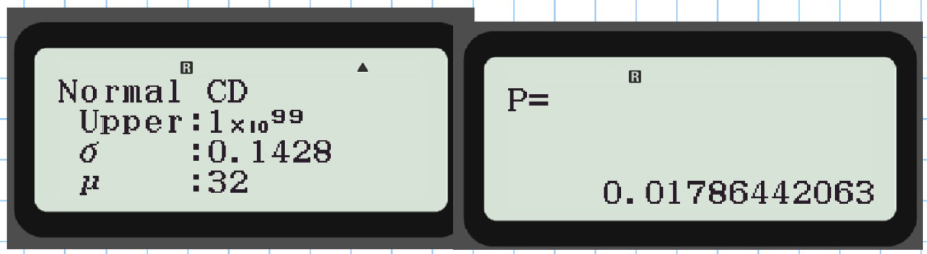
Since:
We accept .
There is insufficient evidence to suggest that the mean waist size is greater than 32 inches.
Note
Q5. (June 2018, Q4) The discrete random variable Y has a probability distribution given by:
| y | 0 | 1 | 2 | 3 |
|---|---|---|---|---|
| P(Y = y') | 0.4 | 0.2 | 0.3 | 0.1 |
Entire population data
denotes the mean of 50 random independent observations of .
(i) Find the approximate distribution of , giving the value(s) of any parameter(s).
(ii) State the possible values taken by in the range from to inclusive.
Solution:
(i) Since n = 50 ≥ 25, by the central limit theorem, we know:
by Central limit Theorem
We calculate:
Thus:
(ii) Possible values for in the range 1.4 to 1.5 are:
Goes up in thus as we divide by 50.