The Poisson Distribution (Edexcel A-Level Further Mathematics): Revision Notes
📚Revision Notes
19.1.1 The Poisson Distribution
Exponential Distribution
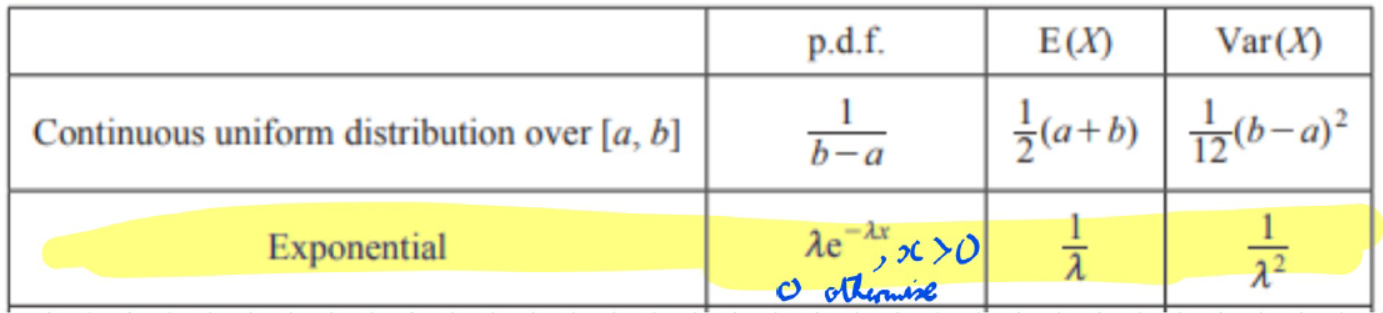
The exponential distribution is the continuous equivalent of the Poisson distribution. It can be used to model the time between events occurring rather than just the number of events, as the Poisson distribution models.
Example
Example (Q1, Jun 2008, Q4): The lifetimes of electrical components follow an exponential distribution with a mean of 200 hours.
, so .
(a) Calculate the probability that the lifetime of a randomly selected component is:
- (i) less than 120 hours;
- (ii) more than 160 hours;
- (iii) less than 160 hours, given that it has lasted more than 120 hours. (b) Determine the median lifetime of these electrical components.
(a.i)
The integral for part (i) is calculated:
(a.ii)
(a.iii)
(a.iv)
Poisson Distribution
This distribution is used to model events that are:
- relatively rare
- occur at a constant average rate
- are independent of each other
Example
Example: The number of accidents per month on a particular stretch of road can be assumed to be rare, occurring at a constant average rate, and (probably) independent of previous accidents.
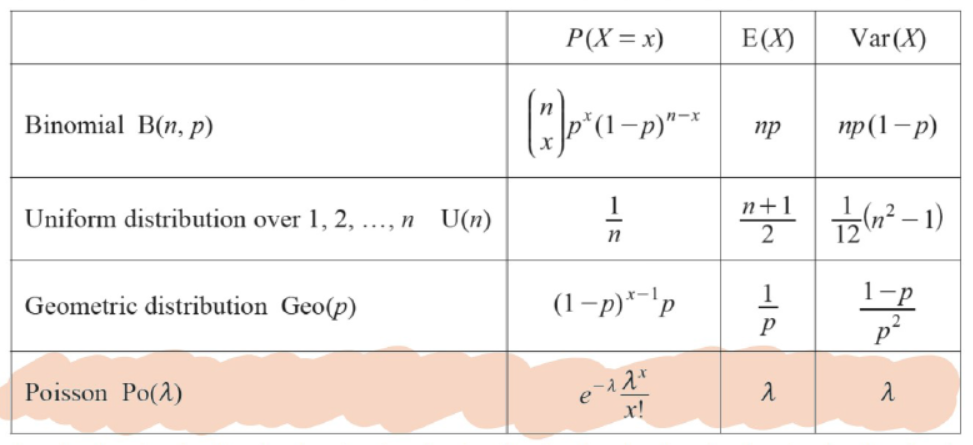
Let's say the accidents occur at a rate of 3 per month. The probability of exactly 2 accidents occurring is given by the formula in the above table:
is given by
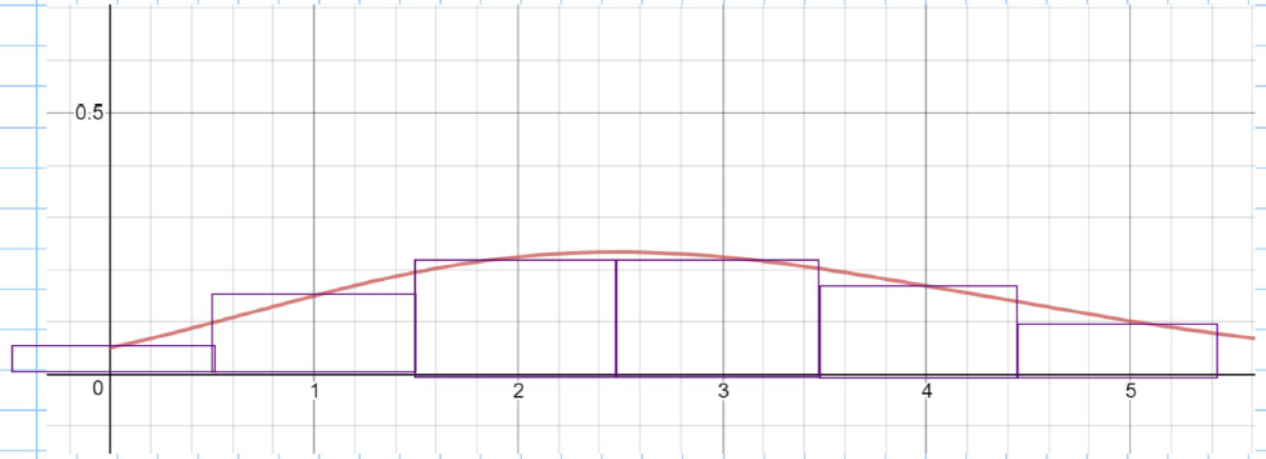
Note: An event can only happen an integer number of times, so the Poisson distribution takes this shape.
This also backs up the assumption that relative to the mean, events are rare. As after the mean, the probability function approaches quickly.
Example
Example:
a)
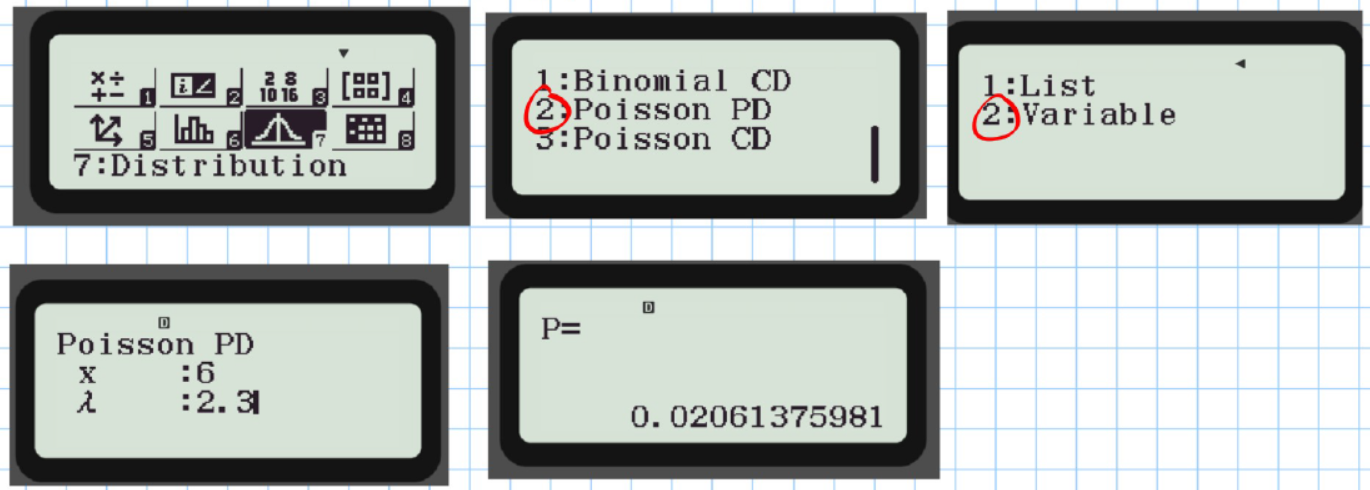
b)
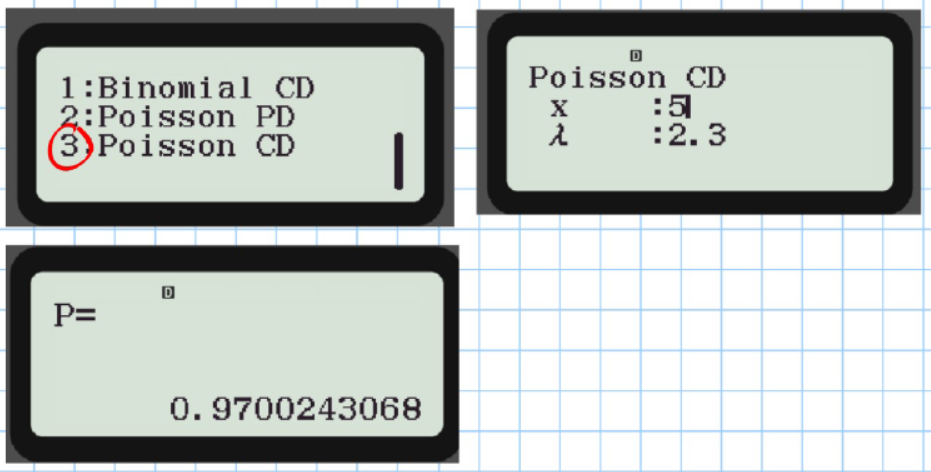
c)
Want:
Don't want:
Example
Example Shannon's big exams lesson interruptions occur, on average, twice per lesson, whether she is meant to be there or not. There are 8 lessons per day. Find the probability that Shannon interrupts these lessons 14 times or more in total.
- Per lesson:
- Per day:
Want:
Don't want: ...
Shannon's anticipated chaotic traits, in order to be modelled by a Poisson distribution, must meet the following conditions:
- Interruptions are assumed to occur at a constant average rate.
- Interruptions are independent of each other. Must be in the context of the situation.
Sum of Two Poisson Distributions
Example
Example: Red cars pass a certain point on the road at a constant average rate of 4 per hour.
Blue cars pass at a constant average rate of 9 per hour.
Assuming both follow Poisson distributions, we can write:
- We can denote the total number of cars that pass as , where also follows a Poisson distribution:
i.e.
a) Find that in an hour-long period, 5 red and 6 blue cars pass.
This does not require considering the sum of the two distributions as we still consider the two colours separately.
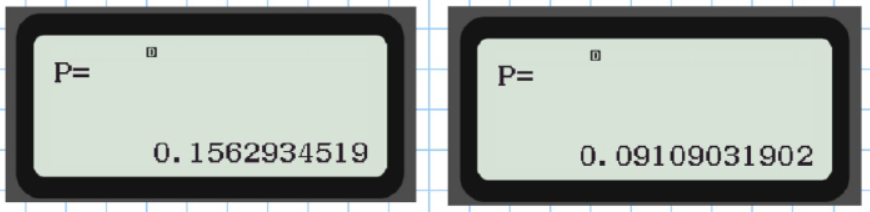
(Images showing the calculator steps for finding the probabilities.)
b) Find the probability that in 8 hours, the total number of red and blue cars is 150.