Introduction to Matrices (Edexcel A-Level Further Mathematics): Revision Notes
📚Revision Notes
2.1.1 Introduction to Matrices
What are Matrices?
Matrices are rectangular arrays of numbers arranged in rows and columns. They are a powerful tool in mathematics used to solve systems of equations, perform transformations in geometry, and more. Matrices are fundamental in many areas of maths, especially in linear algebra.
Definition of a Matrix
A matrix is typically written as:
- The numbers are called the elements or entries of the matrix.
- The subscript refers to the row, and refers to the column, so is the element in row and column .
- A matrix with rows and columns is called an × matrix (read " by ").
Types of Matrices
- Row Matrix: A matrix with only one row (e.g., ).
- Column Matrix: A matrix with only one column (e.g., ).
- Square Matrix: A matrix with the same number of rows and columns ( ).
- Zero Matrix: A matrix where all entries are zero.
Matrix Notation
- Capital letters like A, B, and C are used to denote matrices.
- Each element in the matrix is denoted by , where is the row number and is the column number.
Note
For example, in the matrix
Operations on Matrices
Matrix Addition:
Matrices can only be added if they have the same dimensions. Add corresponding elements.
Example
Example:
Matrix Subtraction:
Like addition, subtraction is performed element by element.
Example
Example:
Scalar Multiplication:
Multiply every element of the matrix by the scalar (a single number).
Example
Example:
Square Matrices Multiplication:
To multiply square matrices, we multiply certain elements of the matrices together. We move from left to right in the first matrix and from top to bottom in the second.
Example
Example**:** Multiply these Matrices
Step 1: Start at the top left of the first matrix and the top left of the second.
Multiply these numbers together and add the product of the two numbers obtained while moving right on matrix and down on matrix .
We started at the top of the first matrix and the left of the second, so this entry goes top left.
Step 2: Now start at the bottom of the first and left of the second.
Move from left to right in the first and top to bottom in the second.
Step 3: Repeat this method starting at the other two possible start points
Understanding Basic Matrix Operations is Crucial
A matrix is an arrangement of numbers in rows and columns.
You can perform addition, subtraction, and scalar multiplication on matrices, but addition and subtraction require matrices to be of the same dimension.
Matrix dimensions are important for determining whether operations like addition and multiplication are possible.
Worked Examples
Example
Example Given the matrices:
Calculate
Step 1: Multiply the first row of by the first column of to find the top-left element.
Step 2: Multiply the first row of by the second column of to find the top-right element.
Step 3: Multiply the second row of by the first column of to find the bottom-left element.
Step 4: Multiply the second row of by the second column of to find the bottom-right element.
Step 5: Combine the elements to form the resulting matrix:
Example
Example Given the matrices:
Calculate
Step 1: Multiply the first row of by the first column of to find the top-left element.
Step 2: Multiply the first row of by the second column of to find the top-middle element.
Step 3: Multiply the first row of by the third column of to find the top-right element.
Step 4: Multiply the second row of by the first column of to find the middle-left element.
Step 5: Multiply the second row of by the second column of to find the middle-middle element.
Step 6: Multiply the second row of by the third column of to find the middle-right element.
Step 7: Multiply the third row of by the first column of to find the bottom-left element.
Step 8: Multiply the third row of by the second column of to find the bottom-middle element.
Step 9: Multiply the third row of by the third column of to find the bottom-right element.
Step 10: Combine all the calculated elements to form the resulting matrix.
Example
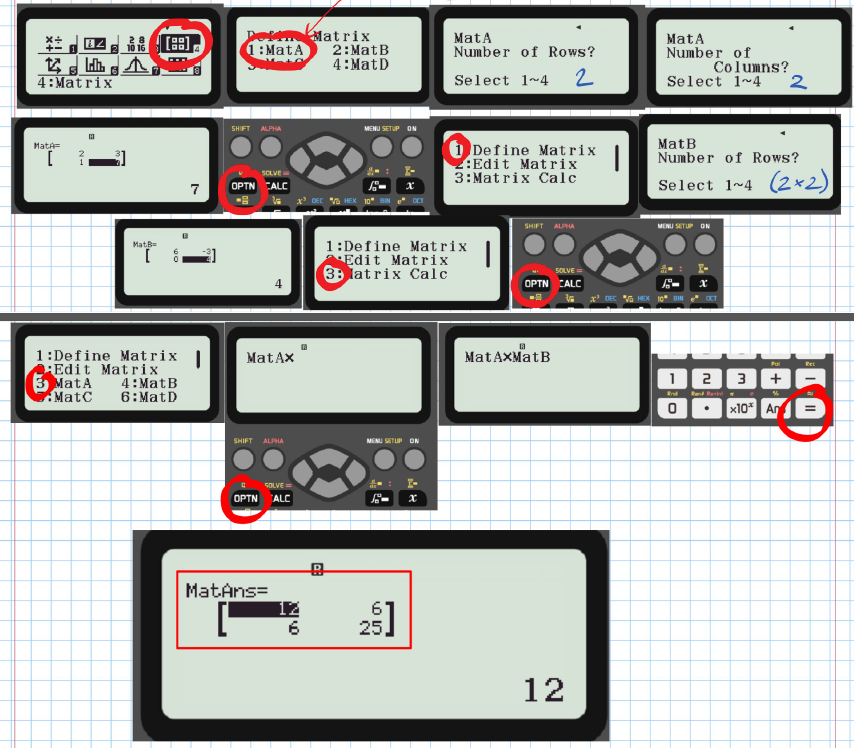
Example Using the Calculator for Matrix Multiplications Multiply the following matrices:
Calculator Steps:
Non-Commutativity of Matrices
Two objects, and , are said to be commutative (or "they commute") if:
For example, real and complex numbers are commutative under multiplication. However, matrices are not commutative in general.
Example
Example: Let:
Step 1: Calculate
Multiply the rows of by the columns of :
Step 2: Calculate
Multiply the rows of by the columns of :
Conclusion:
Clearly,
This shows that matrices do not generally commute under multiplication.
While there are special cases where specific pairs of matrices do commute (i.e., ), this is the exception rather than the rule, as demonstrated in this example.
Multiplying Non-Square Matrices
The same rules for multiplying square matrices apply to non-square matrices.
Example
Example: Let:
Matrix Dimensions:
- is
- is
- is An matrix can only be multiplied by an matrix because the inner dimensions must match.
Checking Multiplications:
Multiplying :
The inner dimensions () match, so multiplication is possible.
The resulting matrix will have dimensions of the outer dimensions:
Multiplying :
The inner dimensions () do not match, so multiplication is not possible.
Example
Example: Let:
Matrix Dimensions:
- is
- is Here, the inner dimensions () match, so multiplication is possible.
The resulting matrix will have dimensions of the outer dimensions:
Note
Calculating :
Multiply the rows of by the single column of :
Note
Key Takeaways:
- To multiply an matrix by an matrix, the inner dimensions must match.
- The result will be an matrix.