Determinants of Matrices (Edexcel A-Level Further Mathematics): Revision Notes
📚Revision Notes
2.1.4 Determinants of Matrices
What is the Determinant?
The determinant is a special value that can be calculated from a square matrix. Determinants play an important role in linear algebra, especially when solving systems of equations, finding inverses of matrices, and determining if a matrix is invertible.
The determinant of a matrix is denoted as:
where is a square matrix.
Determinant of a Matrix
For a matrix:
The determinant of is given by:
Example
Example: Let
Then:
Thus, the determinant of is -2.
Determinant of a Matrix
For a matrix:
The determinant of is calculated using:
Example
Example: Let
Then:
Thus, the determinant of is -24.
Properties of Determinants
Determinant of a Singular Matrix:
- If the determinant of a matrix is 0, the matrix is called singular, and it does not have an inverse.
Example
Example: For the matrix
The determinant is:
Since , the matrix is singular and does not have an inverse.
Effect of Row Operations on Determinants:
- Swapping two rows of a matrix changes the sign of the determinant.
- Multiplying a row by a scalar multiplies the determinant by that scalar.
- Adding a multiple of one row to another does not change the determinant.
Determinant of the Identity Matrix:
- The determinant of the identity matrix is always 1.
Note
For example: For a identity matrix:
Uses of Determinants
- Invertibility: A matrix is invertible (has an inverse) if and only if its determinant is non-zero.
- Area and Volume: In geometry, the determinant of a matrix can represent the area or volume of a transformed shape.
- Solving Systems of Equations: Determinants are used in Cramer's Rule to solve systems of linear equations.
Worked Examples Finding Determinants
Determinant of a 3x3 Matrix
Example
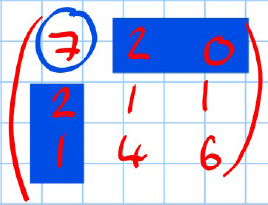
Example: Find the determinant of
Step 1: Take the first value in the first column and ignore any other values in that row or column.
Calculate this number multiplied by the determinant of the remaining values:
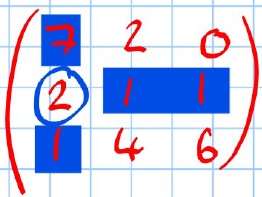
Step 2: Move down a value and follow the same process.
Step 3: Repeat step 2.
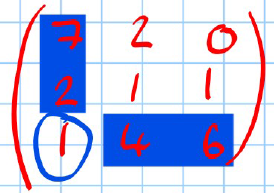
Step 4**: Finally, the determinant is calculated as follows:**
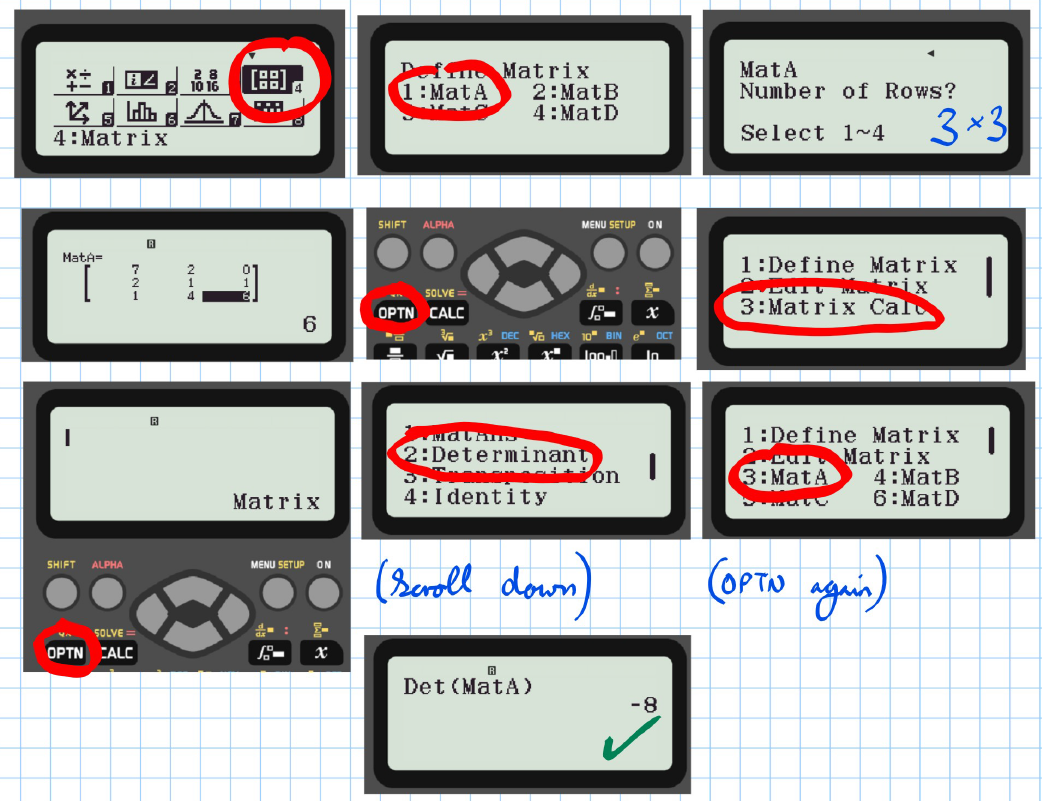
The same calculation on the Calculator can be performed as follows
Example
Example: Find the Determinant of
Step 1**: Use the Formula for the Determinant of a** Matrix
The determinant of a matrix is given by the formula:
Where the matrix is:
For our matrix:
Step 2**: Substitute into the Formula**
Using the formula:
Step 3: Simplify Each Term
First Term:
Second Term:
Third Term:
Step 4: Combine the Results
Now, sum all the terms:
Simplify:
Final Answer:
Example
Example: For What Values of is the Matrix Singular? We are given the matrix:
A matrix is singular if its determinant is zero. We will find the determinant of and solve for such that .
Step 1**: Use the Formula for the Determinant of a** Matrix
The determinant of a matrix is given by the formula:
Where the matrix is:
For our matrix:
Step 2**: Substitute into the Formula**
Using the formula:
Step 3**: Simplify Each Term**
First Term:
Second Term:
Third Term:
Step 4: Combine the Results
Now, sum all the terms:
Step 5: Solve for Singular Condition
A matrix is singular when its determinant is zero:
Solve for :
Final Answer:
The matrix is singular when p = 0
Note
Key Takeaways:
- The determinant of a square matrix provides key information about the matrix, including whether it is invertible or singular.
- For a matrix, the determinant is calculated as .
- For a matrix, the calculation is more involved, using the formula
- A matrix is singular if its determinant is 0, meaning it does not have an inverse. Understanding determinants is crucial in solving equations, finding inverses, and performing more advanced operations in linear algebra.